


 Français
 Deutsch
 Italiano
ACCOMMODATIONS IN ARABBA
Discover the best Hotels, B&Bs and Apartments in the Mountains based on thousands of verified reviews.
Altitude1,602 m (Porta Vescovo 2,478 m)
WhereLivinallongo del Col di Lana, Veneto, Italy
From Venice160 km from the airport, about 2 h 40
Slopesabout 60 km Arabba/Marmolada · Sellaronda
Ski passDolomiti Superski €89/day (high season 2026/27)
Seasonlifts open from 4 December 2026
Updated October 2026 · Sources: Arabba Fodom Turismo, Dolomiti Superski, Funivie Marmolada, Veneto Region
Find a place to stay in Arabba
Arabba is a Dolomites village at 1,602 metres, in the Veneto region of Italy, province of Belluno. It isn’t a municipality in its own right: it’s a hamlet of Livinallongo del Col di Lana, the Ladin valley known locally as Fodom. The village sits below the Sella massif between two passes: the Pordoi Pass, 9.4 km to the west, which drops into Val di Fassa, and the Campolongo Pass, which leads to Alta Badia. To the south, beyond the Porta Vescovo ridge, rises the Marmolada.
Official distances from the local tourist board: 160 km from Venice Marco Polo airport and 150 km from Treviso (about 2 hours 40 minutes by car), 145 km from Innsbruck, 77 km from Bolzano. The nearest railway stations are Brunico (50 km), Belluno (70 km) and Bolzano (75 km). Corvara is about 11 km away, Cortina about 37 km.
Why go? In winter, for the skiing: Arabba sits on the Sellaronda, has some of the most demanding black runs in the Dolomites and is linked to the Marmolada glacier. In summer, for the hiking: from the Porta Vescovo lift starts the Viel del Pan, one of the finest panoramic trails in the area. The village is small, a few hundred residents, and lives almost entirely from tourism.
What to see in Arabba

Arabba is a cluster of hotels and chalets around the road and the lifts. The interest lies all around it: peaks, passes, forts and a castle.
Porta Vescovo
Porta Vescovo is the ridge that closes Arabba to the south. From the village centre a funifor cable car climbs to the top station at 2,478 metres, where there’s a mountain hut with a restaurant. On one side you see the Sella, on the other the Marmolada with Lake Fedaia below. It’s the start of the Viel del Pan and the geology trail in summer, and of Arabba’s best-known black runs in winter.
The Marmolada and Punta Rocca
The Marmolada is the highest group in the Dolomites: Punta Penia reaches 3,343 metres. On the Veneto side a cable car runs from Malga Ciapela (municipality of Rocca Pietore): three sections and about 12 minutes from 1,450 to 3,265 metres, up to Punta Rocca and its viewing terrace. At the Serauta mid-station, the Marmolada Great War Museum covers the First World War fighting on the glacier.
As of October 2026 the cable car is closed: the operator announces it will reopen for the 2026/27 winter season, usually in December depending on snow. In summer it normally runs from mid-June to late September. Check dates and prices at funiviemarmolada.com. The north side, above Lake Fedaia, has been subject to local ordinances since the 2022 serac collapse: to climb to the summit on foot you need mountaineering experience or a guide.
The Pordoi Pass

9.4 km and 637 metres of climbing from Arabba is the Pordoi Pass (2,239 m). From there the Sass Pordoi cable car rises to 2,950 metres, the “Terrace of the Dolomites”, and it’s the shortest way to Piz Boè. On the Arabba side, just below the pass, the German military memorial holds mainly soldiers of the First World War. Times and prices are in our guide to the Pordoi Pass.
The Campolongo Pass
Campolongo (1,875 m) is the lowest and easiest of the four Sella passes: a few kilometres of wide road between Arabba and Corvara. In winter it’s part of the Sellaronda; in summer a quiet crossing to Alta Badia by bike or on foot.
Col di Lana
Col di Lana (2,452 m) gives the municipality its name. In the First World War it was one of the most fiercely contested summits on the Dolomites front: on 17 April 1916 the Italian army blew a mine under the peak, killing around 150 Austro-Hungarian soldiers. Trenches and tunnels can still be seen. The climb from Pieve di Livinallongo is over 1,000 metres of ascent: for fit, experienced hikers only.
Andraz Castle
Heading down towards Pieve, Andraz Castle stands on a rocky spur. Built around the year 1000 to control the route between Agordo and the Puster Valley, it belonged from 1416 to 1802 to the prince-bishops of Brixen, who used it to protect forests and mines from the Republic of Venice. Its most famous guest was Cardinal Nicholas of Cusa. Ruined in the 19th century and shelled in the First World War, it has been restored and opens in summer, with hours that change every year.
The Great War forts
Between Arabba and Livinallongo stand the remains of two Austrian forts, Forte Ruaz and Forte Corte, built to block the valley. Until 1918 Fodom was part of Tyrol, in other words Austria, and the Italian border ran just to the south. That’s why the area is full of wartime positions, which skiers pass in winter on the Great War Ski Tour.
Livinallongo and Ladin culture
Livinallongo del Col di Lana (Fodom in Ladin, Buchenstein in German) has about 1,200 residents in 17 hamlets; the main village is Pieve di Livinallongo. People speak Ladin, as in Val Badia, Val Gardena and Val di Fassa: in Ladin, Arabba is called Rèba. The municipality has belonged to the province of Belluno since 1923; in 2007 a referendum voted to move to South Tyrol, but the process has never been completed. In Pieve, the culture house hosts the Mujeo Ladin Fodom, the valley museum, reopened in 2024.
The geology trail
From Porta Vescovo a waymarked geology loop with 18 stops explains how the Dolomites formed: fossil reefs, dark volcanic rock, layers of sediment. A good option with curious kids.
Skiing in Arabba

Arabba is part of Dolomiti Superski, about 1,200 km of slopes on one pass, and of the Arabba/Marmolada area: about 60 km of runs and more than 20 lifts. The 2026/27 season opens on 4 December 2026, together with the Sellaronda; skiing usually runs until mid-April (until 19 April in 2026), but check the closing date on arabba.it.
Runs and level
Last season the Arabba side had 16 blue, 15 red and 4 black runs, plus 2 blue and 4 red on the Marmolada. Lifts start in the village centre, a short walk from the hotels. The area has two sides: the north-facing runs under Porta Vescovo, steep and often hard-packed, and the gentler slopes towards Campolongo and Pordoi.
Arabba isn’t ideal for beginners: there are ski schools and nursery areas, but it’s built for confident skiers. First-timers will be happier in Alta Badia.
The Porta Vescovo black runs
Arabba is known for its blacks. The Fodoma is 3.6 km long with 804 metres of vertical and is rated one of the toughest runs in the whole Dolomiti Superski. The Sourasass, in the Porta Vescovo sector, has 3.3 km and 749 metres of vertical. The Burz is shorter, about 1 km. Ski them in the morning on fresh legs; the snow deteriorates quickly in the afternoon.
Sellaronda and Great War Ski Tour
From Arabba you can start the Sellaronda, the circuit of about 40 km around the Sella, roughly half of it on skis, over the Pordoi, Sella, Gardena and Campolongo passes. Clockwise, follow the orange signs; anticlockwise, the green ones. Allow a full day and start early. Arabba is also the gateway to the Great War Ski Tour, a circuit of about 80 km along the old front line. It’s demanding: good technique and a long day.
La Bellunese on the Marmolada
Arabba is linked on skis to the Marmolada. From Punta Rocca (3,265 m) the Bellunese runs 12 km down to Malga Ciapela with about 1,800 metres of vertical, one of the longest descents in the Dolomites. The top is glacier, so it only opens in good conditions. Before you go, check the Marmolada cable car is running.
Ski pass 2026/27
In Arabba you ski on the Dolomiti Superski pass. For 2026/27 an adult day pass in high season costs 89 euros and a 6-day pass 453 euros (official price list of 30 September 2026). Until 19 December 2026 the tourist board offers early-season deals (4 nights for the price of 3, 8 for the price of 6).
Beyond downhill skiing
Snowshoeing, ice skating and, with a guide, ice climbing. Cross-country skiing is limited to a few scenic loops: for more kilometres, Cortina or Alta Badia are better.
Summer in Arabba
In summer Arabba is a handy base for walking above 2,000 metres without long climbs, thanks to the lifts. They run in the main season, with dates that change every year: check on the tourist board website which ones are open.
Viel del Pan from Porta Vescovo
If you only have one day, this is the walk. Ride up to Porta Vescovo (2,478 m) and follow path 601, the old “bread trail”, almost level along the ridge with the Marmolada and Lake Fedaia opposite. After about 3 hours you reach the Pordoi Pass. It’s easy, but wear proper hiking boots. To get back to Arabba, in summer 2026 bus 472 ran from the Pordoi; check the current timetable.
Lake Boè
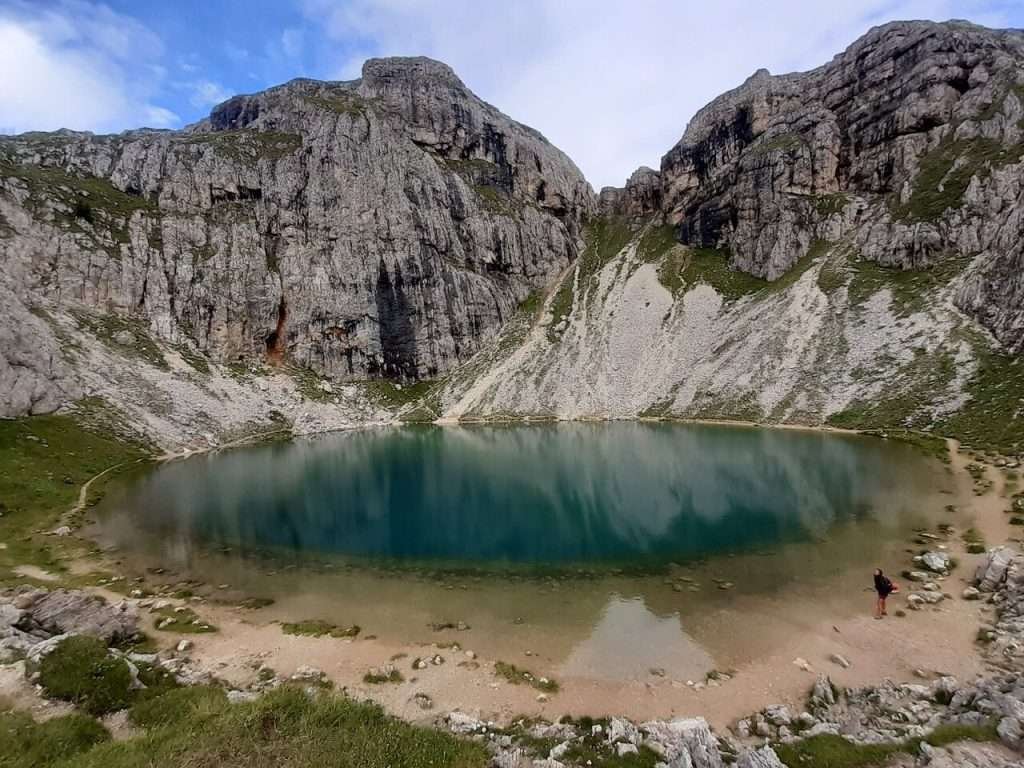
Lake Boè is a small high-altitude lake at 2,275 metres below Piz Boè. The easiest way: go to Corvara (about 11 km, also by bus 472 in summer), take the Boè gondola and walk 10 to 30 minutes. You can combine it with the Kostner hut at Vallon.
Col di Lana and the Great War trails
Col di Lana is the valley’s historic climb: over 1,000 metres of ascent from Pieve, with trenches and tunnels at the top. Every summer there’s also a vertical kilometre race, the Vertical Km Còl de Lana (26 July in 2026). For something shorter, Andraz Castle is a short walk from the road.
Cycling the passes
Two classic Giro d’Italia climbs start from Arabba: the Pordoi (9.4 km, 637 m, 6.8% average) and the shorter, easier Campolongo. The Giro finished in Arabba in 1983 and 1984. In 2027 the Sella passes will be closed to cars from 9:00 to 16:00 for the Sellaronda Bike Day on 5 June and 11 September. On Sunday 4 July 2027 the Maratona dles Dolomites crosses Campolongo and Pordoi, with roads closed that day.
What to eat in Arabba
Food in Arabba is Ladin and Belluno-style: canederli (bread dumplings), casunziei (half-moon stuffed pasta), polenta with cheese and mushrooms, game, strudel. The village has restaurants, pizzerias and après-ski bars; on the slopes and at the top stations there are huts serving food, such as the one at Porta Vescovo. In high season, book dinner.
Day trips from Arabba

- Pordoi Pass (9.4 km): Sass Pordoi cable car, Piz Boè, German military memorial.
- Canazei and Val di Fassa (about 22 km over the Pordoi): Trentino village with lifts, shops and the road to Lake Fedaia.
- Corvara in Badia (about 11 km over the Campolongo): Alta Badia, Boè gondola, Sassongher.
- Marmolada and Malga Ciapela: by car via Caprile and the Pettorina valley; cable car to Punta Rocca and the Great War museum.
- Alleghe (about 20 km): the lake and Monte Civetta with its north-west face.
- Falzarego Pass and Lagazuoi: cable car from the pass (2,105 m) to the Lagazuoi hut and First World War tunnels.
- Passo Giau: one of the most photographed passes in the Dolomites, between Selva di Cadore and Cortina.
- Cortina d’Ampezzo (about 37 km via the Falzarego): the best-known resort of the Veneto Dolomites.
Where to stay in Arabba

Arabba is small and almost all accommodation is a few minutes’ walk from the lifts: 3- and 4-star hotels (some with pool and spa), garni B&Bs, apartments and a few mountain huts. The areas:
- Arabba centre: for skiers, right by the Porta Vescovo and Sellaronda lifts. Also the best choice without a car.
- Towards the Campolongo Pass: a little quieter, handy if you plan to ski Alta Badia often.
- Pieve di Livinallongo and the hamlets: further down the valley, often cheaper, with a village feel. You’ll need a car to reach the slopes.
- Families: apartments in the centre or the hamlets; few easy runs on the doorstep, but Alta Badia is a quarter of an hour away.
- Budget: early December and March are cheaper; for Christmas, New Year and February, book months ahead.
How to get to Arabba
By car
From Venice or Treviso: A27 motorway to the Belluno exit, then through Agordo, Alleghe and Caprile following signs for Livinallongo and Arabba. From the Brenner/Bolzano: A22 to Ponte Gardena, then Val Gardena, the Sella Pass and the SS48; or exit at Egna-Ora for Val di Fiemme, Val di Fassa and the Pordoi Pass. From the Puster Valley: via Cortina and the Falzarego Pass. In winter, winter tyres or chains on board are required; passes may close in heavy snow.
By train
There’s no railway to Arabba. The nearest stations are Brunico (50 km), Belluno (70 km) and Bolzano (75 km). From there you’ll need a hire car, a transfer or a bus.
By bus
Dolomiti Bus links Belluno and the Agordino valley with Caprile; from Caprile a line climbs to Arabba (timetables at dolomitibus.it). In July and August a direct coach runs from Venice-Mestre and Treviso to Caprile. In summer 2026, line 472 linked the Pordoi Pass, Arabba and Corvara from 7 June to 11 October. In winter, getting between valleys is mostly done on skis.
By air
The most convenient airports are Treviso (150 km) and Venice Marco Polo (160 km), both about 2 hours 40 minutes by car, with plenty of flights from the UK. Innsbruck is 145 km away, Bolzano 77 km (few flights), Verona 226 km, Bergamo 310 km. In winter, private shuttles run from Venice, Treviso and Bolzano airports straight to your accommodation.
Parking
There are car parks near the lifts, but they fill up early in high season: if you’re staying in Arabba, leave the car at your hotel. At the Marmolada cable car in Malga Ciapela there’s a large car park at the base station. Fees and rules change, so ask at the tourist office.
Frequently asked questions about Arabba
What is the altitude of Arabba?
Arabba is at 1,602 metres. The Porta Vescovo top station is at 2,478 metres, Punta Rocca on the Marmolada at 3,265 metres.
Where is Arabba?
In the Dolomites, in the Veneto region of Italy, province of Belluno. It’s a hamlet of Livinallongo del Col di Lana, between the Pordoi and Campolongo passes, at the foot of the Sella.
Is Arabba in South Tyrol?
No, it’s in the Veneto. But the valley is Ladin and was part of Austrian Tyrol until 1918. Canazei (Trentino) and Corvara (South Tyrol) are over the passes.
How many km of slopes does Arabba have?
The Arabba/Marmolada area has about 60 km of runs. With the Dolomiti Superski pass you can ski about 1,200 km, including the Sellaronda.
How much is a ski pass in Arabba in 2026/27?
Dolomiti Superski costs 89 euros a day for an adult in high season and 453 euros for 6 days (official 2026/27 prices).
When does the 2026/27 ski season start?
Arabba’s lifts open on 4 December 2026. The Marmolada cable car reopens in winter depending on snow: check the date on the operator’s website.
Is Arabba good for beginners?
There are ski schools and blue runs, but Arabba is known for demanding reds and blacks. Beginners will find more easy runs in Alta Badia.
What is Porta Vescovo?
The ridge above Arabba at 2,478 metres, reached by lift from the village. It’s the start of the Viel del Pan in summer and of the famous black runs in winter.
How far is Arabba from Venice airport?
About 160 km from Venice Marco Polo, around 2 hours 40 minutes by car via the A27 and Belluno. Treviso airport is about 150 km.
Where is the Arabba tourist office?
The information office (IAT) is at Via Mesdì 66 in Arabba, phone +39 0436 79130.
Weather in Arabba
Photos of Arabba


