


 Français
 Deutsch
 Italiano
ACCOMMODATIONS IN APRICA
Discover the best Hotels, B&Bs and Apartments in Mountain based on thousands of verified reviews.
Altitude1,181 m (pistes up to 2,300 m)
WhereAprica Pass, province of Sondrio (Lombardy, Italy)
From MilanAbout 165 km · around 3 h; Bergamo airport 115 km
PistesAbout 50 km (Aprica–Corteno), 6 km floodlit Superpanoramica
Ski pass2026/27 prices not yet published: see apricaonline.com
Ski seasonLifts open Saturday 28 November 2026
Updated October 2026 · Sources: Pro Loco Aprica (apricaonline.com), Trenord, ISTAT
Find a place to stay in Aprica
Aprica is in Lombardy, northern Italy, in the province of Sondrio, at 1,181 metres. The village sits right on the Aprica Pass (Passo dell’Aprica), a flat saddle about 3 km long that links Valtellina to the west with Val Camonica to the east. It has around 1,400 residents and lies in the Orobie Alps, at the eastern gateway to the Orobie Valtellinesi nature park.
Driving distances: Edolo about 16 km, Tirano about 17 km, Sondrio about 31 km, Ponte di Legno about 35 km, Bormio about 54 km. Milan is about 165 km away (around 3 hours); Bergamo and Orio al Serio airport about 115 km (around 2 hours). Without a car, you take the train to Sondrio, Tresenda or Edolo and finish by bus.
Why go: in winter there are about 50 km of south-facing slopes between Aprica and Corteno, including the Superpanoramica on the Baradello, 6 km lit up in the evening. The lifts open on Saturday 28 November 2026. In summer you get more than 200 km of trails, a wildlife observatory with brown bears, the Pian di Gembro peat bog and climbs made famous by the Giro d’Italia. It is a family resort, quieter and closer to Milan than Bormio or Livigno.
What to see in Aprica
The village, Corso Roma and the murals
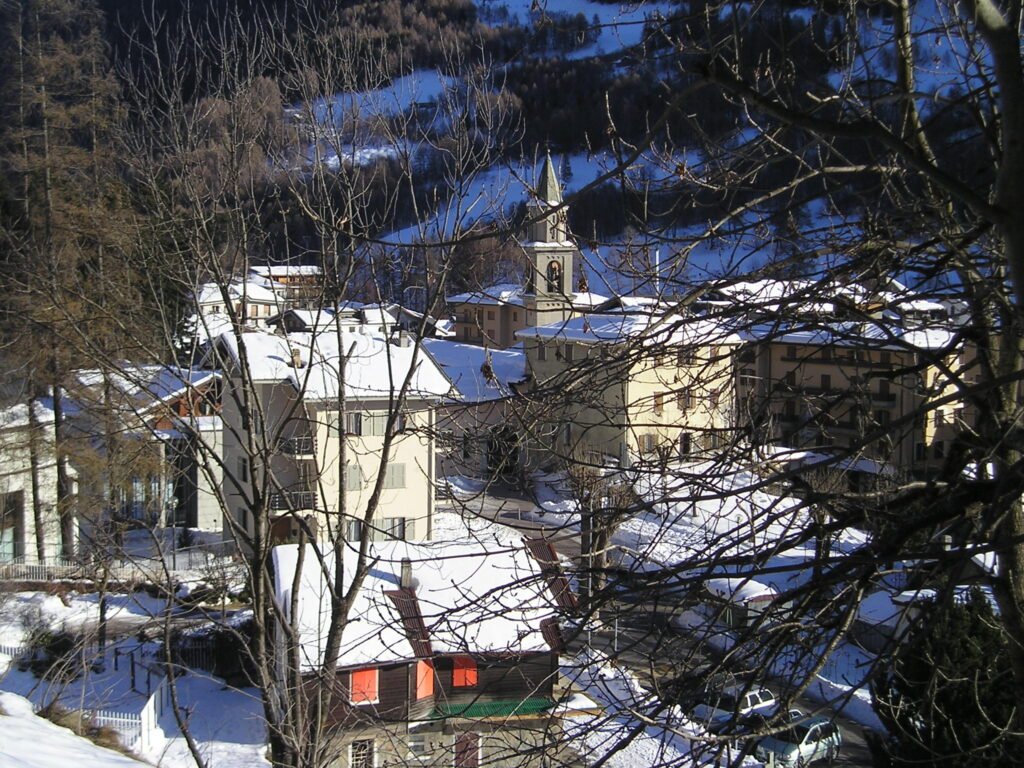
Aprica is a long, narrow village strung along the pass road, today’s SS39. The main street is Corso Roma, with shops, bars, restaurants and the Pro Loco tourist office. Don’t expect a medieval old town: tourism started here in the late 19th century and the village grew mainly in the 20th, after it split from Teglio to become its own municipality in 1923.
There are six districts (contrade): Liscedo, Liscidini, San Pietro, Santa Maria, Dosso and Mavigna. Three of them have murals by the painter Alcide Pancot, showing local history, plants and animals. The parish church of Santi Pietro e Paolo is in San Pietro. If you are here in late February, look out for the Sunà da Mars: cowbell ringers from the six districts gather in the squares, followed by a shared meal.
The Aprica Pass and the Giro d’Italia
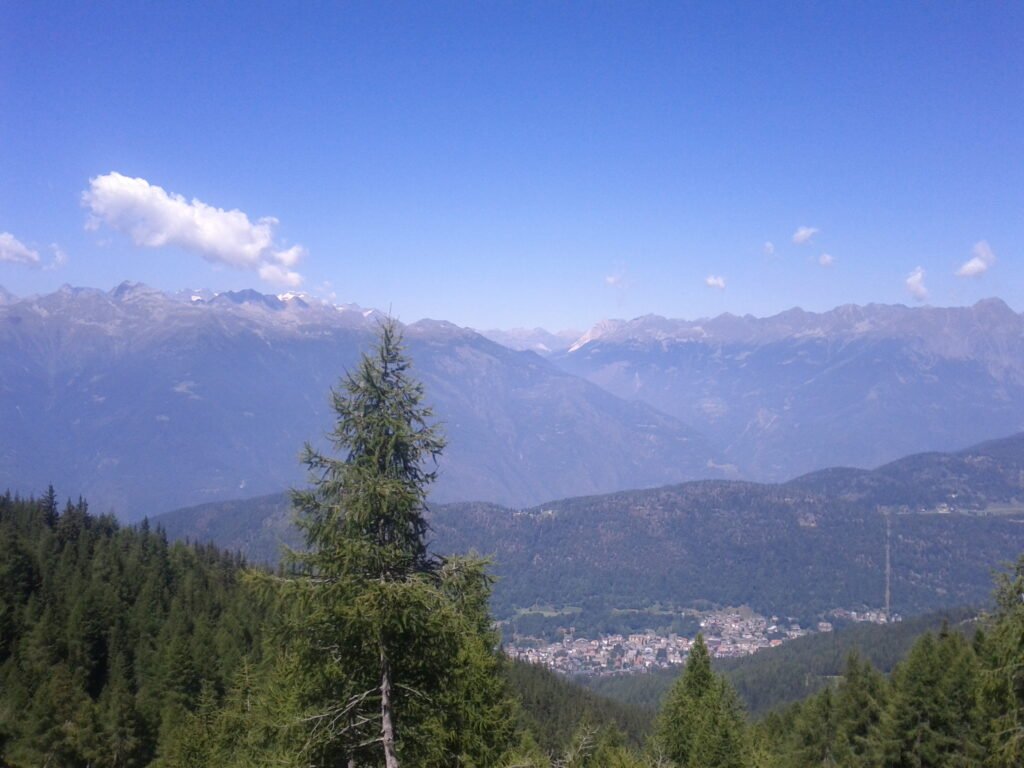
The pass has linked Valtellina and Val Camonica since the Middle Ages, probably since Roman times. The Austrian government started building the carriage road in 1848. Today it is the easiest crossing between the two valleys, and the SS39 is the main road between Tresenda and Edolo. On the Valtellina side you look down on the Adda valley and the vineyard terraces of Teglio.
For cyclists, Aprica is a big name. The Giro d’Italia has finished here ten times: first in 1962 (won by Vittorio Adorni), most famously in 1994, when Marco Pantani won after dropping everyone on the Mortirolo, and most recently in 2022 with Jan Hirt. Other winners include Ivan Gotti, Ivan Basso, Michele Scarponi and Mikel Landa. The Granfondo Gavia & Mortirolo also starts in Aprica, with routes from 85 to 175 km.
Alpine wildlife observatory
Aprica’s most searched-for attraction is the Osservatorio eco-faunistico alpino: more than 25 hectares in the Orobie Valtellinesi park with a marked nature trail. You can see chamois, ibex, roe deer, birds of prey and squirrels, and above all two Alpine brown bears, watched from several viewpoints.
Visits are guided only, in the morning, during the summer months, and must be booked at least the day before at the Aprica Pro Loco Infopoint. Dates are listed in the events calendar on apricaonline.com. In the village, the Galleria delle Emozioni nella Natura belongs to the same project. Groups and schools contact the observatory’s director directly.
Pian di Gembro nature reserve
A few minutes from the village, towards Trivigno, is a peat bog of glacial origin, formed after the glaciers retreated and now a nature reserve. The paths are easy and flat, and a themed trail with information panels explains how it formed. It is one of the best outings with children.
You will see rare plants, including some carnivorous species, and amphibians: frogs, toads, newts and salamanders. In summer there is a small education room dedicated to them. Wear shoes that can get wet and stay on the paths: the bog is a fragile habitat.
The Sant’Antonio valleys
Heading down from Aprica towards Edolo, turn off at Campagnola for the hamlet of Sant’Antonio, part of Corteno Golgi. This is the start of the Valli di Sant’Antonio nature reserve: streams with waterfalls and clear pools, spruce forest, a visitor centre and an alpine hydrobiology station.
Both valleys are easy and family-friendly. In Val Campovecchio you follow the stream: about 20 minutes to a wooden bridge, about 40 minutes to the Rifugio Alpini Campovecchio. In Val Brandet a track, steep at first and then almost flat, reaches the Rifugio Brandet in about 40 minutes; on the way you pass the remains of old iron mines and smelting furnaces. Fishing is regulated.
Val Belviso and the Frera dam
Val Belviso is the easternmost valley of the Orobie Valtellinesi park and easy to reach from Aprica. The lower part is narrow and steep; higher up it opens onto a large reservoir held back by the Frera dam. Around it are the alpine lakes of Torena, Lavazza, della Cima and di Pisa.
Along the road to the dam you’ll find wooden statues carved by Andrea Fanchi, a hit with children. The Rifugio Cristina is the starting point for walks of various lengths. The Belviso stream is popular with anglers.
Corteno Golgi and Camillo Golgi
Corteno Golgi is the next village, about 8 km away on the Val Camonica side, at 925 metres. Camillo Golgi was born here in 1843; in 1906 he became the first Italian to win the Nobel Prize in Medicine, and his name lives on in the “Golgi apparatus”. The village, once just Corteno, added his name in 1956.
Golgi was also attached to Aprica, where he spent his summers from 1880 to 1913. There is a museum dedicated to him in Corteno; check opening times before you go.
The view from the Magnolta
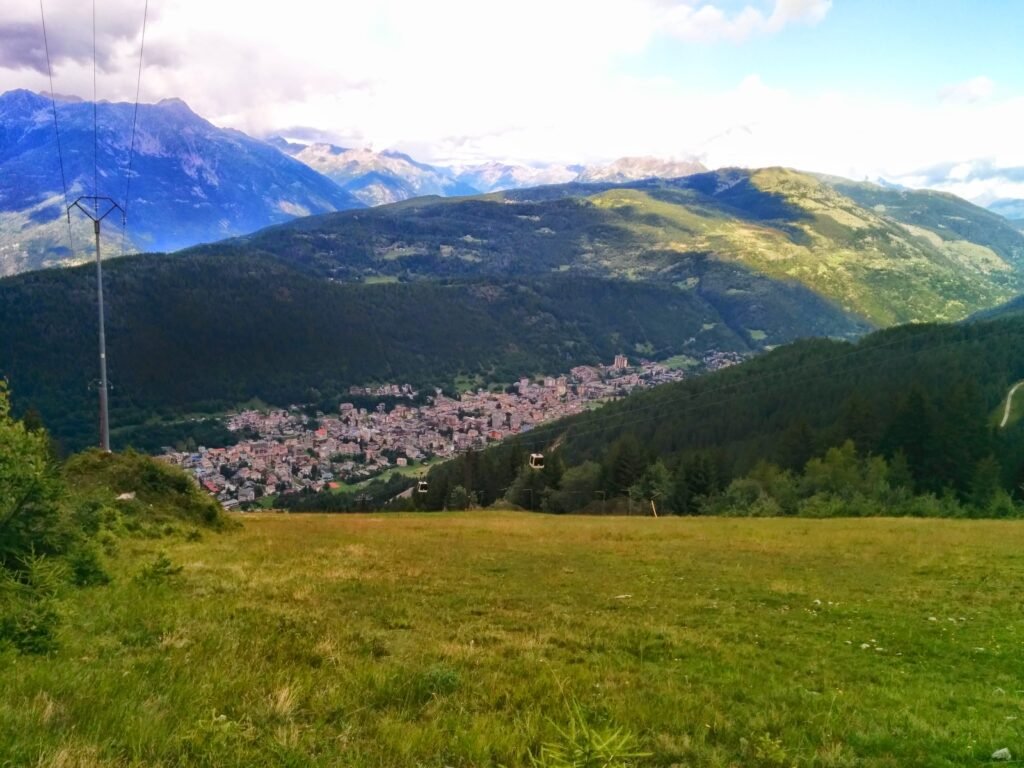
Aprica’s south-facing slope, where the pistes are, looks down on the village and Valtellina. In winter you ride the lifts up; in summer, on trails that climb above 2,000 metres, you see the village laid out on the pass with the mountains of Valtellina and Val Camonica behind.
Skiing in Aprica
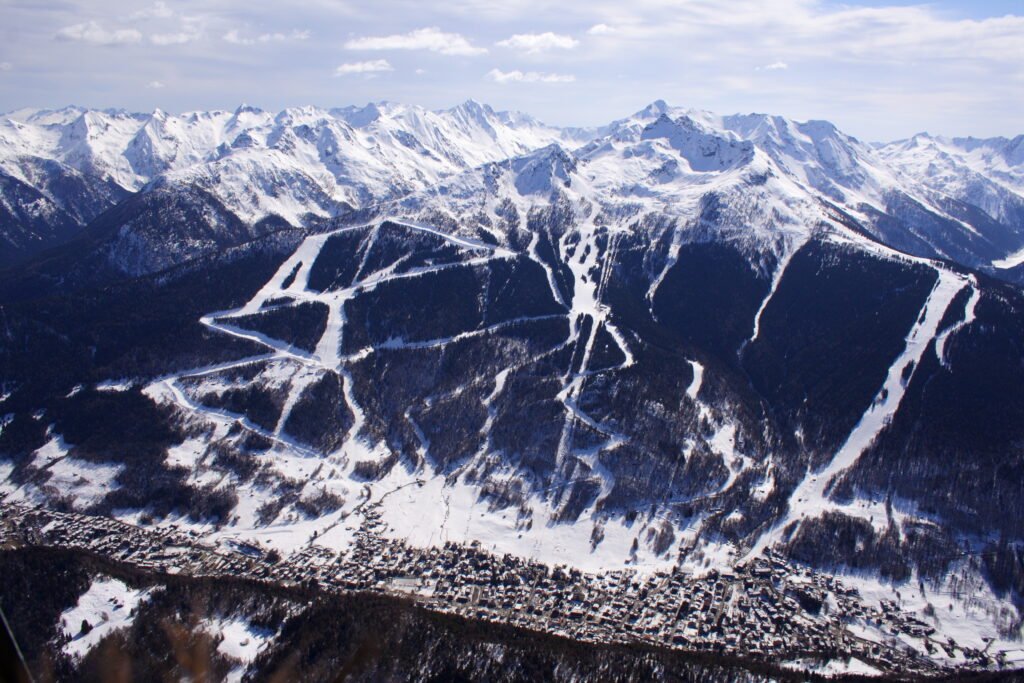
The Aprica–Corteno ski area has about 50 km of pistes, from blue to black, with snowmaking on almost all of them. The slopes face south, so you get plenty of sun, and snowmaking keeps the season long. The lifts open on Saturday 28 November 2026; the 2026/27 closing date is not yet official.
The areas to know:
- Campetti: in the village, the beginners’ area.
- Palabione: the historic area, with the highest point of the ski area, the Valletta, at 2,300 metres.
- Magnolta: red and black runs, including the “Pistone”, for confident skiers.
- Baradello: the Superpanoramica, a 6 km easy run with views over Valtellina. It is floodlit and open in the evening; the Pro Loco calls it the longest floodlit piste in Europe.
Aprica hosted Alpine Ski World Cup races in 1975 and 1981. Today it is mainly a family resort, busy at weekends with skiers from Milan, Bergamo and Brescia. For a week’s holiday it pairs well with day trips to Bormio or Livigno.
Ski passes: 2026/27 prices are not yet published on the official website (season-pass presales start on 19 October 2026). Be wary of prices on ski portals: they are often last season’s. Check apricaonline.com before you travel.
Beyond downhill: cross-country loops in natural areas, ski-touring routes, snowshoe trails through the woods, sledging areas, ice skating and an indoor pool. Outside lift hours the Superpanoramica is also used for ski touring and snowshoeing. Ski hire and ski storage are available in the village.
Summer in Aprica
In summer Aprica has more than 200 km of trails for hiking, walking and mountain biking, many above 2,000 metres. The Gran Via delle Orobie, the long-distance trek across the Valtellina Orobie, ends here. The best ideas, starting with the easiest:
- Pian di Gembro: an easy loop around the peat bog, fine with small children.
- Val Campovecchio: about 40 minutes on an easy path along the stream to the Rifugio Alpini Campovecchio, with picnic spots by the water.
- Val Brandet: about 40 minutes to the Rifugio Brandet; then 20 minutes to the Ponte del Gallina picnic area and 40 minutes to Malga Casazza.
- Val Belviso: the road to the Frera dam and the Rifugio Cristina, then walks to the lakes.
- Wildlife observatory: the guided morning visit, booked the day before.
Baradello Wild Park: Aprica’s adventure park covers over 15,000 m², with five courses for adults and children, more than 40 obstacles (rope bridges, nets and platforms up to 19 metres high) and a 60-metre panoramic zip line. Book on the park’s website.
Cycling: many trails are open to mountain bikes and e-bikes. On the road, Aprica is a classic base for the Mortirolo and the Gavia, which leads to Bormio. The Gavia is closed in winter.
Also: tennis, an indoor pool, a golf driving range, rock climbing outdoors and indoors (lead climbing World Cup 2001–2004), fishing and paragliding.
What to eat in Aprica
Aprica is in Valtellina and the food is Valtellina food. Pizzoccheri, buckwheat pasta with cabbage, potatoes, butter and cheese, come from Teglio, about 22 km away. Try also sciatt, buckwheat fritters filled with cheese, Valtellina bresaola and the Casera and Bitto cheeses. To drink: Nebbiolo reds from the terraces, Valtellina Superiore and Sforzato.
Day trips from Aprica
- Corteno Golgi (about 8 km): Camillo Golgi’s village and the Sant’Antonio valleys.
- Tirano (about 17 km): end of the line from Milan and departure point of the Bernina Express to St. Moritz, about 2 hours 15 minutes, reservation required.
- Teglio (about 22 km): home of pizzoccheri, overlooking the terraced vineyards.
- Sondrio (about 31 km): the main town of Valtellina.
- Ponte di Legno (about 35 km): the Pontedilegno-Tonale ski area and the Presena glacier.
- Bormio (about 54 km): thermal baths and Olympic pistes.
- Livigno: beyond Bormio, the duty-free resort of upper Valtellina.
- Stelvio Pass (2,758 m): from Bormio, summer only.
- Capo di Ponte, in Val Camonica: UNESCO-listed rock carvings.
Where to stay in Aprica
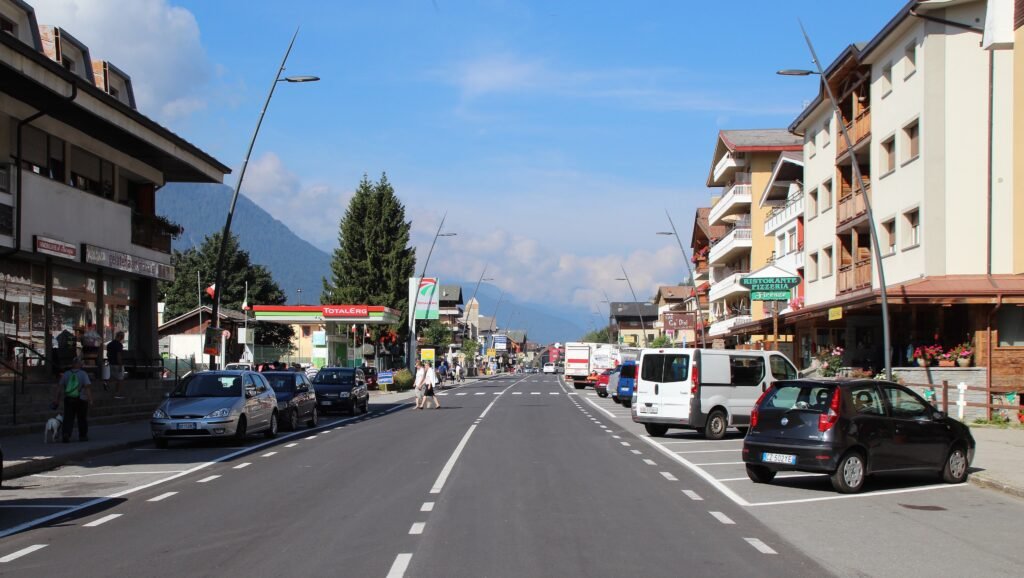
The village stretches for a few kilometres along the pass road, so location matters. Choose by what you plan to do.
- For skiing: the central part of the village, near the lift stations and the Campetti.
- For families: the centre around Corso Roma, with shops, pool and services on foot. Apartments are the usual choice for a week.
- Without a car: stay near Corso Roma and the stops of the buses from Edolo, Tresenda and Sondrio.
- Budget and quiet: the outer districts or neighbouring villages such as Corteno Golgi, on the Val Camonica side.
You’ll find hotels of every category, residences, holiday apartments and B&Bs. For weekends in January and February and for August, book early: many guests come from Milan, Bergamo and Brescia.
How to get to Aprica
By car
From Milan take the SS36 towards Lecco, then the SS38 along Valtellina to Tresenda and the SS39 up to Aprica: about 165 km, around 3 hours. From Bergamo and Brescia, drive up Val Camonica on the SS42 to Edolo, then take the SS39 west: about 110–115 km, around 2 hours. The pass is open all year, but in winter carry snow chains or fit winter tyres.
By train
Two lines get you close. Trenord’s Milano Centrale–Sondrio–Tirano line runs roughly hourly, Milan to Tirano in about 2 hours 30 minutes: for Aprica, get off at Sondrio or Tresenda and continue by bus. Or take the Brescia–Iseo–Edolo line, about 2 hours, then the bus from Edolo. Timetables on trenord.it.
By bus
Buses link Sondrio and Tresenda with Aprica; Edolo has connections to Val Camonica. From Milan, the BS1 Milano–Edolo–Ponte di Legno line lets you change at Edolo. Check current timetables: off-season there are few runs. The Pro Loco lists the lines on apricaonline.com.
By plane
The nearest airport is Bergamo Orio al Serio, about 115 km away (around 2 hours by car), served by many low-cost flights. Without a car, take the BS1 bus to Edolo, then the local bus to Aprica. From Milan Linate (about 165 km) and Malpensa (about 185 km, around 3 hours), go to Milano Centrale and take the train to Sondrio or Tresenda. A hire car or a private transfer is the simplest option if you are skiing with luggage.
Parking
There are car parks along the village, near the lift stations and in the centre. On winter weekends arrive early: spaces close to the slopes fill up in the morning. If you are staying here, ask your accommodation about parking and walk around the village.
Frequently asked questions about Aprica
Where is Aprica?
In Lombardy, northern Italy, in the province of Sondrio, on the Aprica Pass between Valtellina and Val Camonica. Tirano is about 17 km away, Edolo about 16 km.
What is the altitude of Aprica?
The village and the pass are at 1,181 metres. The highest point of the ski area, the Valletta, is at 2,300 metres.
How many kilometres of pistes does Aprica have?
About 50 km in the Aprica–Corteno ski area, spread across Campetti, Palabione, Magnolta and Baradello.
When does the 2026/27 ski season start?
On Saturday 28 November 2026. Ski pass prices have not been published yet: check the official website.
How far is Aprica from Milan and Bergamo airport?
About 165 km from Milan (around 3 hours) and about 115 km from Orio al Serio (around 2 hours).
Can you reach Aprica without a car?
Yes: train to Sondrio or Tresenda (Milan–Tirano line) or to Edolo (Brescia–Edolo line), then bus. Check bus times before you travel.
Can you see bears in Aprica?
Yes, two brown bears live at the alpine wildlife observatory. Visits are guided, in summer mornings, and must be booked at the Infopoint.
How many times has the Giro d'Italia finished in Aprica?
Ten times, from 1962 to 2022. The best-remembered stage is Marco Pantani’s win in 1994.
What can you do in Aprica in summer with kids?
Pian di Gembro, the wildlife observatory, the Baradello Wild Park and the easy walks in Val Campovecchio and Val Brandet.
Photos of Aprica
Photos from Wikimedia Commons: Noperation (CC BY-SA 4.0), No machine-readable author provided. Massimo Macconi assumed (based on copyright (Public domain), Gianluca Cogoli (CC BY 3.0), Gianluca Cogoli (CC BY 3.0), Noperation (CC BY-SA 4.0), Adrian Michael (CC BY-SA 3.0).


