


 Français
 Deutsch
 Italiano
ALLOGGI AD Alleghe
Scopri i migliori Hotel, B&B e Appartamenti in Montagna in base a migliaia di recensioni verificate.
Altitudeapprox. 1,000 m · lake 966 m
WhereAgordino, province of Belluno (Veneto)
From Bellunoapprox. 46 km · 1 h by car or bus
Slopes72 km · 23 lifts (Ski Civetta)
Ski passDolomiti Superski €89 a day (high season 2026/27)
Seasonskiing from December · summer lifts June – September
Updated October 2026 · Sources: Ski Civetta, Dolomiti Superski, Veneto Region, Trenitalia, ISTAT
Find a place to stay in Alleghe
Alleghe is a Dolomites village in the province of Belluno, in Veneto, in the Agordino, the valley of the Cordevole river. It sits at about 1,000 metres (the town hall is at 993 m) on the shore of a lake created by a landslide in 1771, right below the north-west face of Monte Civetta, 3,220 metres. Belluno is about 46 km away, just under an hour by car; Venice and its airport about 150 km.
The municipality is small: 29.7 km² and just over a thousand residents, spread between the lakeside village, Masarè at the southern end and Caprile to the north. The land rises from 834 metres on the valley floor to 3,220 metres on the summit of the Civetta. The first document to mention Alleghe is a papal bull from 1185.
In winter you ski the Ski Civetta area: 72 km of slopes linked to Selva di Cadore and Val di Zoldo, part of the Dolomiti Superski, with a gondola straight from the village. In the evening there is ice hockey, a local tradition for decades. In summer you walk around the lake, hike up to Lago Coldai and the Tissi hut below one of the most famous walls in the Alps, and you are half an hour from the big Dolomite passes. It is a quieter and usually cheaper base than Cortina, about 40 km away.
What to see in Alleghe
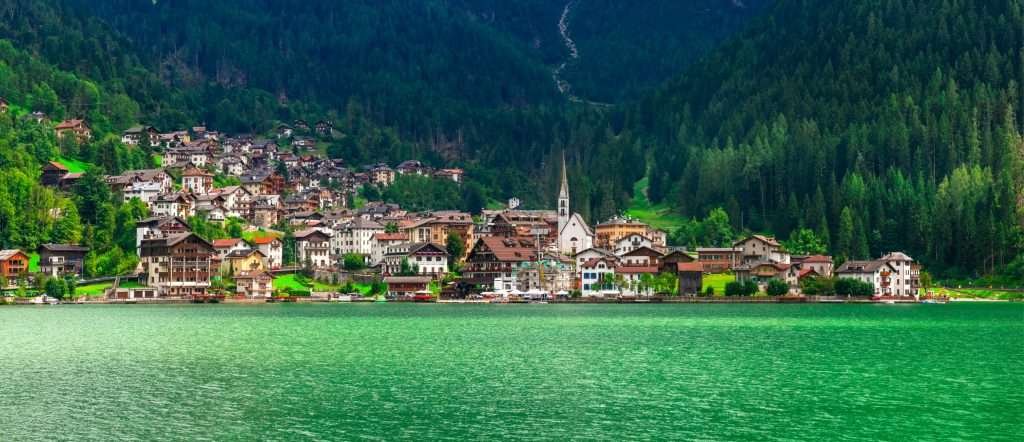
The village itself takes little time on foot: the lakefront, the square, the church of San Biagio, the ice stadium. Everything else is outside the centre: Masarè and the waterfall to the south, Caprile to the north, the hamlets on the opposite slope and the lifts heading up towards the Civetta.
Lake Alleghe

Lake Alleghe is not a glacial lake. On the night of 11 January 1771 a landslide came off Monte Piz, on the right bank of the Cordevole. It buried the village of Riete and parts of Marin and Fusine, killing 49 people. The debris blocked the valley and the river backed up over the following weeks, flooding more hamlets. On 1 May the same year a second landslide fell into the lake: the wave hit Alleghe and destroyed the rectory and part of the church.
Today the lake lies at 966 metres, covers about half a square kilometre and is up to 55 metres deep. The full loop is about 5 km and almost flat: two easy hours, partly on the cycle path. In summer you can rent rowing boats and pedal boats; swimming is allowed only in the designated bathing area. In August there is an evening parade of illuminated boats on the lake.
The village and the church of San Biagio
The centre of Alleghe is the stretch between the square and the lakefront, with shops, bars and ski rental. The church of San Biagio (Saint Blaise, the patron saint, feast day 3 February) stands where a chapel was already recorded in 1185. It was consecrated in 1466, rebuilt after the 1771 landslides and again after a fire in 1899.
Inside there is a cycle of paintings by the 18th-century painter Valentino Rovisi and his workshop, a statue of Saint Blaise from the early 1400s and an old Madonna of Loreto. The latest restoration returned the roof to its original shape, covered with larch shingles.
Monte Civetta and the north-west face
From the lakefront you look straight at the north-west face of the Civetta: more than a thousand metres of vertical rock, several kilometres wide, with the small hanging glacier of the Cristallo in the middle. On 7 August 1925 the Germans Emil Solleder and Gustav Lettenbauer climbed it in a single day, on a route of about 1,100 metres: it is considered the first grade VI route in the Alps.
You don’t need to climb to see it up close: the trail between the Coldai and Tissi huts runs right below the face (see the summer section). The best light is at sunset.
Masarè and the Ru de Rialt waterfall

Masarè is the hamlet at the southern end of the lake, about a kilometre from the centre along the shore. From its square starts the path to the Ru de Rialt waterfall, also called the Masarè waterfall: walk up to the tennis courts at Pian Grant, continue through the woods to a water fountain, then climb gently to the falls. About an hour there and back, 200 metres of ascent, easy even with children.
The last stretch crosses a small scree slope, so wear hiking boots. The season runs from May to October. Don’t go in winter: the path ices over and avalanche gullies come down above the falls.
Caprile
Caprile is the hamlet north of the lake where the road splits: towards the Marmolada and the Fedaia Pass, towards Colle Santa Lucia and the Giau Pass, and towards Arabba. It has the church of San Bartolomeo Apostolo and a small, quiet centre. The bridge over the Cordevole gives one of the best views of the Civetta, especially at sunset.
Santa Maria delle Grazie and Bramezza

Across the lake from the village, the sanctuary of Santa Maria delle Grazie is a stop on the lake loop. From here a road and then a forest track climb to Bramezza: a tiny, almost deserted hamlet of stone and timber houses, technically in the municipality of Rocca Pietore, with views over the lake and the Civetta. Allow about an hour and a half on foot from the sanctuary and 450 metres of ascent. In winter the track can be icy.
Piani di Pezzè and Col dei Baldi
From the village a gondola runs up to Piani di Pezzè, at about 1,450 metres, and a second gondola continues to Col dei Baldi, at about 1,920 metres. This is the gateway to Ski Civetta in winter and to the hiking trails in summer. At Piani di Pezzè you’ll find the Civetta Adventure Park, a treetop course with suspension bridges, and the Ally Farm, a children’s play area around a small pond. On 29 May 2026 the Giro d’Italia stage won by Sepp Kuss finished here.
Alvise De Toni ice stadium
On the lakeshore stands the Alvise De Toni ice stadium: about 2,500 seats and a 30 × 60 metre rink. It is home to HC Alleghe, a hockey club with a long history in Italy’s top league; the women’s team won the Italian title in 1991 and 1995. In season you can skate with rental skates and watch a game at the weekend. Fixtures and times on the club’s website.
Skiing in Alleghe

Alleghe is part of Ski Civetta, the largest ski area in Veneto: according to the lift company, 72 km of slopes and 23 lifts, linking Alleghe, Selva di Cadore, Palafavera and Pecol in Val di Zoldo on skis. The runs go from about 1,000 metres in the village to just over 2,000. Ski Civetta belongs to the Dolomiti Superski: with the regional pass you can also ski Val di Fassa, Arabba, Cortina and the other areas, about 1,200 km in total.
The Alleghe slopes
The gondola leaves from the village and climbs to Piani di Pezzè, the hub of the sector, with nursery slopes, a children’s area and mountain restaurants. From there lifts go up to Col dei Baldi and Col Fioret and down towards Selva di Cadore and Val di Zoldo. Red runs dominate: this is an area for intermediate and good skiers, with a run back down to the village. Open runs and lifts on the Ski Civetta website.
Selva di Cadore, Palafavera and Val di Zoldo
On the far side from the lake you ski down to Selva di Cadore and Palafavera and reach Pecol in Val di Zoldo. This is where you’ll find the Foppe, a black run that has hosted four women’s World Cup races. Val di Zoldo also has night skiing: the Foppe and Cristelin runs are floodlit, about 5 km, usually from January to mid-March. For winter 2026/27 the Pecol – Pian del Crep gondola is being renewed.
Ski passes 2026/27
As of early October 2026, Ski Civetta has not yet published its prices for the new season. As a guide: in 2025/26 an adult day pass cost €63 in low season and €70 in high season. Dolomiti Superski has already set its 2026/27 prices: adult day pass in high season €89, 6 days €453, pre-sale season pass €990; the Dolomiti Superski Family costs €43 a day and can now be bought online. If you only ski the Civetta area, the local pass is cheaper. Passes can be bought online on the Dolomiti Superski shop.
Season, ski schools and non-skiers
The season usually runs from early December to late March or early April, snow permitting; official dates come out in November. Ski schools and a children’s area are at Piani di Pezzè. Non-skiers can walk or snowshoe around the lake, ride the gondola to Piani di Pezzè, skate at the ice stadium or watch a hockey game.
Summer in Alleghe

In summer both gondolas from Alleghe to Col dei Baldi run from mid-June to late September (13 June to 27 September in 2026) and save you almost a thousand metres of climbing. Times and ascents below are indicative: always carry the map (Tabacco 1:25,000) and check the weather.
Lago Coldai and Rifugio Coldai

This is the classic Alleghe hike. From Piani di Pezzè or Col dei Baldi you reach Casera di Pioda (about 1,800 m), then follow trail 556, an old military mule track, to Rifugio Sonino al Coldai at about 2,130 metres: an hour and a half from Pioda. The hut belongs to the CAI Venice section and opens from mid-June to mid-September.
From the hut, climb 15–20 minutes to Forcella Coldai (2,191 m) and drop to Lago Coldai at 2,143 metres, a small glacial lake below the towers of the Civetta. Difficulty E (hiking trail). The path is part of Dolomites Alta Via 1.
Rifugio Tissi and the north-west face
From Lago Coldai continue on trail 560: you lose about 200 metres below the north-west face, then take trail 563 up to Col Reàn. Here stands Rifugio Tissi, at about 2,250 metres, built in 1963 by the CAI Belluno section and named after the climber Attilio Tissi. From the terrace you face the whole Civetta wall, with Alleghe and its lake more than a thousand metres below.
From Piani di Pezzè allow about three and a half hours one way and around 1,000 metres of total ascent with the ups and downs. A full day, for fit hikers. Watch the time of the last gondola down.
Cima Fertazza
On the opposite side from the Civetta, Cima Fertazza (just over 2,100 m) is a viewpoint over the valley and the Civetta. It makes a loop from Piani di Pezzè via Col dei Baldi, about five hours, on trails and forest roads with no technical difficulty.
Lake loop, cycling and passes
The lake loop (about 5 km) is the walk for everyone. Road cyclists have some of the best-known climbs in the Dolomites on the doorstep: the Fedaia Pass below the Marmolada, the Giau Pass, Passo Duran and Forcella Staulanza. The very steep climb from Alleghe to Piani di Pezzè was a Giro d’Italia stage finish in 2026.
With children
For a family day: gondola to Piani di Pezzè, Civetta Adventure Park in the woods and Ally Farm with its play area and small bike park. In the village, a rowing or pedal boat on the lake and the Ru de Rialt waterfall, an hour there and back.
Day trips from Alleghe
- Serrai di Sottoguda (about 10 km): a narrow gorge between rock walls in the municipality of Rocca Pietore, destroyed by storm Vaia in 2018 and reopened after restoration. Open in summer with a ticket: check dates with the Rocca Pietore council.
- Fedaia Pass and Marmolada (about 20 km): via Caprile and Malga Ciapela up to the lake and pass below the highest peak in the Dolomites.
- Arabba (about 20 km): the Sella Ronda village, in Val di Livinallongo.
- Giau Pass (about 20 km): one of the most photographed passes in the Dolomites, between Colle Santa Lucia and Cortina.
- Cortina d’Ampezzo (about 40 km via the Giau Pass): host of the 2026 Winter Olympics.
- Selva di Cadore (about 12 km): mountain village at the foot of Monte Pelmo, linked to Alleghe on skis too.
- Agordo (about 15 km): the main town of the Agordino, on the road to Belluno.
- Falcade (about 25 km) and Passo San Pellegrino: the Biois valley, with slopes and trails towards Trentino.
- Val di Fassa (about 35 km from Caprile over the Fedaia Pass): Canazei and the Sella group.
Where to stay in Alleghe
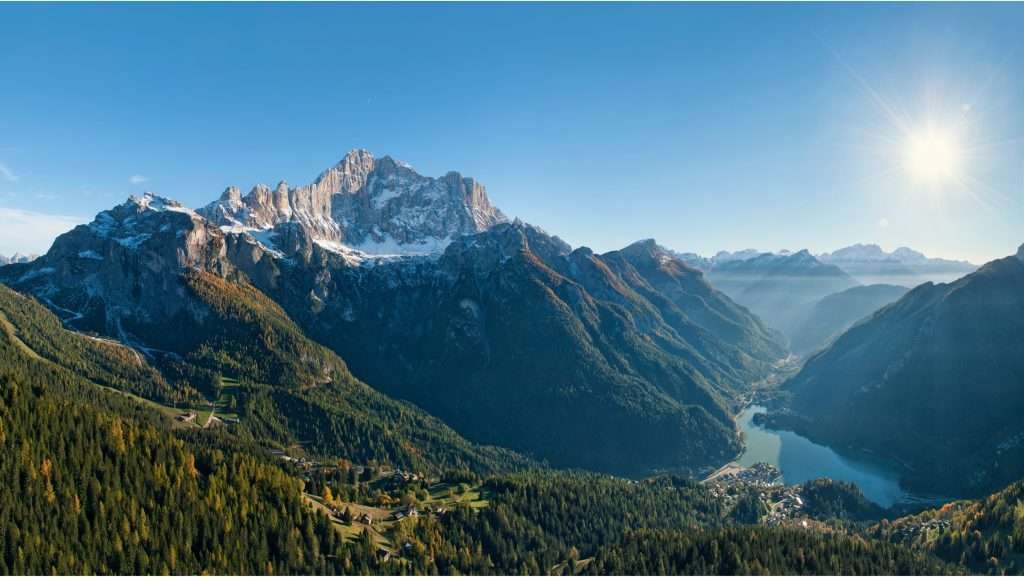
Centre and lakefront: the most practical choice. The gondola, shops, ice stadium and bus stop are all within walking distance. There are hotels of various categories, apartments and residences: the right area for skiers and for anyone arriving without a car.
Masarè: quieter, at the southern end of the lake, a kilometre from the centre along the shore. Good for families and couples who want peace, with the waterfall nearby; the lifts are a walk or a short drive away.
Caprile: north of the lake, the starting point for the Marmolada, Arabba and the Giau Pass. Handy if you plan to drive or cycle the passes a lot.
On a budget: in the Agordino you’ll find apartments, B&Bs and guest rooms generally cheaper than in Cortina or Val di Fassa. Book early for Christmas, February and August.
How to get to Alleghe
By car
From the A27 Venice – Belluno motorway, exit at Belluno and take the Agordina road (SR 203) through Agordo and Cencenighe to Alleghe: about 46 km, one hour. From Venice airport it is about 150 km, from Treviso about 135. From the north you come over the passes: Fedaia from Val di Fassa, Giau or Falzarego from Cortina, Pordoi and Arabba from South Tyrol. Some passes may close in winter or after snowfall. If you rent a car, ask for winter tyres or chains between November and April.
By train
There is no station in Alleghe: the nearest is Belluno, with regional trains from Venice (via Conegliano or via Treviso and Montebelluna) and from Padua. With Trenitalia’s “Alleghe Link” through ticket you buy train and bus to Alleghe together: the bus from Belluno adds €5.70, or €6.70 to Caprile. Details on the Trenitalia website.
By bus
Dolomiti Bus services leave from the bus station in front of Belluno railway station and run up the Agordina road to Alleghe and Caprile; some trips change at Agordo or Cencenighe. Allow about an hour. Current timetables at Dolomiti Bus.
By plane
The most convenient airports are Venice Marco Polo (about 150 km) and Treviso Canova (about 135 km). Without a car: from Venice airport take a bus to Mestre and a train to Belluno; from Treviso a train to Belluno via Conegliano. Then Dolomiti Bus. By car or private transfer, allow about two to two and a half hours.
Parking
There are car parks near the gondola station and along the lake; in Masarè there is a car park for the waterfall. At Christmas and in August, arrive early. If you stay in the centre, leave the car at your accommodation: the village is easy to explore on foot.
Frequently asked questions about Alleghe
What is the altitude of Alleghe?
About 1,000 metres: the town hall is at 993 m and the lake at 966 m. The summit of the Civetta above the village reaches 3,220 m.
Where is Alleghe in Italy?
In Veneto, in the province of Belluno, in the Agordino (Cordevole valley), in the heart of the Dolomites. About 46 km from Belluno and 150 km from Venice.
How was Lake Alleghe formed?
By a landslide from Monte Piz on the night of 11 January 1771, which buried three villages, killed 49 people and dammed the Cordevole.
Can you swim in Lake Alleghe?
Only in the designated bathing area. Otherwise the lake is for rowing, pedal boats, fishing and the 5 km lakeside loop.
How many km of slopes does Ski Civetta have?
72 km and 23 lifts according to the lift company, between Alleghe, Selva di Cadore, Palafavera and Val di Zoldo. It is part of the Dolomiti Superski.
How much is a ski pass in Alleghe?
Civetta’s 2026/27 prices are not out yet (in 2025/26 an adult day pass was €63–70). The 2026/27 Dolomiti Superski day pass costs €89 in high season.
How do I get to Alleghe from Venice without a car?
Train to Belluno, then Dolomiti Bus. With Trenitalia’s “Alleghe Link” ticket you buy both in one go.
How long is the hike to Lago Coldai?
From Piani di Pezzè, reached by gondola, about two and a half hours to the hut and the lake at 2,143 m. Graded as a hiking trail.
What can you do in Alleghe in winter without skiing?
Walk or snowshoe around the lake, ride the gondola to Piani di Pezzè, go skating and watch an HC Alleghe game.
Which villages are near Alleghe?
Caprile, Rocca Pietore with the Serrai di Sottoguda, Selva di Cadore, Agordo, Arabba, Falcade and, about 40 km away, Cortina d’Ampezzo.
Weather in Alleghe
Photos of Alleghe


