


 Français
 Deutsch
 Italiano
ACCOMMODATIONS IN SAN CANDIDO
Discover the best Hotels, B, and Apartments in the Mountains based on thousands of verified reviews.
Altitude1,175 m
WhereAlta Pusteria, South Tyrol (BZ)
From Venice airportabout 175 km
SlopesMonte Baranci in the village · 3 Zinnen about 115 km
Dolomiti Superski€89 day pass, high season 2026/27
Seasonsskiing from December · Baranci chairlift late May–late Sept
Updated October 2026 · Sources: 3 Zinnen Dolomites, Dolomiti Superski, IDM South Tyrol, FAI, Osttirol Tourismus
Find a place to stay in San Candido
San Candido, Innichen in German, is a village in South Tyrol, in the province of Bolzano, in the Alta Pusteria (Hochpustertal). The centre sits at 1,175 metres, about 105 km from Bolzano and 6 km from Dobbiaco (Toblach). It is the last village in the Puster Valley before the Austrian border: Sillian, in East Tyrol, is 12 km away and Lienz about 42 km. Around 3,300 people live here, eight in ten of them German speakers.
Its story starts in 769, when Duke Tassilo III of Bavaria gave this land to an abbot to found a Benedictine monastery. That is where the Romanesque collegiate church and the village itself come from. Just west of the centre is the source of the Drava (Drau), which flows from here into Austria and on to the Danube. Along the river runs the cycle path to Lienz, the best-known bike ride in the area.
The nearest airports are Bolzano (about 110 km), Innsbruck (about 140 km), Treviso (about 160 km) and Venice (about 175 km). In winter you ski on Monte Baranci, right at the edge of the village, and from Versciaco (Vierschach), part of San Candido, you ride up Monte Elmo (Helm): both belong to the 3 Zinnen Dolomites ski area, about 115 km of slopes inside the Dolomiti Superski pass. In summer you have the cycle path, the trails on Monte Baranci and a railway that ends right here, so you can explore the valley without a car.
What to see in San Candido

The centre is small and mostly pedestrian: you can walk around it in an hour. The main sights are the churches, plus the old spa ruins in the forest, Monte Baranci and the source of the Drava, all within walking distance.
The Collegiate Church of Saints Candidus and Corbinian

The collegiate church (Stiftskirche) is the main reason to stop in San Candido. It is a 13th-century Romanesque church, consecrated in 1284, and one of the most important Romanesque churches in the Eastern Alps. The monastery founded in 769 belonged to the bishops of Freising in Bavaria; around 1140 it became a collegiate chapter, a community of canons, and stayed under Freising until 1803.
Inside, look above the altar for the 13th-century Romanesque wooden Crucifixion group: it is the piece many visitors come for. Fifteen minutes is enough for the church.
The Collegiate Museum
Next to the church, in the 16th-century former chapter house, the Stiftsmuseum has seven rooms of local sacred art, sculpture from six centuries, illuminated manuscripts, prints and the church treasury. It is small, but it explains why a mountain village has a church of this rank. Opening hours change with the season, so check at the tourist office.
St Michael’s Square and Church
A few steps from the collegiate church is the parish church of St Michael, on the square of the same name. It was originally Romanesque (12th century) and was rebuilt in Baroque style after 1735: you will recognise it by the round tower with an onion dome. Together with the collegiate church, it forms the heart of the village, with the town hall, tourist office, shops and cafés around it.
The Holy Sepulchre (Außerkirchl)
On the edge of the village stands the Außerkirchl, “the little church outside”, a pair of chapels built in the 17th century by Georg Paprion, an innkeeper and pilgrim from San Candido. The first copies the Marian shrine of Altötting in Bavaria. The second, from 1653, he built after a pilgrimage to the Holy Land: it is a copy of the Holy Sepulchre in Jerusalem, a domed rotunda with a two-storey arcade.
A Passion chapel links the two. The outside is always visible; for the interior, ask at the tourist office.
The Franciscan Church
The Franciscan friary dates from the 17th century, under Emperor Leopold I. It burned down in the Second World War and was rebuilt almost exactly as before. The church is mostly Rococo, with Lukas Plazer’s paintings (1707–1709) of the life of St Francis and Christoph Unterperger’s high altarpiece from 1764.
DoloMythos and Acquafun: for rainy days
DoloMythos, in the centre, is a museum about the Dolomites: how they formed, fossils, minerals, dinosaur models and local legends. A good choice with children on a wet day.
The other option is Acquafun, the village pool: a 25-metre sports pool, a 75-metre slide, a toddler pool and a sauna area. In summer the outdoor lawn opens too.
The San Candido spa ruins (Wildbad)
In the forest south-east of the village stand the ruins of the Wildbad, the old San Candido baths. The springs were known as early as the 16th century. In the mid-19th century a Tyrolean doctor turned them into a sanatorium, and in the early 20th century they became a grand hotel for the nobility of the Habsburg empire. After the First World War and the new border the guests stopped coming and the hotel was abandoned. Today the façades with empty windows stand among the spruces: view them from the trail.
You get there on the themed trail from the car park at the Monte Baranci chairlift: 3.3 km, about 145 metres of ascent, one hour, easy. It is open in all seasons unless there is too much snow.
Monte Baranci

Monte Baranci (Haunold) is San Candido’s own mountain: its cliffs close off the village to the south. A chairlift leaves just outside the centre and climbs to about 1,500 metres, to the Rifugio Gigante Baranci hut. In winter it is the village’s family ski area; in summer it is the start of walks and of the Funbob, a summer toboggan on rails that takes you back down.
The source of the Drava
The Drava rises on the Dobbiaco plain, halfway between Dobbiaco and San Candido. An easy, child-friendly trail leads to the source past the “Drava stations”: each metre of path stands for 1.4 km of river. The Drava is about 750 km long and crosses five countries before joining the Danube.
The Christmas market
San Candido’s Christmas market fills the pedestrian centre between the collegiate church and St Michael’s. It is smaller and quieter than the one in Bolzano. In 2026 it opens on 27 November, on Advent weekends and then daily over the holidays: the full calendar is on the Tre Cime region website.
Skiing in San Candido

San Candido is part of the 3 Zinnen Dolomites (Tre Cime Dolomiti) ski area: about 115 km of slopes across five mountains (Monte Baranci, Monte Elmo, Croda Rossa, Passo Monte Croce and Val Comelico), with more than 30 lifts. Most runs are blue and red, with a few blacks. The season usually runs from early December to Easter, snow permitting.
Monte Baranci: family skiing and night skiing
Monte Baranci is a small area with wide, easy runs and children’s zones: ideal for your first days on skis or for skiing with young kids. You can walk there from the centre or take the ski bus. On some evenings each week the slopes are floodlit for night skiing and the hut stays open: check the days on the lift company website.
A toboggan run also comes down from the top station, served by the chairlift. It is the favourite activity for non-skiers.
Versciaco and Monte Elmo: the new Helmissimo gondola
For full ski days, head to Versciaco, a few kilometres east. The new 10-seat Helmissimo gondola climbs from 1,132 to 2,047 metres on Monte Elmo and replaces the old lift; it is scheduled to open for winter 2026/27. From Monte Elmo you ski down towards Sesto and link up with Croda Rossa.
Without a car, you reach Versciaco by train (Versciaco stop) or ski bus. The Ski Pustertal Express, the skiers’ train, also takes you to Plan de Corones (Kronplatz), above Brunico.
Ski passes
The area is part of Dolomiti Superski. For the 2026/27 season, an adult one-day Dolomiti Superski pass costs 89 euros in high season and a six-day pass 453 euros. There is also a cheaper local 3 Zinnen Dolomites pass; its 2026/27 prices had not been published by October 2026, so check the lift company website. Ski schools and rental shops are easy to find in the village and near the lifts.
Cross-country skiing
San Candido’s cross-country trails connect with those of Dobbiaco and Sesto: the Tre Cime region has about 200 km of groomed tracks. The main hub is Dobbiaco and its Nordic Arena: see our Dobbiaco guide.
Snowshoeing and winter walks
The winter classic is the walk from the Wildbad up to the Rifugio Gigante Baranci: about 8.5 km, 380 metres of ascent, two and a half hours, on a steady gentle climb. Walk back down or take the chairlift if it is running. The shorter spa trail also works on snowshoes.
Summer in San Candido
In summer San Candido is a handy base for two reasons: the train arrives in the village and the cycle path starts in the centre. The Monte Baranci chairlift and hut usually open from late May to late September.
The Drava cycle path from San Candido to Lienz
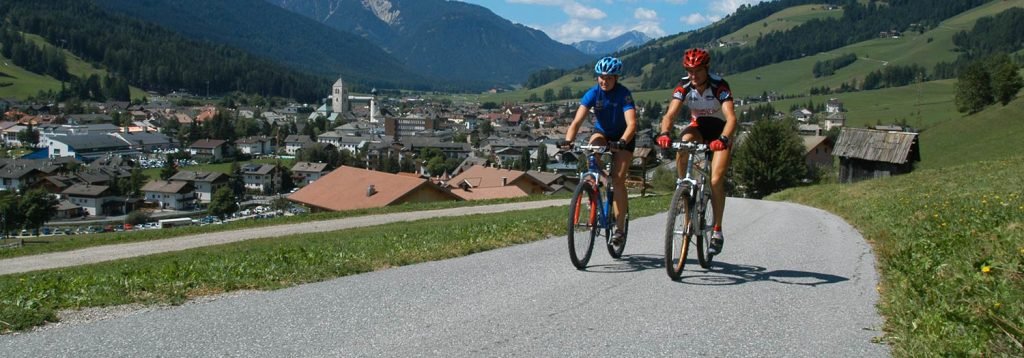
The Drava cycle path (Drauradweg) runs from San Candido to Lienz in Austria: 44.8 km, dropping from 1,175 to 655 metres. It is almost all gently downhill, paved and wide, suitable for families with small children and for e-bikes. You pass Versciaco and Prato alla Drava, cross the border, then from Sillian follow the left bank of the river, away from traffic, all the way to Lienz.
Most people come back by train: in summer, trains with bike transport run from Lienz to Sillian and San Candido. They fill up in high season, so start early. Several rental shops in San Candido let you drop the bike off in Lienz. Prices and timetables change every year, so ask the rental shop.
In Heinfels, about 14 km after San Candido, the path passes the Loacker café and shop, open every day: the kids’ favourite stop.
Hikes from Monte Baranci
The easiest walks start at the chairlift car park. For families: the trail up to the Rifugio Gigante Baranci, 2.8 km and about 310 metres of ascent. A half-day loop climbs to the hut along the toboggan run and returns via the Wildbad: 8.7 km, about 330 metres up and down, 2.5 to 3 hours.
For stronger walkers there is the climb to Pausa Ganda (Gantraste), 2,126 metres: 11.4 km and nearly 1,000 metres of ascent, a full day. In summer, forestry work can close some trails, so check first.
Towards the Three Peaks
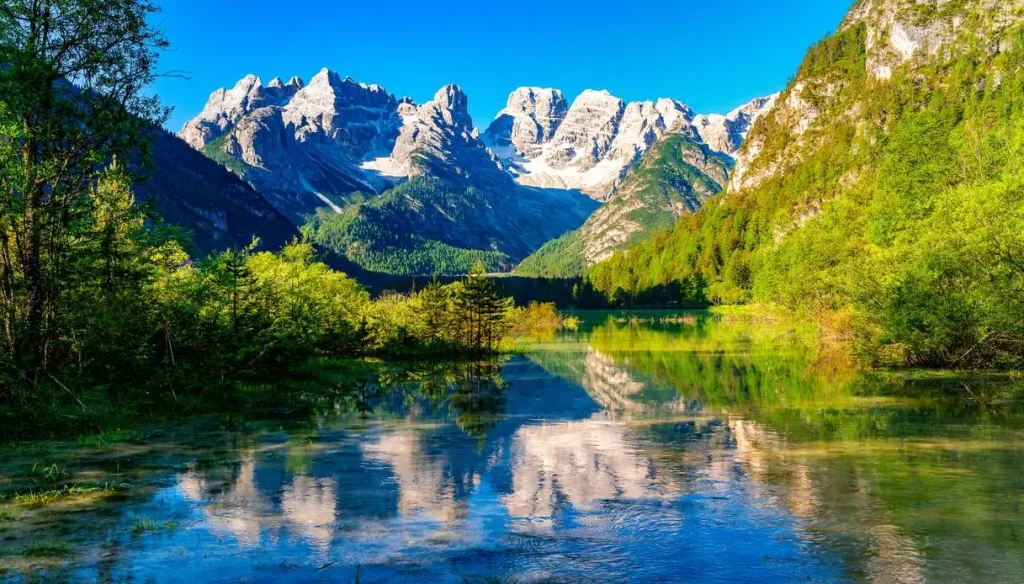
San Candido is one of the three municipalities of the Tre Cime Nature Park, with Dobbiaco and Sesto. The most famous hikes start from the neighbouring villages, though: from Val Fiscalina in Sesto you walk up to the Rifugio Locatelli, and from Dobbiaco a shuttle bus goes to the Rifugio Auronzo. Full details in our Tre Cime di Lavaredo guide.
Day trips from San Candido

- Dobbiaco (6 km): the lake, Gustav Mahler’s composing hut and the Three Peaks shuttle. Guide: Dobbiaco.
- Sesto and Val Fiscalina (about 8 km): the Sesto Sundial peaks and the Dance of Death. Guide: Sesto.
- Lake Dobbiaco (about 8 km): a flat lap of the lake, under an hour.
- Sillian and Heinfels (12–14 km): already in Austria, by car, train or bike.
- Lake Braies (about 21 km): in high summer, cars only with a booked parking space, or take bus 442 from Dobbiaco. Guide: Lake Braies.
- Lake Misurina (about 25 km): already in the Veneto, start of the toll road to the Three Peaks.
- Brunico (about 32 km): old town and castle.
- Cortina d’Ampezzo (about 38 km): through Val di Landro, by car or bike. Guide: Cortina d’Ampezzo.
- Lienz (about 42 km): capital of East Tyrol, by train or by bike along the Drava.
Where to stay in San Candido
San Candido has hotels, guesthouses, apartments and farm stays. The right area depends on your plans.
- Centre: for train travellers, families and anyone who wants shops, restaurants and the Christmas market on foot. The station is a few minutes away.
- Monte Baranci area: for skiing with children and summer hiking; chairlift and car park nearby, centre on foot.
- Versciaco: for skiing every day on Monte Elmo, next to the new gondola. Quieter, with its own train stop.
- Prato alla Drava and Monte San Candido: farms, apartments and lower prices; you need a car or bike.
- Without a car: stay near the station or a stop on bus 446, which links Dobbiaco, San Candido and Sesto.
Book early for August, the Christmas market weeks and the period from Christmas to Epiphany. Many places give you a guest card for South Tyrol’s public transport; it is not valid on the bookable summer shuttles to the Three Peaks and Braies.
How to get to San Candido
By car
On the A22 Brenner motorway, take the Bressanone/Varna – Val Pusteria exit and follow the SS49 for about 60 km via Brunico and Dobbiaco. From Bolzano it is about 105 km, an hour and forty minutes. From Cortina, drive up Val di Landro (about 38 km); from Austria, come from Lienz along the Drava (about 42 km).
By train
San Candido is the end of the Puster Valley line from Fortezza (Franzensfeste). At Fortezza you meet the Brenner line trains from Verona, Bolzano, Innsbruck and Munich, and change for San Candido; from Bolzano that means one change. There are also trains to and from Lienz in Austria. Timetables on südtirolmobil.
By bus
Bus 446 runs year-round between Dobbiaco, San Candido, Sesto and Passo Monte Croce, with a “Baranci” stop by the chairlift. In summer, the shuttles to the Three Peaks (444) and Lake Braies (442) leave from Dobbiaco, 6 km away, and must be booked online.
By plane
The nearest airports are Bolzano (about 110 km), Innsbruck (about 140 km), Treviso (about 160 km) and Venice (about 175 km); Munich is about 300 km away. From Bolzano and Innsbruck continue by train via Fortezza; from Venice and Treviso, book a transfer or hire a car. In winter, a transfer straight to your accommodation is the simplest option with ski gear.
Parking
The centre is pedestrian: leave the car in the car parks on the edge of the village, at the station or at the Monte Baranci chairlift, which is also the start of the walks and the family ski area.
Frequently asked questions about San Candido
What is the altitude of San Candido?
The centre is at 1,175 metres. The Rifugio Gigante Baranci above the village is at about 1,500 metres, and the Versciaco gondola tops out at 2,047 metres.
Where is San Candido?
In South Tyrol, province of Bolzano, in the Alta Pusteria: the last village in the Puster Valley before Austria. Dobbiaco is 6 km away, Sesto about 8 km, Lienz about 42 km.
Are San Candido and Innichen the same place?
Yes. San Candido is the Italian name and Innichen the German one; South Tyrol is bilingual and signs show both.
How far is San Candido from Bolzano?
About 105 km by car, roughly an hour and forty minutes, via the A22 and the Puster Valley road. By train you change at Fortezza.
How long is the San Candido–Lienz cycle path?
44.8 km, almost all gently downhill, from 1,175 to 655 metres. It is fine for families. You come back from Lienz by train with your bike.
Where can I rent a bike to ride to Lienz?
There are several rental shops in San Candido, some with drop-off in Lienz. Prices and bike-train timetables change every summer, so ask locally.
Can you ski in San Candido?
Yes: on Monte Baranci, a family area with night skiing, and from Versciaco on Monte Elmo, within the 3 Zinnen Dolomites area (about 115 km). The 2026/27 Dolomiti Superski day pass costs 89 euros in high season.
When is the San Candido Christmas market?
In 2026 it opens on 27 November: on Advent weekends and then daily over the holidays. The full calendar is on the Tre Cime region website.
Is there a lake in San Candido?
Not in the village. The nearest is Lake Dobbiaco, about 8 km away; Lake Braies is about 21 km away.
Should I stay in San Candido or Dobbiaco?
San Candido for downhill skiing, a lively centre and the cycle path to Lienz. Dobbiaco for cross-country skiing and the shuttles to the Three Peaks and Braies.
Weather in San Candido
Photos of San Candido


