


 Français
 Deutsch
 Italiano
ACCOMMODATION IN FALCADE
Discover the best Hotels, B&Bs and Apartments in Mountain based on thousands of verified reviews.
Altitude1,148 m
WhereBiois valley, Belluno (Veneto)
From Bellunoabout 46 km
SlopesSan Pellegrino–Falcade ski area: 59 km, 15 lifts
Dolomiti Superski pass€80–89 per day (2026/27)
Ski season4 Dec 2026 – 4 Apr 2027
Updated October 2026 · Sources: Comune di Falcade, Promo Falcade consortium, ApT Val di Fassa, Murer Museum, Dolomiti Superski
Find a place to stay in Falcade
Falcade is a Dolomites village at 1,148 metres in the province of Belluno (Veneto), at the western end of the Biois valley. It is the last town in Veneto before Trentino: above the village the road climbs to the San Pellegrino Pass (1,918 m, about 11 km away) and drops on the other side to Moena in the Val di Fassa. Belluno is about 46 km away, Venice airport about two hours by car.
The municipality has about 1,700 residents spread across many hamlets: the lower village (Piè Falcade) around the Piana, Falcade Alto on the hillside, Molino where the lifts start, and further down Caviola, the largest hamlet. Around you are the Marmolada, Civetta, Pale di San Martino, Focobon and Cime d’Auta. The name comes from the Italian for “to mow”: people here lived off hay meadows, and old wooden barns (tabià) are still everywhere.
In winter Falcade is one of the two gateways to the San Pellegrino–Falcade ski area: 59 km of slopes in the Dolomiti Superski, with a gondola right from the village. On the Piana there is a cross-country loop of about 10 km, floodlit two evenings a week. In summer it is a quiet base for walking: easy trails between hamlets, waterfalls, mountain huts just over an hour away, lifts open until mid-September. It is a real village, not a purpose-built ski resort.
What to see in Falcade
The sights are spread across the hamlets. In the village you walk everywhere; for Sappade, the Valfredda and the Gares valley you need a car or a few hours on foot.
The Piana di Falcade and its small lake

The Piana is the big meadow in the middle of the village, with a small lake and views of the Cime d’Auta and the Focobon. In summer it is where families gather and where the valley-floor walks begin. In winter it becomes the Pietro Scola cross-country centre. At the end of September it hosts Se Desmonteghea, the festival of the cattle coming down from the summer pastures.
The Augusto Murer Museum
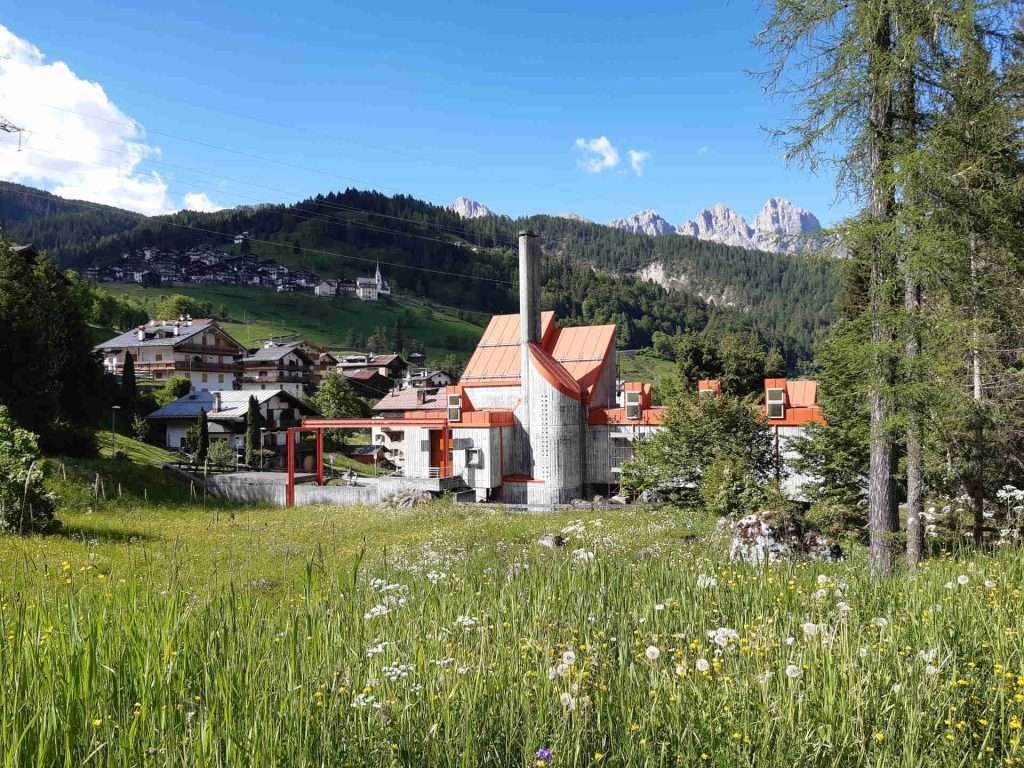
Augusto Murer (1922–1985) is Falcade’s sculptor. His studio in the hamlet of Molino was designed in 1972 by the architect Giuseppe Davanzo and became a museum after his death. Inside, over three floors, are more than a hundred sculptures in wood and bronze, plus drawings and paintings. Outside, in the garden, about thirty bronzes stand in the open.
The museum opens in summer, usually from mid-June to mid-September, 10:00–12:00 and 15:00–19:00; in 2026 admission was €5 (€3 reduced). Out of season, visits are by appointment for groups only: check the museum website. Murer also made the Stations of the Cross and the doors of Falcade’s church (1946) and the memorial to the victims of Caviola.
Falcade Alto, the tabià and the Coste loop
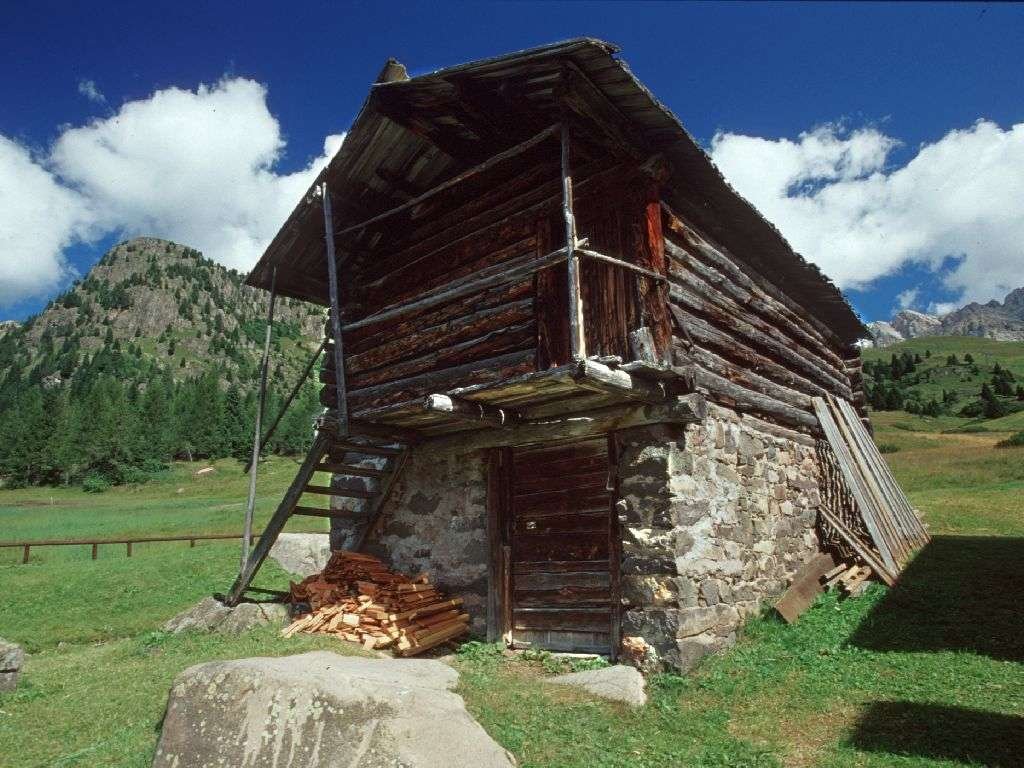
Falcade Alto is the oldest part of the village, on the slope above the Piana. The church of Saints Fabian and Sebastian was built between 1471 and 1488 as a vow against an epidemic. Around it are fountains and tabià, wooden barns with the stable below and the hayloft above.
The best way to see them is the Coste loop: 5 km from Piazza Municipio through Falcade Alto, Somor and Le Coste, about 2 hours with 230 metres of ascent. It is easy and runs through meadows and barns.
The valley of the saints at the windows
On house fronts across the Biois valley there are around eighty religious paintings from the 17th to the 19th century. They were meant to protect against fire and disease, and were often painted by travelling artists in exchange for food and lodging. In 1958 the writer Enzo Demattè called it “the valley of the saints at the windows”. You will spot them walking between Falcade, Canale d’Agordo and Vallada Agordina.
Caviola and the Madonna della Salute
Caviola, at 1,090 metres below the Cime d’Auta, is the most populated hamlet in the municipality. On 20 August 1944 German troops burned almost all of it: what you see today is largely rebuilt. In Piazza Sandro Pertini stands the memorial Murer carved in 1974.
On the hill above the village, the small church of the Madonna della Salute, built in 1713, survived intact. Legend says the stones gathered to build it vanished from the village one night and reappeared up there.
Sappade and the hamlet of Jore
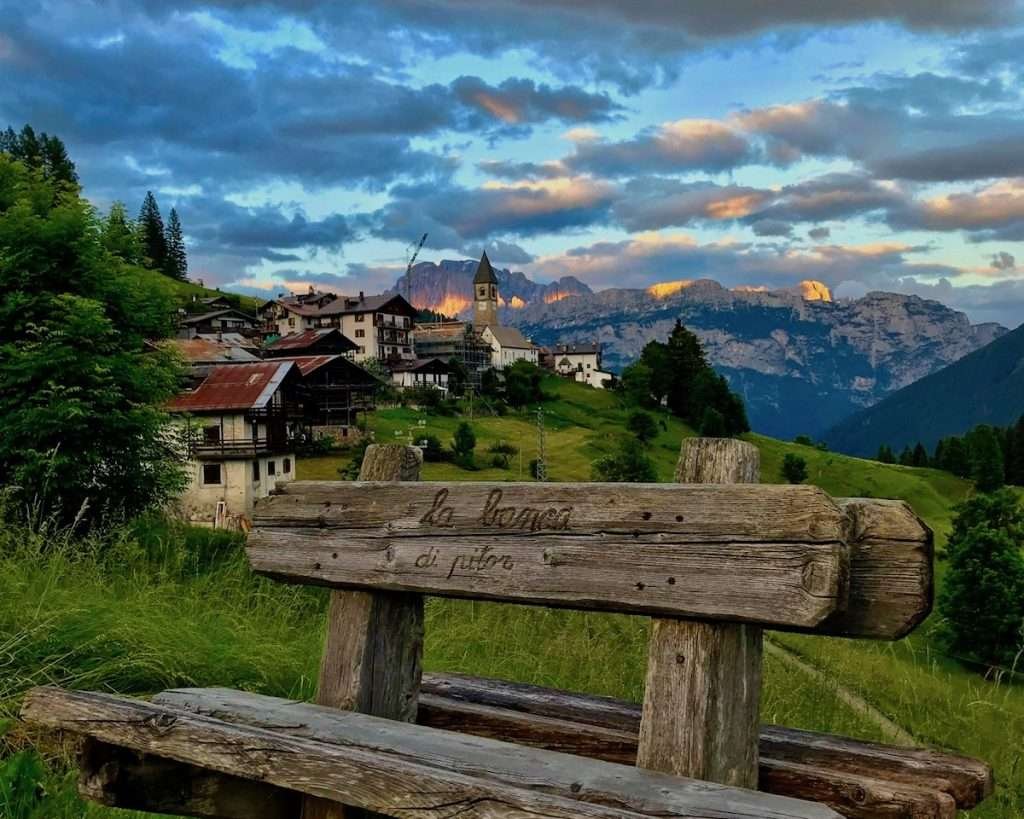
Sappade sits above Caviola and is nicknamed “the sunny village”. It is the start of one of the easiest walks in the valley: CAI trail 692 takes you to the hamlet of Jore in about an hour, 2.5 km with 170 metres of ascent. Jore has a small church from 1858, an old bread oven and the caretaker’s house. In winter the same route is walked on packed snow.
The Barezze waterfall and the geology trail
From the hamlet of Marmolada (1,240 m), the geology trail along the Gaon stream, with information panels, passes through Valt and reaches the Barezze waterfall in a small gorge: about 2 km and 250 metres of ascent, one hour, an hour and a half with children. Easy.
If you have the legs, trail 631 climbs steeply from the waterfall to Malga Bosch Brusà at 1,867 metres: about 4 km and 690 metres of ascent in total, two and a half hours one way.
The Valfredda
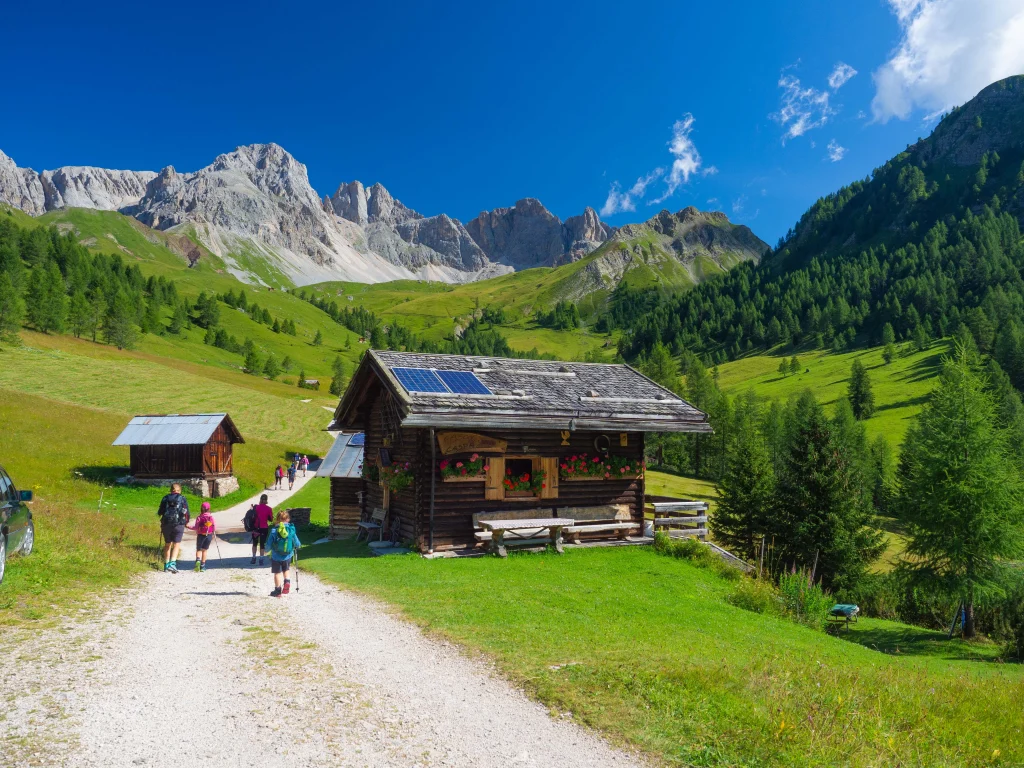
The Valfredda is a bowl of meadows below the Marmolada group, within Falcade’s municipality, just before the San Pellegrino Pass. Turn right at about 1,880 metres before the pass; the car park is about 800 metres further on. A forest track leads to the Casoni, old shepherds’ shelters now private huts, and to the chapel dedicated to Blessed Pier Giorgio Frassati. The Flora Alpina hut is also in the Valfredda.
From here you can walk on towards Fuciade and make a loop; Fuciade and the Forca Rossa loop are covered on our San Pellegrino Pass page. In winter the walk to the Casoni takes about two hours and is easy, but watch for icy patches.
The Gares valley waterfalls
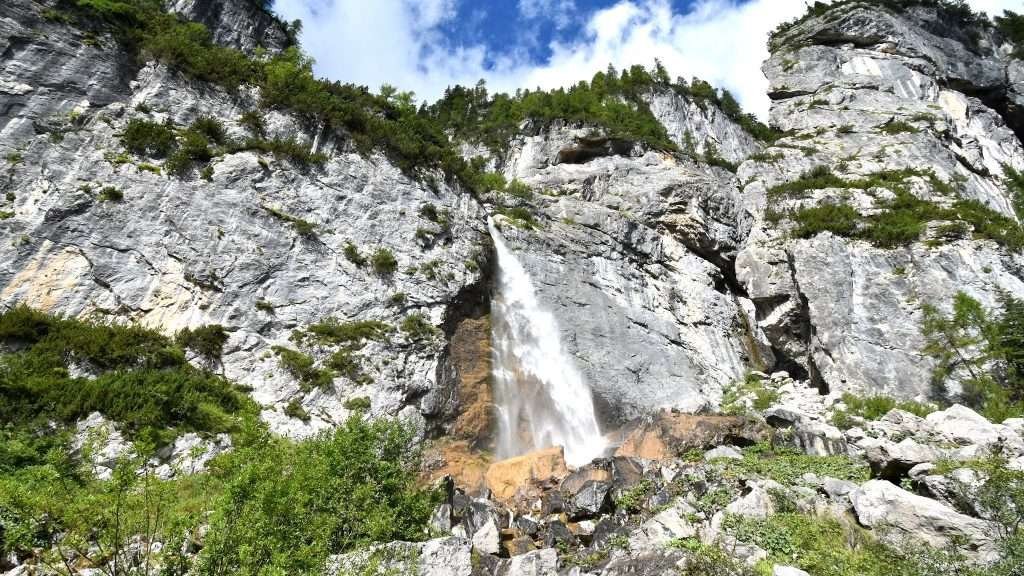
The Gares valley starts in Canale d’Agordo, about 4 km from Falcade, and runs for about 8 km to the foot of the Pale di San Martino plateau. At the end is the hamlet of Gares.
From the hamlet a trail follows the stream up to the Comelle waterfalls. The first stretch is fine for everyone; the upper part is steep and demanding, so if you are not used to it, turn back at the first waterfall.
The Artists’ Wood at Le Buse
The gondola from Molino arrives at Le Buse, at around 1,800 metres. Here is the Bosco degli Artisti: a flat loop of about 1 km through the trees, with more than fifty works by local artists and large red wood ant nests. Allow about an hour; not suitable for pushchairs.
Skiing in Falcade
The San Pellegrino–Falcade ski area

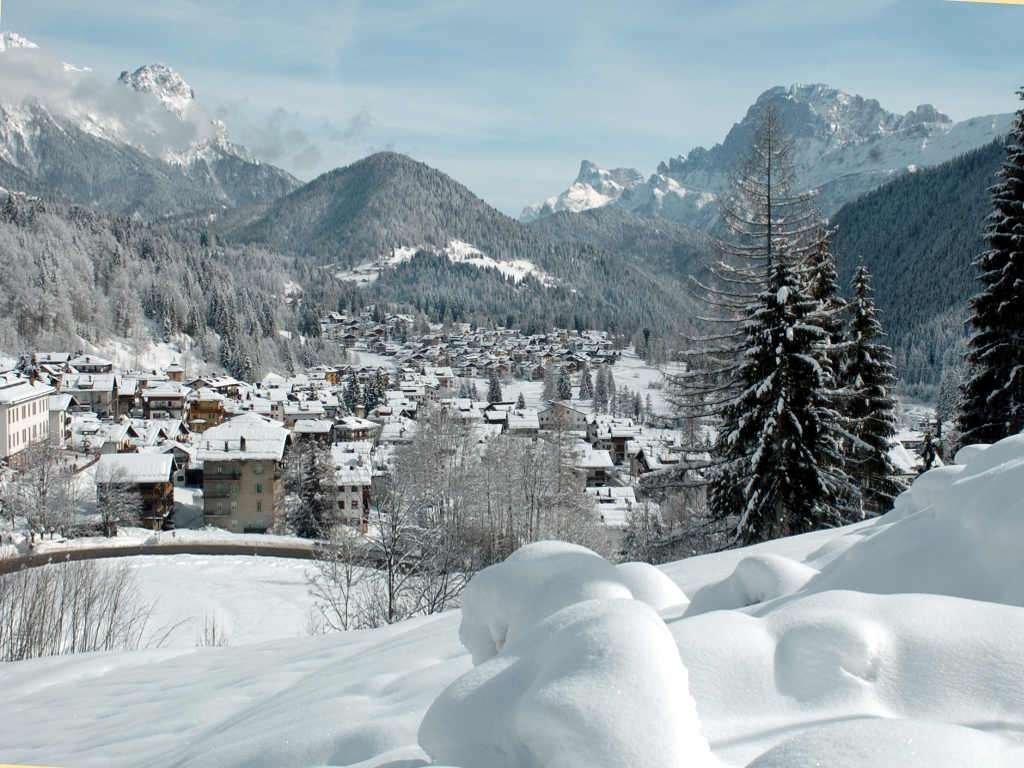
Falcade is part of the Passo San Pellegrino–Falcade ski area in the Dolomiti Superski: 59 km, 40 runs and 15 lifts across Veneto and Trentino. The 2026/27 season runs from 4 December 2026 to 4 April 2027; the Falcade-side lifts open on 5 December and close on 6 April, 8:30–16:00.
From the village you take the gondola and chairlifts up to the Col Margherita (2,514 m) and over to the San Pellegrino Pass; in the evening you ski back down the long run to Molino. The pass side (cable car, the LaVolatA World Cup run, Costabella) is covered on our San Pellegrino Pass page.
Seen “Tre Valli” mentioned? It is the name of a ski tour linking San Pellegrino–Falcade with the Alpe Lusia above Moena, not a separate ski area with its own pass.
Runs and lifts on the Falcade side
The lifts start at Molino. The Molino–Le Buse gondola (8 seats) goes up to Le Buse, where there is a beginners’ area with a drag lift. From there the Le Buse–Laresei, Saline–Laresei and Lago Cavia–Laresei chairlifts serve the upper slopes, and the Lago Cavia–Col Margherita chairlift links to the pass.
Runs on this side are mostly red: Laresei, Plateau and Panoramica, each 1.7 to 1.8 km long. Beginners have the Le Buse nursery slope, the blue Saline run and a small fun park. The highlight is the Le Buse–Molino run, almost 4 km back to the village. Ski schools and rental shops are in the village.
Ski passes
You can buy the Alpe Lusia/San Pellegrino pass, which also covers Moena’s Alpe Lusia (about 85 km in total), or the Dolomiti Superski. For 2026/27 an adult Dolomiti Superski day pass costs €80 in low season and €89 in high season; buy online at least two days ahead and you save 5%. Local pass prices are on the Ski Area San Pellegrino website.
Cross-country skiing
The Pietro Scola cross-country centre is on the Piana, right in the village: about 10 km of loops across meadows and through woods, from a beginners’ area to race-standard tracks. It is floodlit two evenings a week and rents skis and snowshoes. The cross-country school teaches every day.
The second centre, Franco Manfroi, is at the end of the Gares valley: 7.5 km, more technical and wooded, with natural snow that lasts. Both are part of the SuperNordicSkipass network.
Snowshoeing and winter walks
You do not need to ski to enjoy winter here. La Cavalera, the path along the Biois from the Piana to Canale d’Agordo, is groomed: about an hour, easy. Higher up, from Passo Valles (2,032 m) you walk alongside the slopes to the Laresei hut (2,250 m) in about an hour and a half, with 200 metres of ascent. Sappade–Jore and the Valfredda Casoni also work in winter. Off groomed tracks, go with a guide and check the avalanche bulletin.
Ski bus
In winter a Dolomitibus ski bus links Canale d’Agordo, Caviola and Falcade with the gondola at Molino. You pay a fare; if you are staying with a member of the local tourism consortium, ask for the discount voucher. Times and fares change every season: ask at the tourist office on Piazza Municipio.
Summer in Falcade
In summer the Molino–Le Buse gondola and the Le Buse–Laresei chairlift usually run from late June to mid-September, and carry bikes. Times are one way unless stated.
Easy walks
- La Cavalera: from the Piana to Canale d’Agordo along the Biois, 4.5 km, about 1 hr 15. Flat, for everyone.
- Coste loop, Sappade–Jore, Barezze waterfall: described above under What to see.
- Laresei hut by lift: 800 metres on a gravel track from the top of the chairlift, 15 minutes. Fine with a pushchair.
Hikes to mountain huts
Rifugio Bottari (1,573 m). From Molino (about 1,100 m) a forest trail climbs steadily: 2 km, 370 metres, about 1 hr 15. The hut belongs to the CAI Oderzo section and opens in summer. You can loop back via Malga Valles Bassa.
Passo Valles – Rifugio Laresei. From the Passo Valles car park (about 2,030 m), 12 km from Falcade, CAI trail 658 leads to the Laresei hut (2,250 m): 3.5 km, 220 metres, an hour and a half. All above the treeline, with cows and horses grazing: good with children.
Lago di Cavia. Take the gondola and chairlift to Laresei, climb to Forcella Pradazzo and descend to Lago di Cavia (2,102 m); return to Le Buse on trail 695. 4.2 km, about an hour and a half, moderate.
For experienced hikers, Dolomites High Route No. 2 (Alta Via 2) passes through Falcade, heading for the Mulaz hut and the Pale di San Martino.
Cycling
The cycle path along the Biois starts at the Piana and runs down the valley to Canale d’Agordo and Cencenighe: ideal for easy rides and children. The easiest Falcade Bike Trail loop is 15.9 km with 360 metres of climbing via Molino, Falcade Alto, Le Coste, Valt and Caviola. The lifts carry bikes free of charge. The 11 km road climb to the San Pellegrino Pass is a Giro d’Italia classic.
When to go to Falcade
For skiing, early December to early April. For hiking, late June to mid-September, when lifts and huts are open. September is ideal for quiet and autumn colours: the last weekend usually brings Se Desmonteghea, with decorated animals, folk groups and local food on the Piana.
Before you set off, check the Falcade webcams and the forecast on the local tourism consortium’s website. From 15 November to 15 April, winter tyres or snow chains on board are required, especially over the San Pellegrino and Valles passes.
Day trips from Falcade
- Canale d’Agordo (about 4 km): birthplace of Pope John Paul I, with the Albino Luciani museum, his birth house and the Casa delle Regole from 1640.
- San Pellegrino Pass (about 11 km): Fuciade, the lake and the Col Margherita cable car.
- Moena and the Val di Fassa (Moena about 22 km): over the pass in Trentino.
- Alleghe (about 17 km): the lake below the Civetta.
- San Martino di Castrozza (about 34 km): over Passo Valles and Passo Rolle, below the Pale.
- Arabba (about 40 km): gateway to the Sellaronda.
- Dolomiti in miniatura: in San Tomaso Agordino, a loop with 19 stone sculptures of Dolomite peaks, good for families.
Where to stay in Falcade
Falcade is small: everything is a few minutes’ drive away.
- Molino: for skiers. The gondola is on your doorstep and you ski back in the evening.
- Piè Falcade and the Piana: for families and visitors without a car. Shops, bus and ski-bus stops, the cross-country loop and flat walks right outside.
- Falcade Alto and Le Coste: for views and quiet. You will need a car.
- Caviola and Canale d’Agordo: usually cheaper. On the ski-bus route, handy for the Gares valley and Sappade.
Most accommodation is holiday apartments, small family-run hotels and a few campsites. For Christmas, New Year and the February weeks, book well ahead.
How to get to Falcade
By car
From Venice or Treviso: A27 motorway to Belluno, then the road to Agordo (SS 203) and up the Biois valley via Cencenighe and Canale d’Agordo; about 40 minutes from the motorway exit. From the north (Brenner): A22 to Egna-Ora or Bolzano Nord, through the Val di Fassa to Moena and over the San Pellegrino Pass; Bolzano is about 66 km away.
By train
The handiest station is Belluno, about 46 km away, served by regional trains. From there, Dolomitibus buses run to Falcade.
By bus
Dolomitibus buses link Belluno and Agordo with Falcade. Towards the Val di Fassa, Trentino Trasporti line B123 Falcade–San Pellegrino Pass–Moena has only one weekday run each way: designed for commuters, not day trips. In summer there are usually a few extra buses up to the pass. At some times of year there are direct coaches from Mestre and Treviso: check before you travel.
By plane
The nearest airports are Treviso and Venice Marco Polo, both about two hours’ drive; Verona is about 2 hrs 50. Public transport means changing at Belluno, so a hire car or private transfer is the easiest option.
Parking
There is parking at the Molino gondola station and in the centre of Falcade. In peak weeks arrive early or take the ski bus.
Frequently asked questions about Falcade
What is the altitude of Falcade?
The village is at 1,148 metres. Caviola is at about 1,090 m, Le Buse (top of the gondola) at about 1,800 m, the Col Margherita at 2,514 m.
Where is Falcade?
In the province of Belluno, Veneto, at the head of the Biois valley, about 11 km from the San Pellegrino Pass and the border with Trentino. Belluno is about 46 km away, Moena about 22 km.
How many km of slopes does Falcade have?
The San Pellegrino–Falcade ski area has 59 km of slopes and 15 lifts. Add Moena’s Alpe Lusia, on the same pass, and it is about 85 km.
When does the 2026/27 ski season start?
The ski area opens on 4 December 2026 and closes on 4 April 2027. Lifts on the Falcade side are scheduled from 5 December to 6 April.
What is "Tre Valli"?
A ski tour between San Pellegrino–Falcade and the Alpe Lusia. It is not a separate ski area: the pass is Alpe Lusia/San Pellegrino or Dolomiti Superski.
Can I get to Falcade without a car?
Yes: train to Belluno, then a Dolomitibus bus. In the village a ski bus serves the gondola. Buses towards the Val di Fassa, however, are very rare.
Where is the Valfredda?
Within Falcade’s municipality, just below the San Pellegrino Pass. Turn right at about 1,880 m, park and walk to the Casoni.
When is the Augusto Murer Museum open?
In summer, usually mid-June to mid-September (10:00–12:00 and 15:00–19:00). The rest of the year, by appointment for groups only.
Where can I check snow and weather in Falcade?
The Falcade tourism consortium website has webcams and forecasts. For open runs, see the Ski Area San Pellegrino website.
Weather in Falcade
Photos of Falcade


