


 Français
 Deutsch
 Italiano
ACCOMMODATIONS IN Bressanone
Discover the best Hotels, B, and Apartments in the Mountains based on thousands of verified reviews.
Altitude559 m (town centre)
WhereSouth Tyrol, northern Italy
From Innsbruckabout 82 km · 1 hr 10 by car
SlopesPlose: about 40 km, 7 lifts
Ski passPlose + Dolomiti Superski · born 2019+ free
SeasonSki 5 Dec 2026–4 Apr 2027 · Market 26 Nov–6 Jan
Updated October 2026 · Sources: Plose (2026/27 season), Novacella Abbey, Hofburg Bressanone, Bressanone tourist board, Dolomiti Superski, ISTAT, Südtirolmobil
Find a place to stay in Bressanone
Bressanone (Brixen in German, Persenon in Ladin) is a town in South Tyrol, northern Italy, in the Isarco (Eisack) valley, where the Rienza river joins the Isarco. The centre sits at 559 metres above sea level and has 23,456 residents (May 2026), making it the third-largest municipality in the province of Bolzano. Both Italian and German are spoken. For centuries it was the seat of the prince-bishops, which explains the cathedral, the bishop’s palace and a compact old town you can explore on foot.
Driving distances: Bolzano about 42 km (40 minutes), Innsbruck about 82 km (1 hr 10), Verona about 193 km (2 hrs 10), Munich about 220 km (3 hrs), Milan about 314 km. Bressanone is on the Brenner railway, served by regional trains and the EuroCity trains between Munich and Verona. The handiest airports are Innsbruck (about 86 km), Bolzano (about 49 km, few flights) and Verona (about 196 km).
Why go: it is a real town with shops, museums and services open all year, and it has its own mountain right above it. The Plose gondola from Sant’Andrea takes you up to 2,050 metres: skiing and tobogganing in winter as part of Dolomiti Superski, hiking with views of the Odle peaks in summer. In December there is the Christmas market on Cathedral Square, and Novacella Abbey is a few kilometres away all year round. It also works well without a car.
What to see in Bressanone
Cathedral Square and the Cathedral
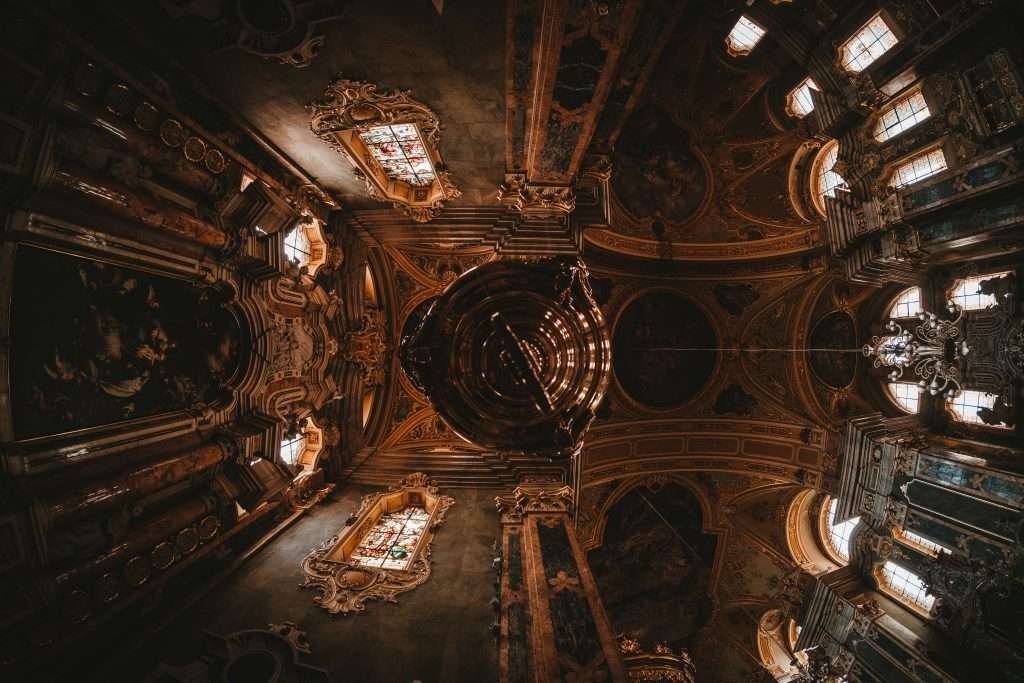
Piazza Duomo is the heart of town: on one side the cathedral with its twin towers, on the other the parish church of St Michael and the town hall. The Cathedral of the Assumption (Santa Maria Assunta) has medieval origins, but what you see today is Baroque: it was rebuilt between 1745 and 1754 and consecrated in 1758.
Inside, look up: the ceiling frescoes are by Paul Troger, the Baroque painter from the Puster valley, and were his last major work (1748–1750). The altars and stucco are by Teodoro Benedetti, the design by architect Josef Delai. Entry to the church is free; outside Mass times you can look around at your own pace.
The cathedral cloister
The cloister adjoins the cathedral on its south side and is the one thing you should not skip. The structure is Romanesque, from the 14th century; the arcade vaults are covered in Gothic frescoes of Bible scenes, which is why it is called the “Bible of the Poor”: the paintings told the sacred stories to people who could not read. It is one of the most important cycles of wall painting in the Alps. Allow 20 to 30 minutes.
The Bishop’s Palace (Hofburg) and Diocesan Museum
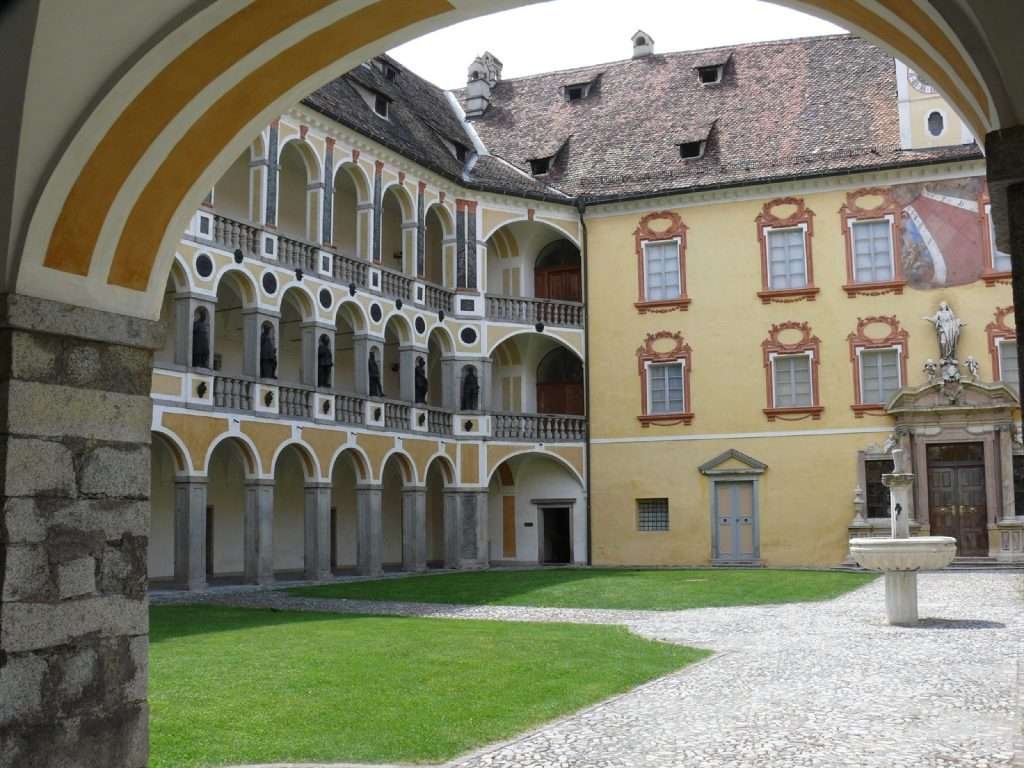
The Bishop’s Palace, or Hofburg, was the residence of the prince-bishops of Bressanone. The first building dates from the 13th century and was remodelled several times; today you recognise it by its inner courtyard with loggias on several floors, one of the finest in South Tyrol.
The palace houses the Diocesan Museum, with around 70 rooms: sacred art from the Middle Ages to the Baroque, the Cathedral Treasury, the Imperial Apartment and a large nativity scene collection, best seen around Christmas. According to the museum’s website it opens 10am–5pm from October to May and 10am–6.30pm from June to September, closed on Easter Sunday and on 24 and 25 December. Check before you go on the Hofburg website.
St Michael’s Church and the White Tower
Opposite the cathedral stands St Michael’s, the town’s parish church, of Romanesque origin. Its bell tower is the White Tower: 15th century, about 72 metres high, with a carillon. It used to be called the Black Tower until its roof was painted white. At certain times of year you can climb it, with a small museum route over several floors.
The arcades and the old town

Behind Cathedral Square start the arcades, the covered merchants’ streets, with shops, cafés and passages into inner courtyards. The old town is largely pedestrianised and small: in two or three hours you can see the cathedral, cloister, Hofburg and arcades without rushing. The centre also has a Pharmacy Museum in a historic pharmacy, a quirky stop that works well with children or on a rainy day.
Stufles, the oldest quarter
Cross the bridge over the Isarco and you are in Stufles, considered the oldest part of Bressanone. Narrow lanes, low houses and courtyards: a quiet corner away from the bustle of the centre.
Novacella Abbey

Novacella Abbey (Kloster Neustift) lies about 3 km north of the centre, in the municipality of Varna. It was founded in 1142 by Blessed Hartmann, Bishop of Bressanone, and Augustinian canons still live there. You can visit the basilica, the museum, the abbey garden and the winery, which the abbey describes as one of the oldest in the world, with vineyard tours and tastings.
Opening times: the museum with audio guide is open Monday to Saturday, 10am–5pm (last entry 4.15pm); guided tours run at 11am and 2.30pm and must be booked. The abbey is closed to visitors on Sundays and religious holidays. It is 10 minutes by car, and you can also walk or cycle from the centre. Prices and bookings on the Novacella Abbey website.
The Plose, Bressanone’s mountain
The Plose is the mountain massif east of town. The gondola leaves from Sant’Andrea, just above 1,000 metres, and climbs in about 10 minutes to Valcroce at 2,050 metres. From the top you see the Odle, the Sass de Putia and, on clear days, much of the Dolomites. Even if you neither ski nor hike much, go up once for the view.
Skiing in Bressanone
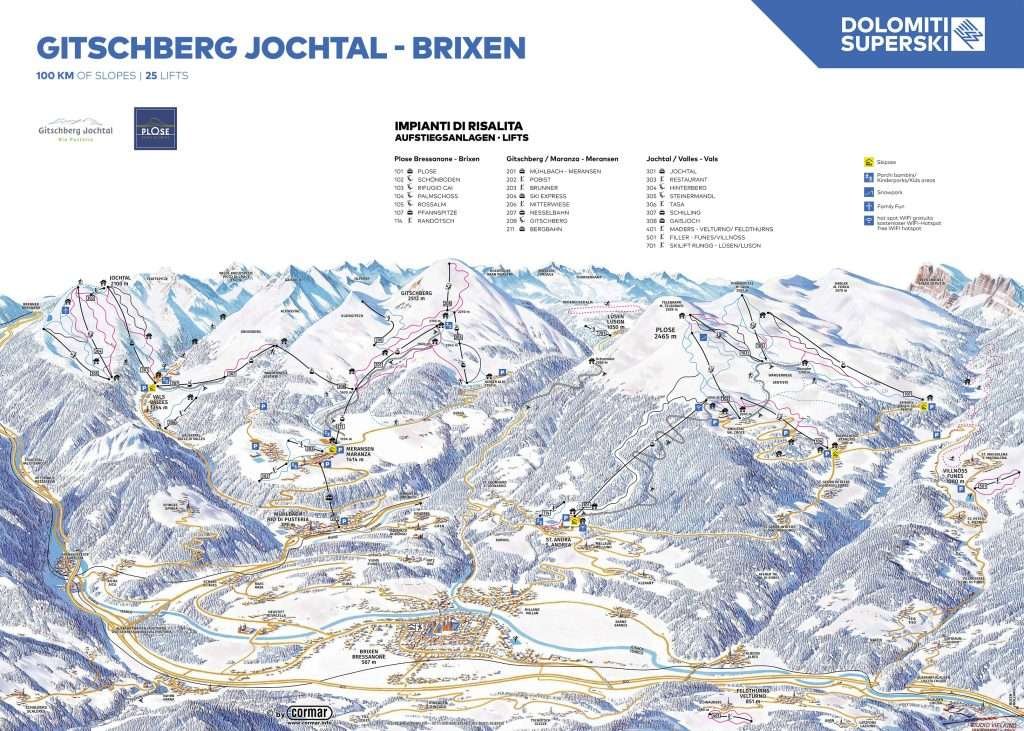
The Plose is Bressanone’s ski area and part of Dolomiti Superski, the 1,200 km network of slopes across the Dolomites. It has around 40 km of runs and 7 lifts: two gondolas, four chairlifts and one drag lift. Runs are split between easy, intermediate and difficult, with a good share of blues: fine for families and beginners, with enough vertical for stronger skiers.
The Trametsch. The Plose’s signature run: about 9 km from the upper part of the ski area down to the valley station, graded difficult. Snow on the lower section depends on the winter, so check the snow report. Another well-known run is the Crazy Horse. There is also a snowboard funpark.
Season and hours 2026/27. The Plose is open from 5 December 2026 to 4 April 2027. The gondola starts at 8.45am, the other lifts at 9am, and everything closes at 4.30pm.
Ski passes. The Plose pass is also valid at Rio Pusteria and on the lifts at Funes, Velturno, Luson and Terento; with a Dolomiti Superski pass you can ski all twelve areas. Children born after 1 January 2019 ski free (with some exclusions), young people born between 2009 and 2018 get about 30% off, and over-65s about 10%. Day pass prices for 2026/27 are in the price list on the Plose website, where you can also buy passes online.
Ski schools and beginners. The Plose has ski and snowboard schools with beginner areas for both children and adults.
Tobogganing. The RudiRun is the Plose toboggan run. The long version, RudiRun 9.0, runs about 9 km from the top station to the valley and only opens with enough natural snow; the RudiRun 4.0 is 4 km long and ends at the mid-station at 1,600 metres, where you take the gondola back up. The run itself is free; sledges and lift rides are extra. Only sturdy sledges are allowed, no bobs.
Cross-country and snowshoeing. Cross-country is not the Plose’s strength: for groomed loops head to Val di Funes, about 20 minutes away, with 18 km of trails. Snowshoe routes follow the Plose winter paths; check conditions and avalanche risk on the day.
Ski bus. A ski bus runs from the centre of Bressanone to the gondola valley station. It is free with the Brixen Südtirol Guest Pass, which many places to stay hand out.
Summer in Bressanone
The Three Peaks hike on the Plose
This is the classic Plose hike. From the Valcroce top station (2,050 m) climb to the Plose hut (2,446 m) and Monte Telegrafo (2,486 m), then follow the ridge east: Forcella Luson (2,371 m), Monte Fana (about 2,545 m) and the Gabler, or Monte Forca Grande (about 2,575 m), the highest summit of the massif. Return via the Rossalm (2,180 m) and the farm track to Valcroce.
It is about 13 km with about 700 metres of ascent: allow 5 hours of walking plus breaks. The path is not technical, but the ridge is rocky in places, with a few cable-protected sections below the Gabler, so you need to be sure-footed. Short version: the Plose hut and Monte Telegrafo (about 400 metres of ascent), back the same way.
Gondola and family activities
The Plose gondola also runs in summer: in 2026 from 23 May to 1 November. Up top there are children’s trails such as the WoodyWalk, the Plosebob (an alpine coaster on rails) and mountain carts for riding down gravel tracks. With the Guest Pass, one return ride a day is included in certain periods. Current times and prices on the Plose website.
Mountain biking
The Plose is home to the Brixen Bikepark, and the lift company suggests panoramic mountain bike routes past high pastures and farms. Routes, rules and bike transport on the gondola change from year to year, so check the Plose website before you go.
Lake Varna

Lake Varna (Vahrner See) is a small woodland lake at about 700 metres, 5 km from Bressanone. Read this before you go: because of underwater operations by the Italian Navy, which is recovering wartime ordnance from the lake bed, the path around the lake has been closed since April 2024 until the end of 2026, and in 2026 swimming and diving are banned. You can walk to the lakeside meadow and back the same way (about 1.5 km, 25 minutes, pushchair-friendly). For 2027, ask the tourist office whether the loop has reopened.
Water Light Festival
In spring Bressanone hosts the Water Light Festival, with light and water installations in the old town and along the rivers. Since 2024 it has been held every two years: the latest edition ran from 29 April to 16 May 2026. Dates of the next edition on the festival website.
Bressanone Christmas market
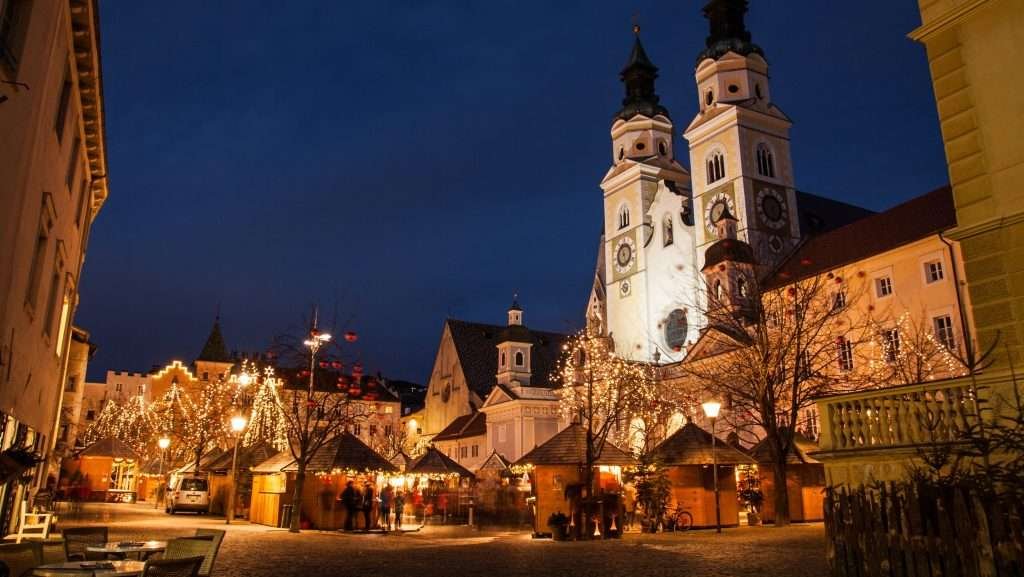
Bressanone’s Christmas market fills Cathedral Square, between the cathedral, St Michael’s and the town hall. For 2026/27 it opens on 26 November 2026, with the opening ceremony at 5pm, and runs until 6 January 2027; it is closed on 25 December. Expect crafts, decorations, South Tyrolean produce and stalls with hot food and mulled wine.
Opening hours usually run from late morning to 7pm, with food stalls open longer and early closing on 24 and 31 December: the final 2026 times are on the Bressanone tourist board website. December weekends get very busy, so come by train (the station is a few minutes’ walk from the square) or on a weekday.
Day trips from Bressanone
- Val di Funes: about 18 km to San Pietro, 20 minutes. The valley of the Odle peaks and the little church of Santa Maddalena; bus 330 runs from Bressanone station.
- Novacella Abbey and Varna: about 5 km. Abbey, vineyards and winery; you can walk there.
- Chiusa (Klausen): about 14 km south, a small town on the Isarco below Sabiona monastery on its rock.
- Vipiteno (Sterzing): about 31 km north towards the Brenner, with its medieval tower in the middle of the main street.
- Ortisei and Val Gardena: about 31 km, half an hour. From Ortisei, ride the lifts up to Seceda, the viewpoint over the Odle on the Gardena side.
- Brunico: about 35 km, 40 minutes towards the Puster valley. The valley’s main town, with its castle and Plan de Corones.
- Merano: about 75 km, just over an hour via Bolzano. Thermal baths, Trauttmansdorff gardens and promenades.
- Innsbruck: about 82 km over the Brenner, also easy by train.
Where to stay in Bressanone
Old town and station area. The best choice without a car, for the Christmas market or a culture trip. Everything is walkable and the Plose ski bus leaves from the centre. Hotels, guesthouses and apartments; book early for December and holiday weekends.
Sant’Andrea and the villages on the Plose road. For skiing every day or hiking high: close to the gondola and away from traffic. Smaller places, apartments and farm stays; you need a car or the bus to get into town in the evening.
Varna and Novacella. North of town among vineyards and orchards: good for families and anyone travelling by bike or car. Farm stays, apartments and family-run hotels, often with parking.
Most partner accommodation gives you the Brixen Südtirol Guest Pass: free regional trains in South Tyrol as far as Trento, town and regional buses and the ski bus for your whole stay. Ask before you book.
How to get to Bressanone
By car
Bressanone is on the A22 Brenner motorway: take the Bressanone exit, which is also the exit for the Puster valley. From Bolzano it is about 42 km (40 minutes), from Verona about 193 km, from Innsbruck about 82 km, from Munich about 220 km (3 hours). In Austria you need a motorway vignette, and the Brenner motorway has a separate toll.
By train
Bressanone station is on the Brenner line, a few minutes’ walk from the centre. Regional trains between Bolzano, Fortezza and the Brenner stop here, as do the EuroCity trains linking Munich and Innsbruck with Verona and Bologna. Timetables on Südtirolmobil, Trenitalia and ÖBB.
By bus
Buses to the nearby valleys leave from the station, including line 330 to Val di Funes, along with the Plose ski bus. They are free with the Guest Pass; otherwise buy a ticket or the South Tyrol Mobilcard.
By plane
Innsbruck (about 86 km) is the nearest larger airport. Bolzano (about 49 km) is closer but has few flights. Other options: Verona (about 196 km), Venice (about 238 km), Bergamo (about 274 km) and Munich. From Munich, Verona or Bolzano you can continue by train to Bressanone; private transfers and shuttles also run from the main airports, so compare prices and times when you book.
Parking
The old town is pedestrianised: use the pay car parks on its edge and walk in. On Christmas market days they fill up fast, so the train is better. For the Plose there is parking at the gondola valley station in Sant’Andrea; for Novacella, the abbey car park.
Frequently asked questions about Bressanone
What is the altitude of Bressanone?
The centre of Bressanone is 559 metres above sea level. The Plose gondola rises to 2,050 metres, and the summits of the massif top 2,500 metres.
Where is Bressanone?
In South Tyrol, northern Italy, province of Bolzano, in the Isarco valley where the Rienza joins the Isarco. About 82 km from Innsbruck and 42 km from Bolzano, on the Brenner motorway and railway.
What can you see in Bressanone in one day?
In the morning, Cathedral Square, the cathedral, the cloister and the Hofburg with the Diocesan Museum; after lunch, the arcades and Stufles, then Novacella Abbey (guided tour at 2.30pm, booking required). If the weather is good, swap Novacella for the Plose gondola.
When does the Plose ski area open?
For 2026/27 the Plose is open from 5 December 2026 to 4 April 2027, lifts 9am–4.30pm (gondola from 8.45am).
What are Novacella Abbey's opening hours?
The museum is open Monday to Saturday, 10am–5pm; guided tours at 11am and 2.30pm, booking required. Closed to visitors on Sundays and religious holidays.
Can you swim in Lake Varna?
Not in 2026: swimming and diving are banned while wartime ordnance is recovered, and the path around the lake is closed until the end of 2026. For 2027, check with the tourist office.
When is the Bressanone Christmas market?
From 26 November 2026 to 6 January 2027 on Cathedral Square, daily except 25 December.
Can you visit Bressanone without a car?
Yes. The station is a few minutes from the centre, with regional and EuroCity trains on the Brenner line; ski buses and valley buses leave from the centre and are free with the Guest Pass from your accommodation.
Bressanone or Merano?
Bressanone is smaller, higher and has its ski area minutes away; Merano is a larger spa town with a milder climate. Choose Bressanone for skiing and hiking, Merano for thermal baths and gardens.
Weather in Bressanone
Photos of Bressanone


