


 Français
 Deutsch
 Italiano
PORDOI PASS ACCOMMODATIONS
Discover the best Hotels, BBs and Apartments in the Mountains based on thousands of verified reviews.
Altitude2,239 m (Sass Pordoi 2,950 m)
WhereDolomites, Trentino – Veneto border
From Canazeiabout 12 km on the SS48 · Arabba about 9 km
Cable carSass Pordoi · up to 2,950 m, the "Terrace of the Dolomites"
SkiingSellaronda · Dolomiti Superski €89/day (high season 2026/27)
Roadopen all year, except closures for snow and avalanches
Updated October 2026 · Sources: Val di Fassa tourist board, Dolomiti Superski, Volksbund, Trentino Trasporti, Alta Badia
Find a place to stay near the Pordoi Pass
Passo Pordoi (Pordoi Pass) is a Dolomites pass at 2,239 metres, between the Sella group to the north and the Marmolada to the south. It marks the border between Trentino and the Veneto: on one side you drop down to Canazei in the Val di Fassa, about 12 km away; on the other to Arabba, a village of Livinallongo del Col di Lana in the province of Belluno, just over 9 km away. The road is the SS48, the Great Dolomites Road.
At the top you’ll find a handful of hotels and mountain huts, car parks, the valley station of the Sass Pordoi cable car and the monument to Fausto Coppi. The cable car takes you up to 2,950 metres in a few minutes, to the “Terrace of the Dolomites”: the easiest way to see the Marmolada and the Sella up close, and the starting point for Piz Boè (3,152 m), the highest summit in the group.
Passo Pordoi works all year round. In summer it draws hikers, road cyclists and motorcyclists: it is one of the classic climbs of the Giro d’Italia. In winter it is one of the four passes of the Sellaronda, the ski circuit around the Sella massif, and the road stays open, apart from temporary closures for snow and avalanches.
In this guide
What to see at Passo Pordoi

You reach the pass by car or bus. Almost everything else is on foot or by cable car.
The pass and the view
From the top of the pass you look south to the Marmolada and its glacier. Behind you rise the walls of Sass Pordoi and the Sella. To the west the Val di Fassa runs down to Canazei; to the east the road heads for Arabba. The Dolomites High Route no. 2, from Bressanone to Feltre, also crosses the pass.
Sass Pordoi and Rifugio Maria
Sass Pordoi is the southernmost spur of the Sella group. Its flat summit at 2,950 metres is known as the “Terrace of the Dolomites”: from here you see the Marmolada, the Catinaccio (Rosengarten), the Sassolungo and, to the east, Piz Boè. At the top station is Rifugio Maria, with a bar, restaurant and terrace. It opens in both summer and winter, following the cable car season.
Forcella Pordoi
Only one path leaves the top station: no. 627A. In about 20 minutes it drops to Forcella Pordoi (2,829 m), a saddle with a small hut. This is the gateway to the Sella plateau and Piz Boè. The path is short but on rock and scree, so wear proper hiking boots.
The Fausto Coppi monument
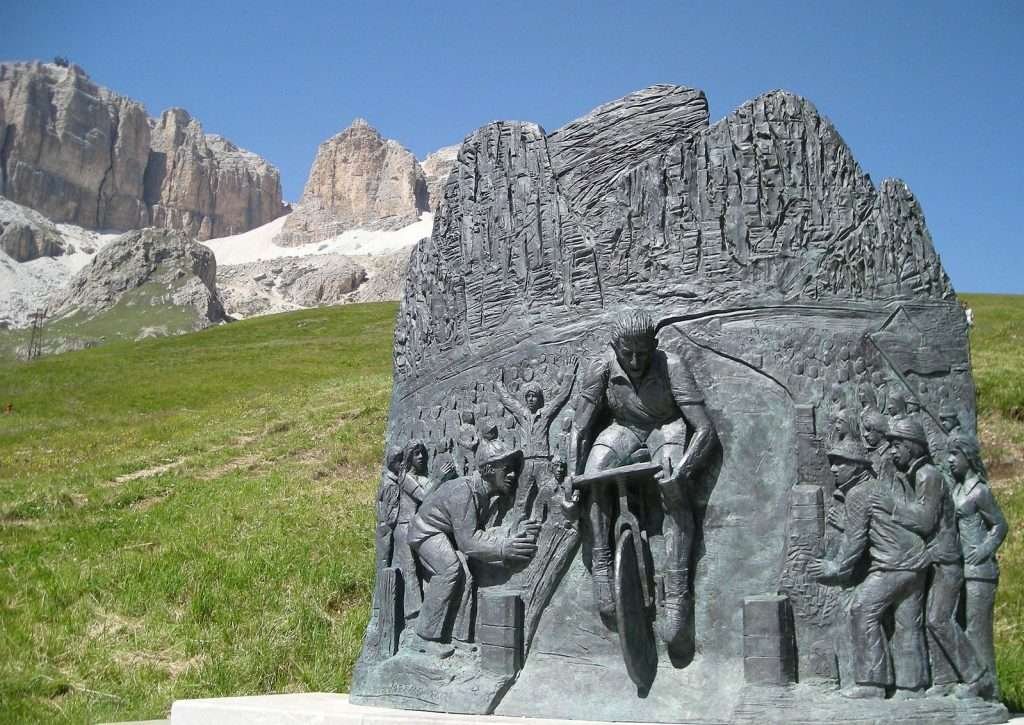
On the pass stands a bronze statue of Fausto Coppi, the cyclist who won the Giro d’Italia five times. It was unveiled in July 2000, with his daughter Marina and three of his teammates there: Ettore Milano, Franco Giacchero and Michele Gismondi. If you ride up, this is the photo to take.
A little further on, since 2011, there is a second cycling monument: the bike Gilberto Simoni rode into the Verona Arena at the end of his last Giro, in 2010, set on a block of rock and metal.
Passo Pordoi and the Giro d’Italia
The Giro first crossed the Pordoi in 1940, with a young Coppi in the pink jersey. Since 1965 the race has awarded the Cima Coppi to the first rider over its highest point: the Pordoi has held that title 14 times, most recently in 2022. In 2021 it was on the route again, but bad weather forced organisers to cut the climb and the Cima Coppi moved to Passo Giau. The pass has also hosted four stage finishes: 1990, 1991, 1996 and 2001.
The German war memorial
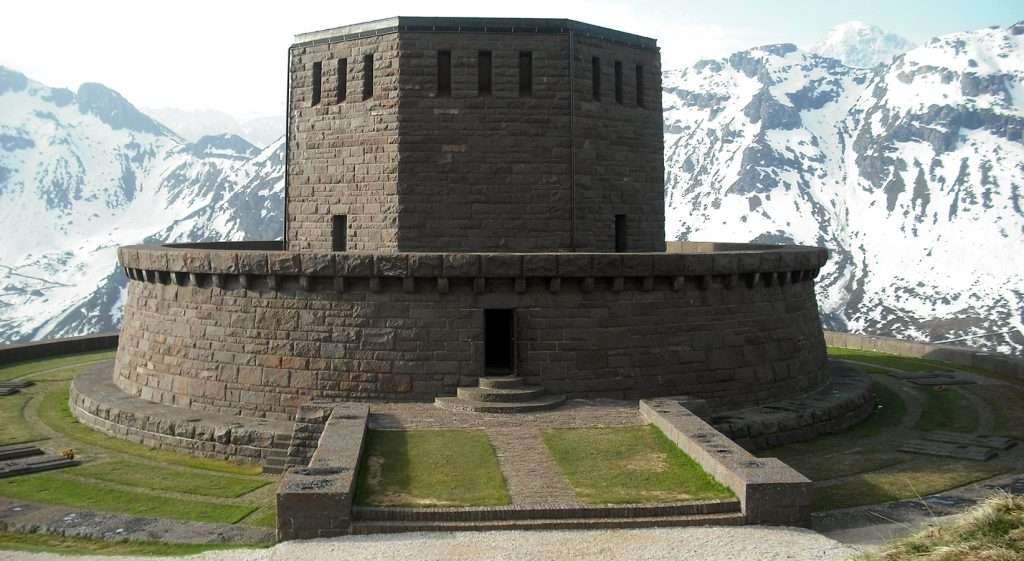
On the Veneto side of the pass is the German war memorial (Sacrario militare germanico), run by the German War Graves Commission (Volksbund). It is a circular stone building on three levels, with an outer wall about 54 metres across and an octagonal crypt in the centre.
Despite what you often read, most of the dead are from the First World War: the crypt holds 8,582 Austro-Hungarian and German soldiers from the Dolomites front. Another 849 soldiers from the Second World War are buried in the ground around it. Work began in 1937 and the memorial was dedicated on 19 September 1959. It opens in the summer months; out of season the inner hall is closed.
The Marmolada from the Viel del Pan
The best view of the Marmolada is from the Viel del Pan, the old “bread path” that runs almost level along the ridge facing the glacier. An hour or two of walking puts the north face of the Marmolada and Lake Fedaia below you. Details are in the hiking section.
Sass Pordoi cable car: times and prices

The cable car leaves from Passo Pordoi, not from Canazei. The valley station is on the pass at 2,239 metres. A single span carries the 65-person cabin to 2,950 metres: about 700 metres of height gain in a few minutes. The lift has run since the 1960s and is owned by a Canazei company.
Opening times
In 2026 the cable car opened on 14 May and closes on 1 November. Hours are 9:00–17:00 until 18 October and 9:00–16:30 from 19 October. In winter it runs with the ski season, December to April: in 2025/26 from 22 December to 7 April. Dates for winter 2026/27 had not been published when we wrote this guide.
Prices
According to the summer price list of the Val di Fassa tourist board, an adult pays 18 euros one way and 32 euros return. Juniors pay 10.50 and 19 euros. From Canazei or Alba there is a day ticket covering Belvedere, Col Rodella and Sass Pordoi: 47 euros, 28 for juniors. The cable car is also included in the valley’s Panorama Pass. Dogs ride free and the lift is wheelchair accessible. Prices and dates change every year, so check with the Val di Fassa tourist board before you go.
Tip: go early. On fine days, clouds often build over the peaks by midday and the queue at the valley station grows, especially in August.
Hiking from Passo Pordoi
Times are approximate and come from route descriptions and local guides. Above 2,800 metres snow can linger into early summer: the best season is mid-June to late September.
Viel del Pan (easy)
From the pass take path 601 heading east. It is almost flat, above 2,400 metres, with the Marmolada in front of you the whole way. In about 2 hours you reach the Rifugio Viel del Pan; if you like, carry on down to Lake Fedaia. It suits everyone, families included, but there is no shade: bring water and a hat.
Piz Boè from Sass Pordoi (demanding)
This is the classic Pordoi hike. Ride the cable car to Sass Pordoi, drop down path 627A to Forcella Pordoi (2,829 m), then follow 627 towards Rifugio Boè. Just before the hut, a junction to the right, path 638, leads to the summit of Piz Boè (3,152 m), where the Capanna Fassa hut stands. Allow about an hour and a half from the cable car to the top.
The final climb has a few short rocky steps with fixed cables. It is not a via ferrata, but you need a sure foot and a head for heights. The full loop, back via Rifugio Boè, Forcella Pordoi and the climb to Sass Pordoi, takes about 3 hours 15 minutes, with around 550 metres of ascent. Check the time of the last cable car down before you set off.
From Passo Pordoi to Sass Pordoi on foot (hard)
If you’d rather skip the cable car, path 627 climbs the steep gully above the pass to Forcella Pordoi. It is a tiring scree slope: allow about 2 extra hours of ascent. Going down, it is the bad-weather escape route, but early-season snow can make it dangerous.
Passo Pordoi by bike and motorbike
The Pordoi is a steady climb with no long steep ramps, which is why amateur riders love it too.
From Canazei
About 12.8 km with around 800 metres of climbing and an average gradient of about 6%. Halfway up you pass the turn-off for Passo Sella. At the cable car valley station there is an e-bike charging point and a small repair kit.
From Arabba
The Veneto side is shorter and a little steeper: 9.4 km, 637 metres, 6.8% average. This is the side riders of the Maratona dles Dolomites tackle as the second pass of the route.
When to ride and car-free days
The Val di Fassa tourist board recommends late April to late June, or September to late October: in July and August traffic from cars, motorbikes and coaches is heavy. On some days the road is closed to motor vehicles. In 2027 Sellaronda Bike Day falls on 5 June and 11 September: the four passes around the Sella, Pordoi included, are reserved for bikes from 9:00 to 16:00. The Maratona dles Dolomites, which crosses the Pordoi, is on Sunday 4 July 2027.
On a motorbike, the Pordoi is part of the Dolomites passes loop with Passo Gardena, Sella and Campolongo.
Skiing at Passo Pordoi

Passo Pordoi is not a resort in its own right but a hub of the Sellaronda, the circuit of about 40 km around the Sella massif, half of it on pistes. From the pass you ski down to Arabba on one side and to the Belvedere above Canazei on the other. Follow orange signs clockwise and green signs anticlockwise.
On the Trentino side you are in the Belvedere–Col Rodella ski area: 31 km of runs and 23 lifts, open from 4 December 2026 to 4 April 2027. On the Veneto side is the Arabba ski area, with long, technical runs and the link towards the Marmolada.
The Dolomiti Superski pass covers 1,200 km of pistes in 12 ski areas. For the 2026/27 season an adult day pass in high season costs 89 euros and a 6-day pass 453 euros; buy online at least two days ahead and you save 5%.
In winter the Sass Pordoi cable car also takes expert skiers up to off-piste descents that are neither groomed nor patrolled. Avalanche risk is real: go only with a mountain guide and full avalanche safety kit.
When to visit Passo Pordoi
The road is open all year. There is no fixed winter closure, but the pass is shut when heavy snow falls or avalanche danger is high, sometimes only on the Belluno side. In winter carry snow tyres or chains and check the Trentino and Veneto road reports.
For the cable car and hiking, mid-June to late September is best. July and August are the busiest months; in September and early October there are fewer people and clearer air. From December to April you can ski.
Tolls and access limits: in 2026 there is no toll and no limited-traffic zone on the Pordoi. A plan to restrict traffic on the Sella passes, discussed since 2022, has been postponed. For 2027 the province of Bolzano is studying a summer limited-traffic zone on Passo Gardena, which could push more traffic onto the Sella and Pordoi. Final rules have not been published, so check before you travel.
Day trips from Passo Pordoi
- Canazei and the Val di Fassa: the nearest village, about 12 km away, with lifts, shops and the cycle path along the Avisio. The whole valley is in our Val di Fassa guide.
- Arabba: just over 9 km down the Veneto side, a base for skiing and the Marmolada.
- Passo Sella: 5.5 km of road from the turn-off halfway down to Canazei, for the Sassolungo and Val Gardena.
- Passo Gardena: beyond the Sella, towards Alta Badia and Val Gardena.
- Lake Fedaia and the Marmolada: on foot along the Viel del Pan, or by car via Canazei and Penia.
- Moena: further down the Val di Fassa, gateway to Passo San Pellegrino.
- Passo Falzarego and Cortina d’Ampezzo: down to Arabba and over the Falzarego.
Where to stay near Passo Pordoi

On the pass a few hotels and mountain huts have rooms, handy for sunrise, the first cable car or the Sellaronda. Otherwise choose one of four areas.
- Canazei: the most complete base, with hotels in every category, apartments, shops and the summer bus to the pass. Ideal for families, Belvedere skiers and anyone without a car.
- Campitello and Alba: just below and just above Canazei, a little quieter, with direct cable cars to Col Rodella and Col dei Rossi.
- Arabba: a small village at the foot of the Veneto side, for strong skiers and anyone who wants to start the Sellaronda in either direction from the door.
- Alta Badia: Corvara and San Cassiano, beyond Passo Campolongo, for more choice and a good base for the four passes. Higher prices in peak season.
How to get to Passo Pordoi
By car
From the Brenner Pass and Bolzano, leave the A22 at Bolzano Nord and drive up the Val d’Ega and over Passo Costalunga to the Val di Fassa, or exit at Egna-Ora and go through the Val di Fiemme. From Canazei take the SS48 to the Pordoi: about 12 km. From the Veneto you come via Agordo and Caprile to Arabba, then 9 km of climbing. From Cortina, cross Passo Falzarego down to Arabba and climb the Pordoi. If you hire a car at Venice or Verona airport, allow for mountain driving on the last stretch.
By train
There is no railway at the pass. The nearest stations are Bolzano, Ora and Trento on the Brenner line. From there continue by bus to Canazei. On summer weekends the FrecciaLink bus links Ora station with the Val di Fassa.
By bus
In summer two lines serve the pass. Trentino Trasporti bus B130 runs Canazei – Passo Pordoi: in 2026 from 27 June to 9 September, with frequent departures from the morning and a journey of about half an hour. Line 472 of altoadigemobilità links the Pordoi/Sella turn-off, the pass, Arabba and Corvara, in 2026 from 7 June to 11 October. Timetables for 2027 are not out yet; in winter there is no confirmed direct line.
By air
The nearest airport is Bolzano, about 40 km from the Val di Fassa. Then come Treviso (160 km), Venice (175 km) and Verona (180 km), plus Bergamo and Milan. Add about 12 km from Canazei to the pass. Innsbruck and Munich are also options, with the drive over the Brenner.
Parking
There are car parks near the cable car and along the road, plus the one at the war memorial. In peak season parking is usually paid and rates change, so check on site. On fine summer days, arrive before 9:00 or take the bus from Canazei.
Frequently asked questions about Passo Pordoi
How high is Passo Pordoi?
Passo Pordoi is at 2,239 metres. The cable car goes up to 2,950 metres on Sass Pordoi.
Where is Passo Pordoi?
In the Dolomites, between the Sella group and the Marmolada, on the border between Trentino (Canazei, Val di Fassa) and the Veneto (Arabba, province of Belluno).
How far is Passo Pordoi from Canazei?
About 12 km on the SS48. In summer the bus from Canazei takes around half an hour.
Where does the Sass Pordoi cable car start?
On Passo Pordoi itself, at 2,239 metres. There is no cable car from Canazei to the pass: you get there by car or bus.
How much is the Sass Pordoi cable car?
According to the Val di Fassa tourist board’s summer price list, 32 euros return and 18 euros one way for an adult. Always check current prices before you go.
When is the Sass Pordoi cable car open?
In 2026 from 14 May to 1 November, 9:00 to 17:00 (16:30 from mid-October). In winter it follows the ski season, December to April.
Can you walk up to Sass Pordoi?
Yes, on path 627 up the gully to Forcella Pordoi: about 2 hours on steep scree, for fit hikers only.
Is Passo Pordoi open in winter?
Yes, the road is open all year, but it can close for a few hours or days during heavy snowfall or avalanche danger.
Is there a toll on Passo Pordoi?
No. In 2026 there is no toll or limited-traffic zone on the Pordoi. The road only closes on certain days for cycling events such as Sellaronda Bike Day.
Who is buried at the German war memorial on Passo Pordoi?
Mainly First World War soldiers: 8,582 Austro-Hungarians and Germans, plus 849 soldiers from the Second World War.
Weather: Passo Pordoi
Photos: Passo Pordoi


