


 Français
 Deutsch
 Italiano
ACCOMMODATIONS IN SESTO
Discover the best Hotels, BBs and Apartments in Mountain based on thousands of verified reviews.
Altitude1,310 m
WhereAlta Pusteria, South Tyrol, Italy
From Innsbruck airportabout 130 km
3 Zinnen slopesabout 115 km · 30+ lifts
Dolomiti Superski€89 day pass, high season 2026/27
Summer lifts 202623 May – 8 Nov
Updated October 2026 · Sources: 3 Zinnen Dolomites, Dolomiti Superski, IDM South Tyrol, Sexten Tourism Association, Province of Bolzano
Sesto (Sexten in German), also called Sesto Pusteria, is a village in South Tyrol, the German-speaking province of Bolzano in northern Italy, in the Alta Pusteria (Upper Puster Valley). The centre sits at 1,310 metres in the Val di Sesto, a side valley that branches off the Puster Valley at San Candido, about 7 km away. It is the easternmost municipality in South Tyrol: Austria lies to the north-east, the Veneto region and the Comelico to the south-east. About 1,800 people live here, nine out of ten of them German speakers.
The municipality has two centres: San Vito (St. Veit), the village itself, and Moso (Moos), a couple of kilometres up the valley at the entrance to the Val Fiscalina. To the south rise the Sesto Dolomites, mostly inside the Tre Cime Nature Park, with the Sesto Sundial and, behind it, the Tre Cime di Lavaredo. The Dolomites have been a UNESCO World Heritage Site since 2009.
The nearest international airports are Innsbruck (about 130 km), Treviso (about 170 km) and Venice (about 190 km). In winter two gondolas leave the village for Monte Elmo and Croda Rossa, part of the 3 Zinnen Dolomites ski area: about 115 km of slopes, included in the Dolomiti Superski pass. In summer Sesto is one of the best bases for hiking to the Tre Cime from the South Tyrolean side, without the toll road from Misurina.
What to see in Sesto
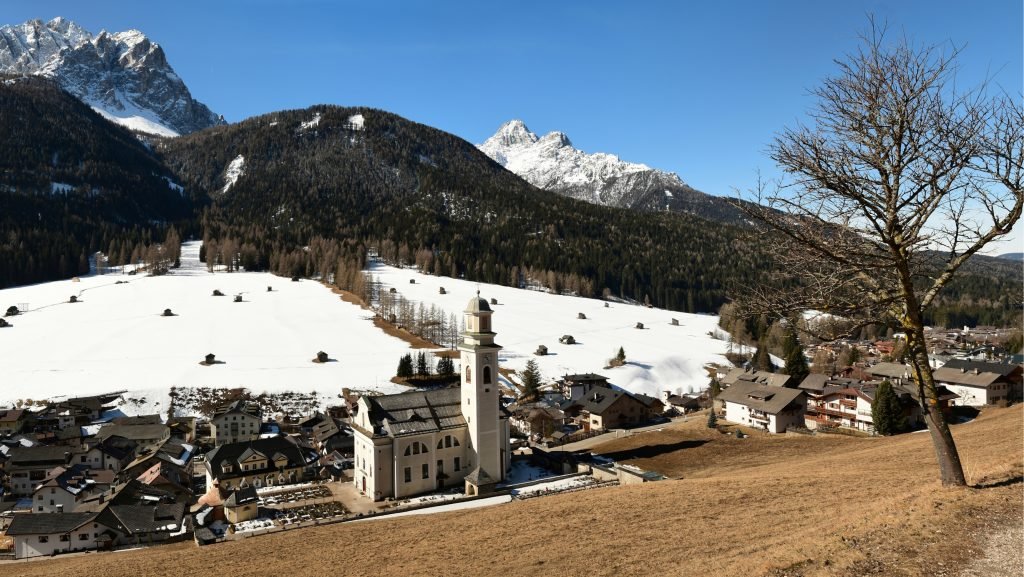
You can walk around the village in an hour. The real sights are around it: the peaks of the Sundial, the Val Fiscalina, the two lift-served mountains and the remains of the First World War, whose front line ran right above the houses.
The village: church, Dance of Death and Rudolf Stolz Museum
In 1915 Sesto was on the front line: in August San Vito was destroyed, and residents only returned in 1917. The village you see today is almost entirely rebuilt. In the middle stands the parish church of Saints Peter and Paul, with a ceiling and Stations of the Cross painted by Albert Stolz.
Next to it, at the cemetery entrance, a small rotunda holds the Dance of Death by Rudolf Stolz, Albert’s brother: death takes away people of every age and rank. Several Sesto mountaineers are buried here, including the guide Sepp Innerkofler. On Via Dolomiti the Rudolf Stolz Museum shows the painter’s drawings, watercolours and sketches; it opens in summer.
The Sesto Sundial

The Sesto Sundial (Sextner Sonnenuhr) is a clock made of mountains. Looking south from Sesto and Moso you see five peaks named after hours: Cima Nove (nine), Cima Dieci (ten, the Croda Rossa di Sesto), Cima Undici (eleven), Cima Dodici (twelve, Croda dei Toni) and Cima Una (one). Around 9 am the sun stands over Cima Nove, at noon over Cima Dodici, and around 1 pm over Cima Una.
The names come from the hours of the day, not from Roman numerals. The two highest peaks, Undici and Dodici, top 3,000 metres. The Sundial is a protected natural monument in the Tre Cime Nature Park; the best viewpoint is Moso, at the mouth of the Val Fiscalina.
Moso and the Val Fiscalina

From Moso the Val Fiscalina (Fischleintal), Sesto’s best-known valley, runs south to the walls of the Sundial and to Cima Tre Scarperi, the highest peak in the municipality (3,145 m). From the Fischleinboden car park an almost flat road takes you to the Rifugio Fondovalle (1,548 m) in 40–45 minutes: an easy walk, even with a pushchair.
From the Fondovalle, trails climb to the Zsigmondy-Comici and Locatelli huts, towards the Tre Cime. In winter the valley is closed to cars: you go in on foot, on snowshoes or on cross-country skis.
Tre Cime di Lavaredo and Rifugio Locatelli
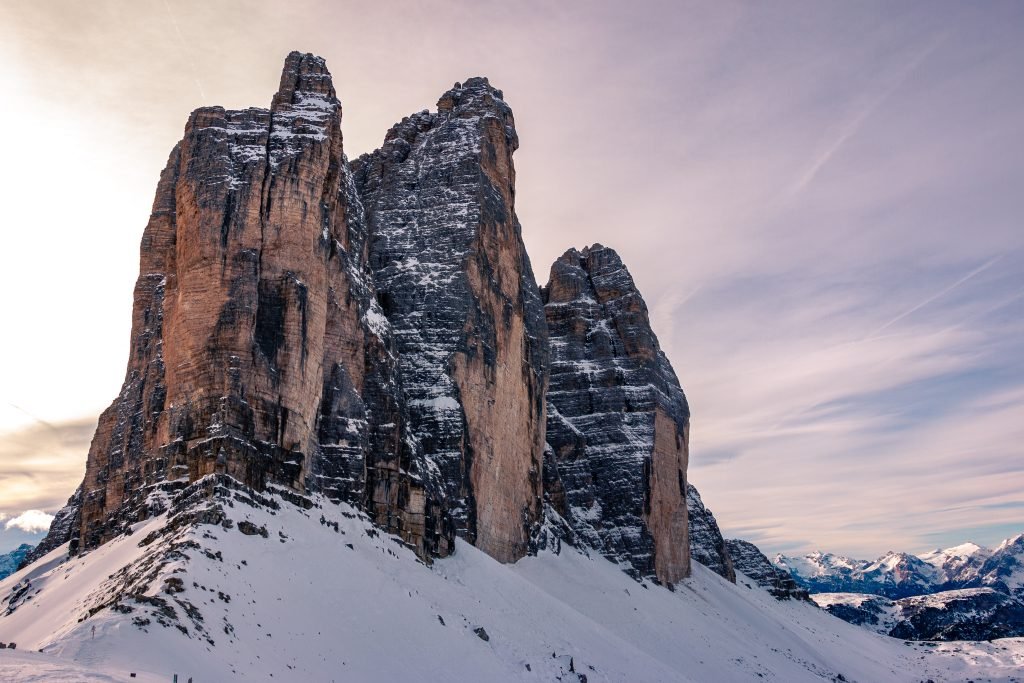
The Tre Cime stand on the border between South Tyrol and the Veneto; the highest, Cima Grande, is 2,999 metres. From Sesto the classic approach is on foot up the Val Fiscalina to the Rifugio Locatelli – Dreizinnenhütte (2,405 m), right in front of the north faces. Next to it rises Monte Paterno, where Sepp Innerkofler died in 1915.
On the other side, a toll road climbs from Misurina to the Rifugio Auronzo: since 2025 cars can only enter with an online booking. From Sesto, either hike up or drive to Dobbiaco and take the shuttle bus.
Monte Elmo and Reinhold Messner Haus
Monte Elmo (Helm, 2,433 m) is the rounded mountain above the village, on the Austrian border. You go up on the Helmjet 10-seat gondola, which starts between Sesto and Moso and replaced the old 1981 cable car in 2020, or from Versciaco, above San Candido. At the top start the border trails, including the Carnic High Trail, more than 100 km long, heading east.
In the former top station, at about 2,050 metres, the Reinhold Messner Haus opened in June 2025: not a classic museum but themed rooms with personal items of Reinhold and Diane Messner, plus summer events. It opens with the summer lifts.
Croda Rossa and the WWI open-air museum
From Moso a gondola climbs to the Croda Rossa meadows (Rotwandwiesen), at just over 1,900 metres. This is the most family-friendly area, summer and winter.
From the top station, a walk of about 45 minutes on trail 100 leads to the open-air museum on the Alpe Anderter: positions, trenches and tunnels from the mountain war, restored by the Bellum Aquilarum association. There are no information boards on site because of nature park rules, so buy the historical guide in the village. It is open from mid-June to October, snow permitting. In summer the same association runs the exhibition “Traces of History” on 1914–1918 in the old primary school in the village.
Passo Monte Croce
Above Moso the road climbs to Passo Monte Croce (Kreuzbergpass, 1,636 m), which links Sesto with the Comelico in the province of Belluno. It is open all year. In winter it is part of the ski area and has a scenic cross-country loop; in summer you can walk up from Sesto in 2–3 hours, with about 300 metres of ascent.
Skiing in Sesto

Sesto is part of the 3 Zinnen Dolomites ski area (Tre Cime Dolomiti): about 115 km of slopes and more than 30 lifts on five mountains, namely Monte Elmo, Croda Rossa, Passo Monte Croce, Monte Baranci in San Candido and the Ski Area Val Comelico in the Veneto. Most runs are blue and red, with a few blacks; the top lifts reach about 2,200 metres.
Monte Elmo and Croda Rossa from Sesto
Sesto has two lift bases. The Helmjet takes you up Monte Elmo, with wide easy-to-intermediate runs on the west side. The gondola from Moso goes to the Croda Rossa meadows, with family slopes and a more demanding run back to the valley. The two areas are linked via Orto del Toro (Stiergarten) with chairlifts and runs, and from Croda Rossa you continue to Passo Monte Croce and the Comelico.
For winter 2026/27 the new 10-seat Helmissimo gondola opens at Versciaco, the other gateway to Monte Elmo. The Ski Pustertal Express train links the area with Plan de Corones (Kronplatz) near Brunico. The season usually runs from late November or early December to Easter, snow permitting: dates and open runs on the 3 Zinnen Dolomites website.
Ski pass 2026/27
The area is part of Dolomiti Superski, about 1,200 km of slopes on one pass. For the 2026/27 season the adult Dolomiti Superski day pass costs €89 in high season and the 6-day pass €453; new this year, the Dolomiti Superski Family pass can be bought online. There is also a cheaper local 3 Zinnen Dolomites pass: 2026/27 prices are in the app and on the lift company’s website. Full price list on the Dolomiti Superski website.
Cross-country, snowshoeing and ski schools
The Tre Cime region has about 200 km of groomed cross-country trails. In Sesto the best loops are in the Val Fiscalina, easy and good for beginners, and at Passo Monte Croce, with wider views. On snowshoes, head into the Val Fiscalina or across the Croda Rossa meadows. The village has ski schools, rental shops, toboggan runs and a large indoor climbing centre for bad-weather days.
Summer in Sesto
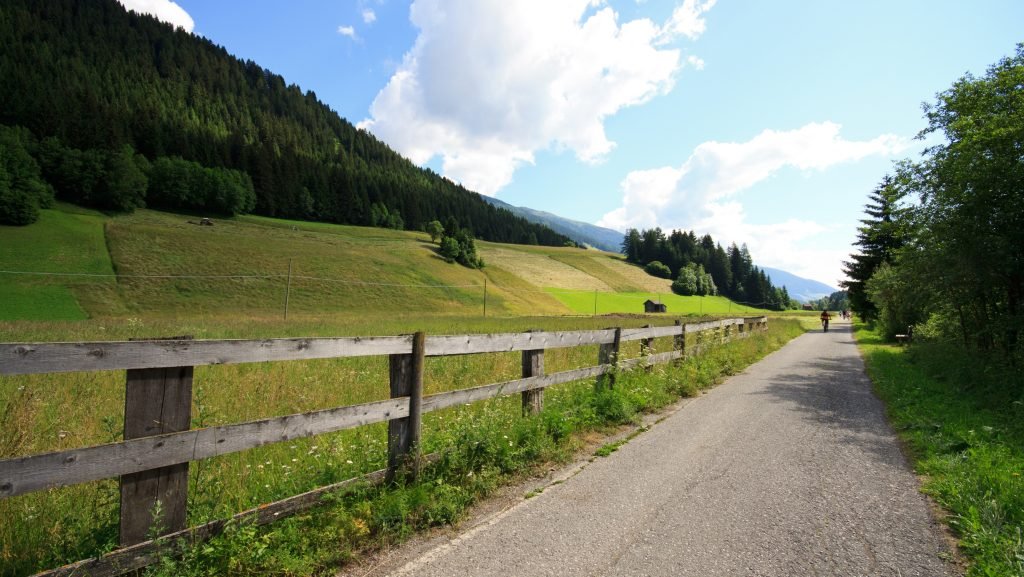
In summer the lifts on Monte Elmo, Orto del Toro and Croda Rossa run from late May to early November (in 2026, 23 May to 8 November). Ride up, walk at altitude and ride back down. The high mountain huts open later, usually from late June to late September.
Hiking to the Tre Cime from the Val Fiscalina

This is Sesto’s signature hike. From the Fischleinboden car park walk to the Rifugio Fondovalle, then climb trail 102 through the Val Sasso Vecchio to the Rifugio Locatelli (2,405 m). It’s about 950 metres of ascent: allow 3.5 to 4 hours up. The hut opens only in summer and is usually full, so book well ahead if you want to stay overnight.
Fit hikers can do the hut loop: Fondovalle, Zsigmondy-Comici, Pian di Cengia, Locatelli and back down the Val Sasso Vecchio. About 18 km, 1,200 metres of ascent and 7 hours of walking: a long, demanding day, from June to mid-October.
Easy walks
- Rifugio Fondovalle: from Fischleinboden, 40–45 minutes on an almost flat road, fine for everyone.
- Croda Rossa meadows: gondola from Moso, then flat loops facing the Sundial; you can walk down towards Passo Monte Croce.
- Monte Elmo: up by gondola, then trails along the border with views of the Sesto Dolomites and the Austrian Alps.
- Sesto – Passo Monte Croce: about 7 km and 300 metres of ascent, 2–3 hours; back by bus.
Via ferratas and climbing
The Sesto Dolomites have been classic climbing terrain since the late 19th century: local guides such as Sepp Innerkofler opened many routes on the Tre Cime and nearby peaks. Today there are via ferratas on Monte Paterno and the Croda Rossa di Sesto, often along WWI paths: you need experience, a via ferrata kit and a helmet. For a first time, hire a mountain guide.
Cycling
From Sesto roll down to San Candido and follow the Puster Valley cycle path towards Dobbiaco and Brunico, or the Drava cycle path to Lienz in Austria. Bikes are not carried on local public transport, so plan to ride back or rent locally. Mountain bikers use the forest roads towards Passo Monte Croce and Monte Elmo.
What to eat in Sesto
Expect South Tyrolean mountain food: dumplings (canederli or Knödel), speck, Schlutzkrapfen (half-moon ravioli), alpine cheeses and apple strudel. Sesto even has its own mountain cheese, recognised as a traditional product. Mountain huts serve simple dishes in generous portions.
Day trips from Sesto

- San Candido (about 7 km): the town at the valley mouth, with its Romanesque collegiate church, the railway station and Monte Baranci.
- Dobbiaco (about 12 km): Lake Dobbiaco, the Tre Cime Nature Park visitor centre and the shuttle buses to the Tre Cime.
- Lago di Braies (about 30 km): South Tyrol’s most photographed lake. In summer, during the middle of the day, cars can only enter the valley with a booking.
- Lago di Misurina (about 35 km, via the Val di Landro): in the Veneto, start of the toll road to the Rifugio Auronzo and of Monte Piana, with its WWI open-air museum.
- Brunico (about 40 km): the Puster Valley’s main town, with its castle and Plan de Corones.
- Lienz (about 45 km): the capital of East Tyrol, in Austria, also reachable by train from San Candido.
- Cortina d’Ampezzo (about 45 km): through the Val di Landro, past Carbonin.
Where to stay in Sesto
Sesto is small and everything is close, but where you stay shapes your day. Choose by what you plan to do.
- San Vito, the centre: easiest without a car, with shops, restaurants and the bus stop for San Candido. A few minutes from the Helmjet. Hotels, guesthouses and apartments.
- Moso: for hikers and Croda Rossa skiers. You are at the gondola and at the mouth of the Val Fiscalina, with the Sundial in front of you.
- Towards Passo Monte Croce: a few isolated places to stay, for peace and quiet and cross-country skiing from the door. You need a car or the bus.
- San Candido: an alternative if you travel by train or on a tighter budget, with more choice and the station in town; Sesto is a few minutes away by bus.
For a family week, an apartment or a farm stay works best; for a weekend, a hotel in the centre. Book early for Christmas, February, July and August.
How to get to Sesto
By car
From the Brenner motorway (A22, toll), leave at Bressanone/Varna – Val Pusteria and follow the SS49 for about 60 km through the Puster Valley to San Candido, then turn off for Sesto. From Austria you can come via Lienz in East Tyrol; from southern Germany also via the Felbertauern road. From Venice, drive north through the Cadore to Cortina and the Val di Landro. Austrian motorways need a vignette. Carry winter tyres or snow chains in winter.
By train
Trains on the Brenner line (Trenitalia, ÖBB, DB) stop at Fortezza/Franzensfeste. From there the Puster Valley regional train runs to San Candido, stopping at Villabassa and Dobbiaco. There is also a train from Lienz in Austria to San Candido. In San Candido change to the bus for Sesto. Timetables on südtirolmobil.
By bus
Line 446 Dobbiaco – San Candido – Sesto – Passo Monte Croce runs all year, hourly, and every half hour in high season. In summer a local bus links Sesto with the Val Fiscalina and Passo Monte Croce. Bikes are not carried on local buses. With the Mobilcard or a guest card you can use public transport across South Tyrol.
By plane
The nearest airport is Bolzano (about 100 km), with few flights. The handiest international airports are Innsbruck (about 130 km), Treviso (about 170 km) and Venice (about 190 km); Verona (about 250 km), Munich and Bergamo (about 330 km) are further away. Cortina Express coaches run from Venice and Treviso; shared transfers from Bolzano, Innsbruck, Verona and Munich can be booked in advance.
Parking
For skiing, use the car parks at the Helmjet base and at the Croda Rossa gondola in Moso. In the Val Fiscalina the Fischleinboden car park charges a fee and fills up early in summer: in peak weeks take the bus. For the Tre Cime via Misurina, the Rifugio Auronzo car park is booked online together with the toll.
Frequently asked questions about Sesto
Where is Sesto, Italy?
In South Tyrol (province of Bolzano), in the Alta Pusteria, about 7 km from San Candido, close to the borders with Austria and the Veneto.
Are Sesto and Sexten the same place?
Yes. Sesto is the Italian name, Sexten the German one, used by most locals.
What is the altitude of Sesto?
The centre is at 1,310 metres. Passo Monte Croce is at 1,636 metres and Monte Elmo at 2,433.
What is the Sesto Sundial?
Five peaks (Nove, Dieci, Undici, Dodici and Una) that, seen from Sesto and Moso, mark the hours: at noon the sun stands over Cima Dodici.
How do you get to the Tre Cime from Sesto?
On foot up the Val Fiscalina to the Rifugio Locatelli: about 950 metres of ascent and 3.5 to 4 hours up. By car via Misurina, on the toll road with advance booking.
How many km of slopes are there in Sesto?
The 3 Zinnen Dolomites area, which includes Monte Elmo and Croda Rossa, has about 115 km of slopes and more than 30 lifts.
How much is a ski pass?
In 2026/27 the adult Dolomiti Superski day pass costs €89 in high season. The local 3 Zinnen pass is cheaper; prices on the lift company’s website.
Can you get to Sesto by train?
To San Candido, on the Puster Valley train from Fortezza or Lienz; then bus 446 to Sesto.
What to do in Sesto when it rains?
The Rudolf Stolz Museum and the WWI exhibition (in summer), the church and the cemetery with the Dance of Death, and the indoor climbing centre. Check opening times before you go.
Weather in Sesto
Photos of Sesto


