


 Français
 Deutsch
 Italiano
ACCOMMODATION IN ALTA PUSTERIA
Discover the best Hotels, B&Bs and Apartments in the Mountains based on thousands of verified reviews.
AltitudeVillabassa 1,158 m · Sesto 1,310 m
WhereSouth Tyrol (Bolzano), eastern Val Pusteria
From Bolzanoabout 105 km (Dobbiaco)
Slopes3 Zinnen Dolomites about 115 km · cross-country about 200 km
Dolomiti Superski pass89 € per day (high season 2026/27)
Summer lifts 202623 May – 8 November
Updated October 2026 · Sources: 3 Zinnen Dolomites, Dolomiti Superski, Braies valley, Province of Bolzano, Südtirolmobil, IDM South Tyrol, Wikipedia
Find a place to stay in Alta Pusteria
Alta Pusteria (Hochpustertal in German, sometimes called the Upper Puster Valley) is the eastern end of the Val Pusteria in South Tyrol, province of Bolzano, on the border with Austria and the Veneto. On the Italian side it covers five municipalities: Villabassa, Braies, Dobbiaco, San Candido and Sesto, about 11,000 people in all, nearly all German-speaking. Most places have two names: Dobbiaco is Toblach, San Candido is Innichen, Sesto is Sexten. In Austria the name also covers the stretch from Sillian to Lienz.
The villages sit between 1,158 m (Villabassa) and 1,310 m (Sesto). The watershed runs across the Toblach plain: the Rienza flows west to the Adige and the Adriatic, while the Drava rises here and flows east to the Danube and the Black Sea. From the Bressanone/Varna – Val Pusteria exit of the Brenner motorway to Dobbiaco it is about 59 km. Bolzano is about 105 km away, Innsbruck about 135 km, Venice about 180 km, Cortina d’Ampezzo about 33 km.
You come for the Sesto and Braies Dolomites, a UNESCO World Heritage Site: the Three Peaks (Tre Cime di Lavaredo), Lake Braies, the Val Fiscalina, Prato Piazza. In winter you ski in the 3 Zinnen Dolomites area (about 115 km of slopes, part of Dolomiti Superski) and cross-country ski on about 200 km of trails. In summer you hike in the Tre Cime and Fanes-Senes-Braies nature parks and cycle along the Drava to Lienz.
What to see in Alta Pusteria
The most famous spots have access rules in summer: check them before you set off.
The Three Peaks (Tre Cime di Lavaredo)
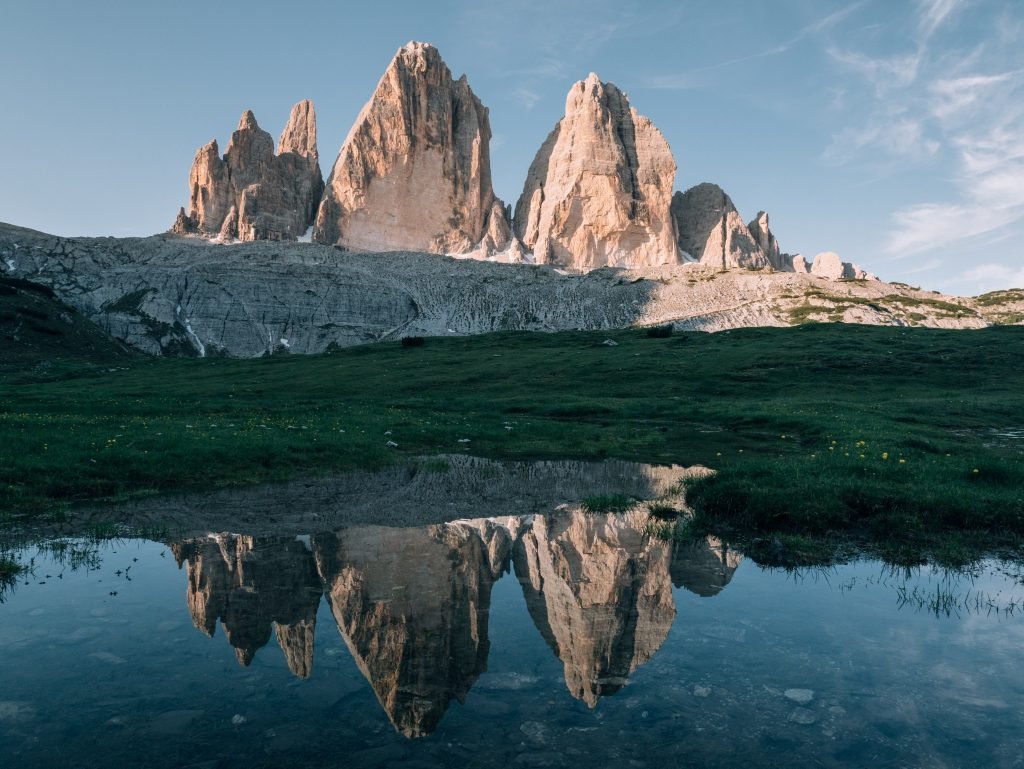
The Tre Cime di Lavaredo (Drei Zinnen) are the icon of the Sesto Dolomites: Cima Grande 2,999 m, Cima Ovest 2,973 m, Cima Piccola 2,857 m. The ridge marks the border between South Tyrol and the Veneto: the famous north faces look towards Alta Pusteria, the south faces towards the Auronzo hut in Auronzo di Cadore.
From Alta Pusteria you see them in three ways: from the Drei Zinnen Blick viewpoint in the Val di Landro, about 8 km from Dobbiaco; on foot up to the Locatelli hut via the Val Fiscalina or the Val Rienza; or on the summer bus from Dobbiaco to the Auronzo hut, the start of the Three Peaks loop.
Lake Braies

Lake Braies (Pragser Wildsee) lies at 1,494 m below the Croda del Becco (2,810 m), in the Fanes-Senes-Braies Nature Park. The walk around the lake is 3.6 km: about an hour, easy, flat on the west shore, with steps on the east shore.
In summer it is one of the busiest places in the Dolomites. In 2026, from 1 July to 15 September between 9am and 4pm, the valley could only be reached by car with an online booking; buses 442 (from Dobbiaco and Villabassa) and 439 (from Monguelfo) had to be booked and paid online. The 2027 rules will be published in spring on the valley’s official website.
Lake Dobbiaco and the Val di Landro
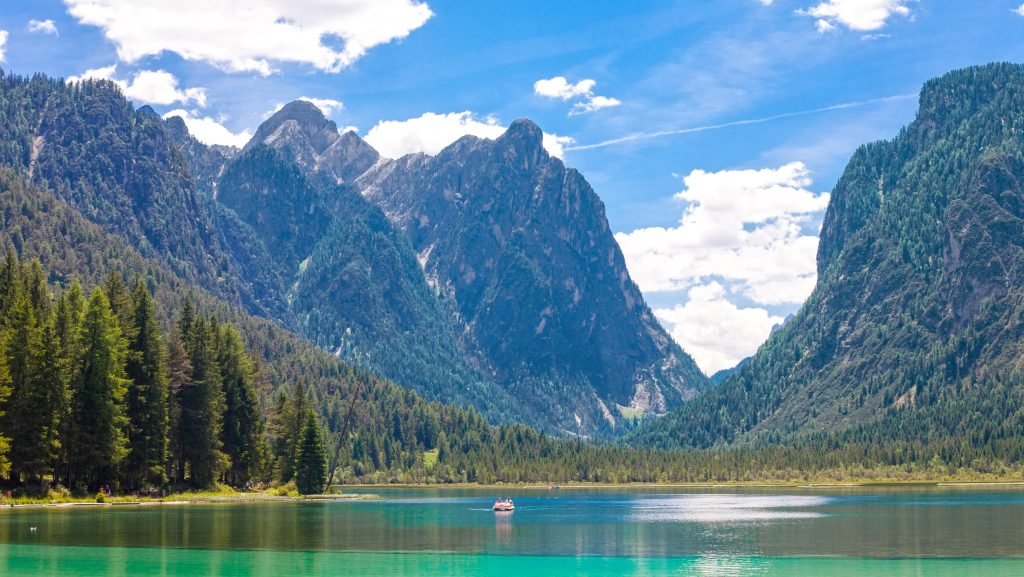
Lake Dobbiaco (1,259 m) is about 4 km from the village, at the start of the Val di Landro, the road to Cortina. A nature trail with 11 stations runs around it. From Dobbiaco there is an almost flat 7.9 km loop, fine for pushchairs. In summer you can rent rowing boats.
Further south: Lake Landro (1,406 m), with Monte Cristallo reflected in the water, the Drei Zinnen Blick and the Austro-Hungarian military cemetery of Nasswand, with more than 1,200 First World War dead.
Prato Piazza and Picco di Vallandro
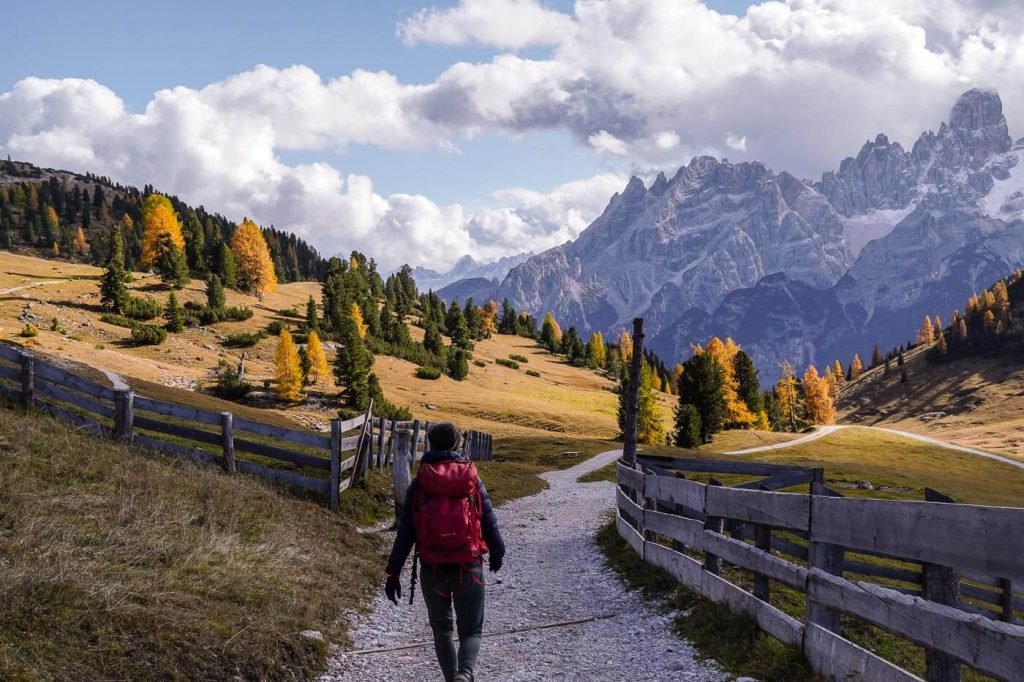
Prato Piazza (Plätzwiese) is a high plateau at about 2,000 m in the municipality of Braies, between Picco di Vallandro and Croda Rossa d’Ampezzo. The road starts at Ponticello in the Braies valley: it is a toll road with a cap on cars and restricted hours in high season. In 2026 bus 443 from Villabassa and Dobbiaco went up without booking, from June to early November.
From here you climb Picco di Vallandro (2,839 m): about 850 m of ascent, 3–4 hours up, with a short cable-protected section. In winter Prato Piazza has a 6 km cross-country loop.
Val Fiscalina and the Sesto Sundial

The Val Fiscalina starts at Moso, above Sesto. In about 40–45 minutes on an almost flat track you reach the Fondovalle hut (1,548 m), the starting point for the Locatelli hut.
Above the village is the Sesto Sundial: five peaks named Nine, Ten, Eleven, Twelve and One, over which, seen from Sesto, the sun stands at that hour of the day.
San Candido: the collegiate church

San Candido grew up around a monastery founded in 769. The collegiate church of Saints Candidus and Corbinian, consecrated in 1284, is one of the most important Romanesque churches in the Eastern Alps, with a 13th-century wooden Crucifixion group.
In the woods outside the village stand the ruins of the San Candido baths, a 19th-century spa, along an easy 3.3 km themed trail.
Dobbiaco and Gustav Mahler
Gustav Mahler spent the summers of 1908 to 1910 in Dobbiaco, where he wrote Das Lied von der Erde and the Ninth Symphony. His composing hut, just outside the village, can be visited in summer. Every summer, between July and early September, the Gustav Mahler Music Weeks take place in the former Grand Hotel of 1878, now a cultural centre and the visitor centre of the Tre Cime Nature Park.
Villabassa and the tourism museum
Villabassa (Niederdorf) is the first village of Alta Pusteria coming from the west. In the Wassermann house on the square, the Alta Pusteria tourism museum tells how the first summer visitors arrived after the railway opened in 1871. One room is devoted to Emma Hellenstainer, “Frau Emma”, the most famous innkeeper in Tyrol.
Two nature parks
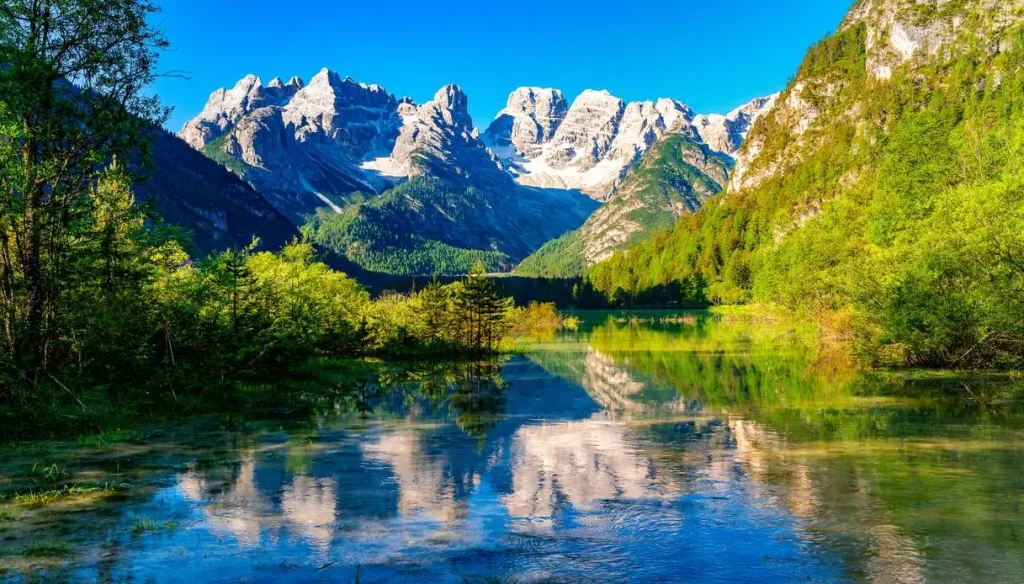
The Tre Cime Nature Park, created in 1981, covers about 11,890 hectares in Dobbiaco, Sesto and San Candido. To the west, above Braies and the Val di Landro, the Fanes-Senes-Braies Nature Park, created in 1980, reaches as far as the Val Badia.
The villages of Alta Pusteria
The five villages are close together and linked by train and bus. Choose by what you want to do.
San Candido
San Candido (Innichen, 1,175 m, about 3,300 people) is the liveliest village: pedestrian centre, shops, a Christmas market (opening 27 November 2026), and the end of the Val Pusteria railway. A chairlift goes up Monte Baranci, a small family ski area with night skiing; a few kilometres away, at Versciaco, the new gondola to Monte Elmo starts.
Best for: train travellers, families, anyone who wants a lively village in the evening. Read the San Candido guide.
Sesto
Sesto (Sexten, 1,310 m, about 1,800 people) is the highest and easternmost village, on the border with the Veneto and Austria. The Helmjet gondola to Monte Elmo leaves from the valley floor and the Croda Rossa gondola from Moso: skiing and hiking without a car. This is where you enter the Val Fiscalina.
Best for: skiers, hikers, anyone who wants the Sesto Dolomites on the doorstep. Read the Sesto guide.
Dobbiaco
Dobbiaco (Toblach, 1,256 m, about 3,500 people) is in the middle of everything: the road to Cortina and the buses to Lake Braies, Prato Piazza and the Three Peaks start here. It is the cross-country capital, with the Nordic Arena and World Cup races. Downhill skiing in the village is limited to a small children’s area; the main ski area is 6–9 km away.
Best for: cross-country skiers, travelling by bus to the big sights, music lovers. Read the Dobbiaco guide.
Villabassa
Villabassa (Niederdorf, 1,158 m, about 1,600 people) is the lowest village, at the mouth of the Braies valley. It has a station on the Val Pusteria line (Villabassa-Braies), bus 442 to the lake and bus 443 to Prato Piazza.
Best for: peace and quiet close to Braies, couples, smaller budgets.
Braies
Braies (Prags, about 690 people) is a municipality of scattered hamlets along the Braies valley, from about 1,200 m up to the lake at 1,494 m. In summer, during the road closure hours, guests staying in the valley get a transit permit from their accommodation.
Best for: silence, hikers, seeing the lake at sunrise without crowds.
Monguelfo and Valdaora
Monguelfo (Welsberg, about 1,087 m) and Valdaora (Olang), further west, are not part of tourist Alta Pusteria: they belong to the Plan de Corones (Kronplatz) area. From Monguelfo, bus 439 reaches Lake Braies in just over 20 minutes.
Skiing in Alta Pusteria

The ski area is 3 Zinnen Dolomites (Tre Cime Dolomiti): about 115 km of slopes and more than 30 lifts across five mountains. Monte Elmo (from Sesto and Versciaco), Croda Rossa (from Moso), Passo Monte Croce, Monte Baranci (San Candido) and, beyond the pass, the Val Comelico in the Veneto. Most runs are blue and red: good for intermediates and families.
New for winter 2026/27 is the Helmissimo 10-seater gondola from Versciaco to Monte Elmo, from 1,132 to 2,047 m, replacing the old one. The exact opening date has not been published yet. Monte Baranci is the family area, with wide runs, night skiing on some evenings and a toboggan run; in Dobbiaco the small Rienza area is for children and beginners.
Ski passes
The area is part of Dolomiti Superski. For 2026/27 an adult day pass in high season costs 89 euros, a 6-day pass 453 euros. There is also a local 3 Zinnen pass, but its 2026/27 prices are not yet published: compare on Dolomiti Superski and 3 Zinnen Dolomites. The season usually runs from early December to Easter, snow permitting.
For a change of scenery, the Ski Pustertal Express train links the area with Plan de Corones, above Brunico.
Cross-country, snowshoeing and tobogganing
Cross-country skiing is the big strength: about 200 km of groomed trails in the region, linking Villabassa, Dobbiaco, San Candido and Sesto, plus loops in the Val Fiscalina and at Prato Piazza. The Nordic Arena in Dobbiaco has loops from 5 to 10 km. The Granfondo Dobbiaco–Cortina takes place on 6 February 2027 in classic style (42 km) and on 7 February in skating (35 km).
On snowshoes you can walk on Monte Rota above Dobbiaco, around Lake Dobbiaco and up to the alpine pastures above Lake Braies. Walking on frozen Lake Braies is forbidden.
Summer in Alta Pusteria
In 2026 the 3 Zinnen summer lifts ran from 23 May to 8 November; mountain huts usually open from June to late September. Walking times exclude breaks.
The Three Peaks loop
From the Auronzo hut (2,333 m) the classic loop is about 9.5 km, about 400 m of ascent and 3–4 hours of walking, via Forcella Lavaredo and the Locatelli hut. You can drive to the Auronzo hut only on the toll road from Misurina with an online booking (40 euros per car in 2026), or take bus 444 from Dobbiaco, which also required booking in 2026.
On foot to the Locatelli hut
Without the toll road, you hike up from the South Tyrol side. Via the Val Fiscalina: about 950 m of ascent, 3.5–4 hours up. Via the Val Rienza from the Drei Zinnen Blick: about 8 km and nearly 1,000 m, about 3.5 hours. The hut (2,405 m) opens only in summer.
Hikes from Lake Braies
From the lake: Malga Foresta in one hour (+118 m), Malga Kaser (1,937 m) in an hour and a half (+555 m), Rifugio Sennes in just under 3.5 hours (+922 m). The lake is also the start of the Alta Via 1.
By bike: the Drava cycle path
The Drava cycle path runs from San Candido to Lienz: 44.8 km of tarmac, almost all gently downhill (from 1,175 to 655 m), suitable for families with young children. You return by train: in summer there are trains carrying bikes from Lienz to San Candido. Timetables and fares: Südtirolmobil.
From Dobbiaco another cycle path heads to Cortina on the line of the old Dolomites railway, closed in 1964, past Lake Landro and over Cimabanche. Bikes are not allowed on bus 444.
Day trips from Alta Pusteria
- Lake Misurina: about 20 km from Dobbiaco via the Val di Landro; start of the road to the Auronzo hut.
- Cortina d’Ampezzo: about 33 km from Dobbiaco, over Cimabanche; also by bike on the old railway line.
- Brunico and Plan de Corones: about 27 km from Dobbiaco, by train down the Val Pusteria.
- Lienz (Austria): about 42 km from San Candido; by bike on the Drava path, back by train.
- Lake Anterselva: about 35 km from Dobbiaco, home of the biathlon centre.
Where to stay in Alta Pusteria
Most accommodation is family-run hotels, B&Bs (garni), apartments and farm stays. Book early for high season.
- Skiers: Sesto and Moso (Helmjet and Croda Rossa), or Versciaco and San Candido for the new Helmissimo.
- Families: San Candido (Monte Baranci, swimming pool, downhill cycle path) and Dobbiaco (lake, flat walks).
- Without a car: San Candido, Dobbiaco or Villabassa, near the station: train along the valley, buses to Braies, Prato Piazza, Sesto and the Three Peaks.
- Cross-country skiers: Dobbiaco and Villabassa, right on the trails.
- Hikers: Sesto for the Val Fiscalina, Braies for the lake and Prato Piazza.
- Budget: Villabassa and the hamlets are usually cheaper; there is also a youth hostel in the Dobbiaco cultural centre.
Many places give you a guest card for public transport: valid on trains and regular buses, not on the Braies and Three Peaks buses during the regulated period.
How to get to Alta Pusteria
By car
Take the Brenner motorway (A22), exit at Bressanone/Varna – Val Pusteria and follow the SS49 for about 59 km to Dobbiaco. From Cortina, drive up the SS51 through the Val di Landro (about 33 km). From Austria, come via Lienz along the Drava.
By train
Trains on the Brenner line (Trenitalia, DB, ÖBB) stop at Fortezza. There you change to the Val Pusteria line towards San Candido, stopping at Monguelfo, Villabassa-Braies, Dobbiaco, San Candido and Versciaco. From Austria you can arrive by train via Lienz. Timetables on Südtirolmobil.
By bus
Line 446 links Dobbiaco, San Candido, Sesto and Passo Monte Croce all year. In summer there are the 442 to Lake Braies, the 443 to Prato Piazza and the 444 to the Three Peaks: in 2026 the 442 and 444 had to be booked online during the regulated periods. Bookable transfers run from the airports.
By plane
Distances from Dobbiaco: Bolzano about 105 km, Innsbruck about 135 km, Treviso about 165 km, Venice about 180 km, Munich about 270 km. Innsbruck and Bolzano are closest; Venice, Treviso and Munich have the most flights.
Parking
The villages have public car parks, many of them paid. At Lake Braies parking is paid and, in summer during the regulated hours, by booking only. In the Val Fiscalina the Fischleinboden car park is paid: in high season take the bus.
Frequently asked questions about Alta Pusteria
Where is Alta Pusteria?
At the eastern end of the Val Pusteria in South Tyrol (province of Bolzano), between Villabassa and the Austrian border, with the side valleys of Braies and Sesto. It borders the Veneto and East Tyrol.
What is the difference between Val Pusteria and Alta Pusteria?
The Val Pusteria runs from the Bressanone area to Lienz in Austria. Alta Pusteria is its highest, eastern section around the Toblach plain. Brunico is in the middle part of the valley.
Which villages are in Alta Pusteria?
San Candido, Sesto, Dobbiaco, Villabassa and Braies. Monguelfo and Valdaora, further west, belong to the Plan de Corones area.
What altitude is Alta Pusteria?
The villages lie between 1,158 m (Villabassa) and 1,310 m (Sesto). San Candido is at 1,175 m, Dobbiaco at 1,256 m and Lake Braies at 1,494 m.
How many km of slopes are there and how much is a ski pass?
3 Zinnen Dolomites has about 115 km of slopes and more than 30 lifts, plus about 200 km of cross-country trails. A Dolomiti Superski day pass costs 89 euros for an adult in high season 2026/27.
Can you visit Alta Pusteria without a car?
Yes. The train links Villabassa, Dobbiaco and San Candido; buses go to Sesto, Braies, Prato Piazza and the Three Peaks. In summer some lines must be booked online.
Do you need to book for Lake Braies and the Three Peaks?
In midsummer, yes. In 2026 Lake Braies required a booking from 1 July to 15 September, 9am to 4pm; the road to the Auronzo hut and bus 444 were booking-only. The 2027 rules come out in spring.
When is the best time to go?
December to March for downhill and cross-country skiing; June to September for high-level hiking with the huts open. June and September are quieter. Official information at dreizinnen.com.
Weather: Alta Pusteria
Photos: Alta Pusteria


