


 Français
 Deutsch
 Italiano
ACCOMMODATION IN POZZA DI FASSA
Discover the best Hotels, B&Bs and Apartments in the Mountains based on thousands of verified reviews.
Altitude1,320 m (Vigo 1,382 m)
WhereSan Giovanni di Fassa, Val di Fassa (Trentino)
From Bolzanoabout 40 km
SlopesBuffaure–Ciampac 23 km · Catinaccio 14 km
Dolomiti Superski pass€80–89 per day (2026/27)
Ski season4 Dec 2026 – 4 Apr 2027
Updated October 2026 · Sources: Val di Fassa tourist board, Catinaccio Buffaure, Dolomiti Superski, Trentino Trasporti, ISTAT
Find a place to stay in Pozza di Fassa
Pozza di Fassa is a village in the Val di Fassa, in Trentino, in the Italian Dolomites, at 1,320 metres above sea level. Since 1 January 2018 it is no longer a municipality of its own: together with Vigo di Fassa it forms the municipality of San Giovanni di Fassa, Sèn Jan in Ladin, whose town hall is in Pozza. The municipality has around 3,600 residents. Vigo sits 2 km further up, at 1,382 metres, right below the Catinaccio (Rosengarten) group.
Key distances: Moena is about 7 km away, Canazei about 10 km, Bolzano about 40 km over the Costalunga Pass, Trento about 80 km. The nearest airport is Bolzano (about 46 km); Verona, Venice and Treviso are all under three hours by car, Innsbruck about 155 km.
Why Pozza: in winter the Buffaure gondola leaves from the village and takes you onto 23 km of slopes linked with Ciampac and Canazei, while from Vigo the cable car climbs to the Catinaccio. In summer there is the car-free Val San Nicolò, trails to the Vajolet Towers and the Roda di Vael, and two spas fed by what the local tourist board calls the only sulphur spring in Trentino.
What to see in Pozza di Fassa
You can see Pozza and Vigo in half a day. The rest of your time is up high: Buffaure, Catinaccio and Val San Nicolò.
Pozza village and the church of San Nicolò

The centre of Pozza runs along the valley road, between the town hall square and the spa area. Its Ladin name is Poza, from an old marshy lake formed by a landslide. The small Gothic church of San Nicolò stands at the foot of the Aloch slope, the ski stadium in the middle of the village. Meida is the upper part of Pozza, where the Buffaure gondola and the shuttles to Val San Nicolò and the Monzoni start.
North of Pozza is Pera, a quieter hamlet with the church of San Lorenzo and the chairlifts up to the Catinaccio. Between Pozza and Pera the valley floor along the Avisio river is flat: a good walk for your first day.
Vigo di Fassa
Vigo is at 1,382 metres, about 60 metres above Pozza. For centuries it was the religious and political centre of the valley, and since 2017 it has been one of the “Borghi più belli d’Italia”, Italy’s most beautiful villages association. The cable car to the Ciampedie, the gateway to the Catinaccio, leaves from the village centre. If you drive in from Bolzano over the Costalunga Pass, it is the first village you reach.
Vigo is home to the Museo Ladin de Fascia, about the life and traditions of the valley’s Ladin people, and the Museo Mineralogico Monzoni, which the tourist board describes as one of the largest collections of Dolomite minerals. Both are good options on a rainy day.
The parish church of San Giovanni and Santa Giuliana
Between Pozza and Vigo, in the hamlet that gives the municipality its name, stands the Pieve di San Giovanni: for centuries the mother church of the whole Val di Fassa. It is Alpine Gothic, with a wooden-shingle roof and a bell tower over 60 metres tall that you see from far away. It was reconsecrated in 1489 after being rebuilt; below it lies a 12th-century crypt from the original Romanesque church.
Above Vigo, on the hillside, Santa Giuliana is a Gothic sanctuary built on a much older place of worship. It opens on some summer afternoons and for guided tours: dates are in the tourist board’s events calendar.
The Buffaure
The Buffaure is Pozza’s own mountain. The gondola leaves from Meida and reaches 2,063 metres in a few minutes; non-skiers can ride it too. From the top you see the Catinaccio, the Latemar, the Sassolungo and, on clear days, the Marmolada. New for the 2026/27 season is a 10-seater gondola up to Col de Valvacin (2,354 metres), replacing the old chairlift. There are several huts and mountain restaurants up there.
The Catinaccio and the Vajolet Towers

The Catinaccio is the Dolomite group above Vigo. You go up from Vigo by cable car to the Ciampedie, at about 2,000 metres, or from Pera on the Vajolet chairlifts. From the Ciampedie, a green plateau looking over the valley, trails lead to the Gardeccia area and on to the Preuss and Vajolet huts, below the Vajolet Towers. The highest, the Main Tower, reaches 2,821 metres.
At sunset the walls turn pink, the alpenglow the Ladins call enrosadira and the reason for the German name Rosengarten, “rose garden”. The Ciampedie is a good place to watch it.
Val San Nicolò
Val San Nicolò opens above Pozza: meadows, wooden hay barns, alpine dairies, waterfalls and, at the head of the valley, Cima dell’Uomo (3,010 metres). In summer the valley is closed to private cars and you go up by shuttle bus. Along the way a chapel of the Crucifix stands at the end of a Way of the Cross. A side valley, the Monzoni, has rocks that differ from the Dolomites around it.
The spas: QC Terme Dolomiti and Terme Dolomia
Pozza has the Alloch sulphur spring, the only one in Trentino according to the tourist board, known since at least the late 15th century. In the Bagnes area there are two facilities side by side. Terme Dolomia offers real spa treatments (inhalations, mud therapy), also within the Italian health service, from age 16. QC Terme Dolomiti is a large wellness centre with outdoor pools facing the Catinaccio, from age 14.
Skiing in Pozza di Fassa
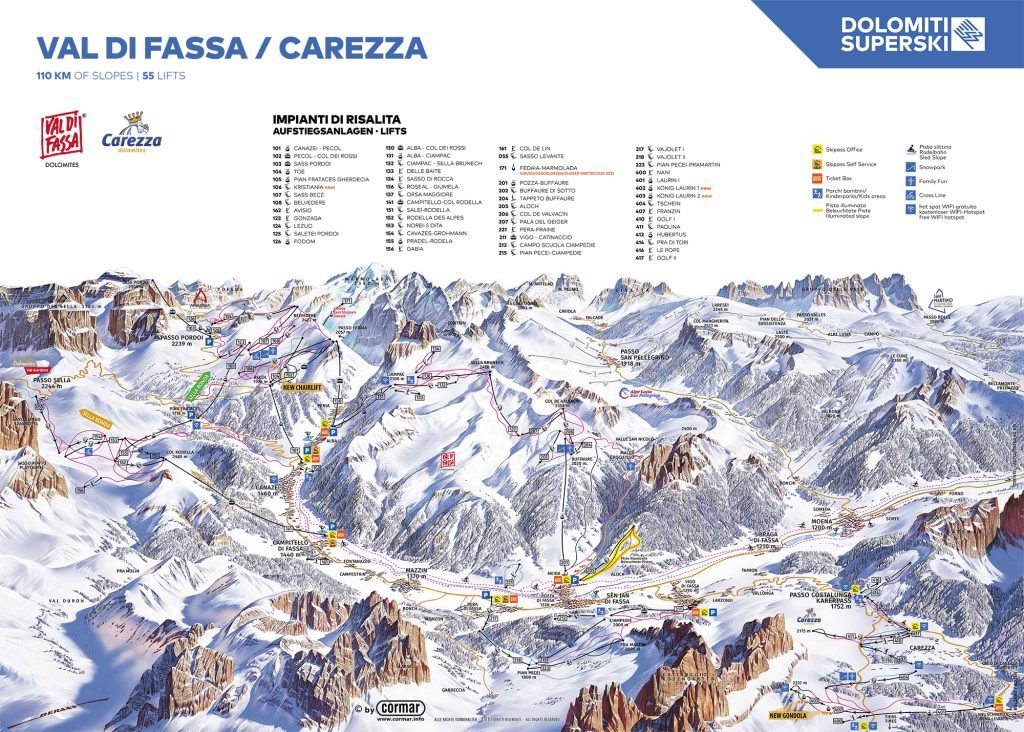
From Pozza you ski two areas: Buffaure–Ciampac, starting in the village, and Catinaccio, starting in Vigo. For the 2026/27 season both open on 4 December 2026 and close on 4 April 2027, according to the Val di Fassa tourist board.
Buffaure–Ciampac
23 km of slopes, 17 runs and 12 lifts. The top point is Sela Brunech, at 2,428 metres. From the Pozza gondola you ride up to the Buffaure, ski the slopes of Col de Valvacin and cross to Ciampac, then ski down to Alba di Canazei. From Alba the cable car to Col dei Rossi takes you to the Belvedere area and the Sellaronda: you can do the loop without your car.
Most runs are red (11 out of 17). The longest on the Pozza side is the Buffaure Panorama, over 5 km of red down to the valley. There are three blacks: Vulcano on the Buffaure, Ciampac–Alba and Aloch. Beginners have the Baby Buffaure conveyor and the Delle Baite nursery slope at Ciampac. Lifts usually run from 8.30am to 4.30pm. Parking at the Pozza gondola is free.
Catinaccio
Smaller, with 14 km, 9 runs and 6 lifts, but with one of the longest descents in the valley: the Thöni, 4.5 km of red from the Ciampedie down to Vigo. The top point is Pra Martin, at 2,042 metres. There is also a short black, the Alberto Tomba. At the Ciampedie, the Kinderpark is for children and beginners. Lift car parks in Vigo are free and an escalator takes you from the square to the cable car station.
The Catinaccio and the Buffaure are not linked on skis: a ski bus and a small road train connect them. A Pera–Meida gondola is planned, with no date.
Aloch Ski Stadium
The Aloch is a black run of about one kilometre right in the village. During the day it is reserved for training: it is a national training centre used by the Italian ski team and usually hosts European Cup slaloms in December. Public night skiing has been suspended in recent seasons: check with the tourist board whether it returns this winter.
Ski passes 2026/27
Three passes are valid on the Buffaure and the Catinaccio. The Val di Fassa/Carezza pass covers four areas (Buffaure–Ciampac, Belvedere–Col Rodella, Catinaccio and Carezza), over 100 km in total: 2026/27 prices are not yet clearly published, so check them on the Val di Fassa tourist board website. The Valle Silver and Dolomiti Superski passes are also valid: an adult day pass for Dolomiti Superski, with about 1,200 km of slopes, costs 80 euros in low season and 89 in high season. If you buy online at least two days ahead, the tourist board quotes a 5% discount.
Cross-country skiing and snowshoeing
From Pozza you can join the Marcialonga trail along the valley floor and the Ciancoal loop. In winter there is no shuttle to Val San Nicolò or the Monzoni valley: you go on foot or on snowshoes. On the Catinaccio a winter path leads from Pian Pecei towards Gardeccia; some huts stay open.
Summer in Pozza di Fassa

The valley’s summer lifts are covered by the Panorama Pass, sold for the season or by days.
Val San Nicolò by shuttle
Leave the car at the Vidor car park, about 2 km above Pozza along Strada de Meida, and take the shuttle to Saùch. Buses run every 30 minutes; a single ride costs 7 euros, children up to 6 ride free, dogs pay 3 euros. In 2026 the service ran from 29 May to 11 October. From the last stop, carry on on foot to the huts and waterfalls. It is the easiest outing from Pozza, fine for families, with dairy huts where you can eat.
With the Val di Fassa Guest Card you get one free return ride at the start and end of the season (in 2026, in June and from September). A summer shuttle from Meida also serves the Monzoni valley.
The Buffaure in summer
The gondola climbs from Pozza to 2,063 metres. At the top: huts, the land-art trail “Il Sentiero Seduto” and paths towards Val Jumela and Val San Nicolò. In summer 2026 the offer was reduced because of work on the new Col de Valvacin gondola, and some themed trails for children stayed closed: check what is open on the Catinaccio Buffaure lift company website before you go.
From the Ciampedie to the Roda di Vael
One of the best hikes starts in Vigo. Take the cable car to the Ciampedie, follow the trail to Malga Vael and the Roda di Vael hut, then continue on the Hirzelweg, the panoramic path below the Catinaccio walls, to the Paolina hut above Lake Carezza. Along the way stands the bronze eagle dedicated to Theodor Christomannos. The tourist board rates it suitable for children from age 8 and suggests walking it in the opposite direction. A variant climbs from Pra Martin along the Vial de le Feide, the old shepherds’ path.
Towards the Vajolet Towers
From the Ciampedie, walk to Gardeccia and climb to the Preuss and Vajolet huts: this is the only family-friendly stretch. Beyond, towards the Re Alberto hut, the trail is steep, with scree and fixed cables: experienced hikers only. The full route to Passo Principe and Antermoia is on our Val di Fassa page.
With children
The Kinderpark at the Ciampedie is open in summer too. The Fly Line is a 1,100-metre aerial ride through the forest for riders weighing 15 to 120 kg; in 2026 it ran from 20 June to 13 September. Without lifts, follow the valley floor to Pera and Ciancoal, or walk up to Malga Aloch above the village.
Day trips from Pozza di Fassa

- Lake Carezza: beyond the Costalunga Pass (about 11 km to the pass), the lake with the Latemar reflected in it.
- Canazei (about 10 km): the highest village in the valley, base for the Belvedere, the Sellaronda and the Marmolada.
- Moena (about 7 km): old centre, the Turchia quarter and Alpe Lusia.
- Pordoi Pass (about 22 km): Sass Pordoi cable car and the Viel del Pan trail facing the Marmolada.
- San Pellegrino Pass: via Moena, skiing and alpine huts such as Fuciade.
- Predazzo (about 17 km): gateway to Val di Fiemme, the Latemar and the Rolle Pass.
- Bolzano (about 40 km): city, Christmas markets and the Ötzi museum, under an hour via Costalunga.
Where to stay in Pozza di Fassa

The municipality of San Giovanni di Fassa has areas with different characters. Choose according to how you get around.
- Pozza centre: if you travel without a car or come for the spas. Bus B101 stop, shops, restaurants and the gondola a few minutes away. Hotels, garni (B&B-style guesthouses) and apartments.
- Meida: for Buffaure skiers and Val San Nicolò hikers. Close to the gondola and the shuttle, quieter than the centre. Mostly apartments and garni.
- Pera: for the Catinaccio in summer and a quiet stay. The Vajolet chairlifts start here and the village is on the bus B101 line.
- Vigo: if you arrive from Bolzano, and for families skiing the Catinaccio: cable car in the village, Kinderpark at the top, historic centre. Handy for Lake Carezza too.
- Tamion and Vallonga: small hamlets around Vigo, for peace and views, with a car.
For families and groups, a weekly apartment is usually the best value. For Christmas, New Year and February, book months ahead.
How to get to Pozza di Fassa
By car
From the Brenner motorway (A22) there are two routes. From the north, exit at Bolzano Nord and follow the SS241 over the Costalunga Pass: about 40 km to Vigo, with Pozza just after. From the south, exit at Ora/Egna and take the SS48 over the San Lugano Pass and through Val di Fiemme: about 55 km. From the Veneto you come over the San Pellegrino Pass to Moena or the Fedaia Pass to Canazei. From 15 November to 15 April, winter tyres or snow chains on board are mandatory in Trentino. If you rent a car at the airport, ask for winter tyres.
By train
The useful stations are Bolzano, Ora/Auer and Trento on the Brenner line. At Ora, on summer and winter weekends, there is usually the Freccialink, a train-plus-bus connection on one ticket. From Trento and Ora you continue by bus.
By bus
Pozza, Pera and Vigo are on Trentino Trasporti line B101 between Cavalese, Moena, Canazei and Penia, roughly every hour during the day. Cavalese to Pozza takes about an hour; Pozza to Canazei about 17 minutes, to Moena about 20. From Trento there are few direct buses (about 2 hours 20 minutes); usually you take the B104 Trento–Ora–Cavalese and change at Cavalese. From Bolzano, altoadigemobilità buses stop in Vigo. Tickets are cheaper in the app than on board.
By plane
Bolzano is the nearest airport (about 46 km), with few flights. Verona (about 190 km), Venice (about 172 km) and Treviso (about 157 km) are the usual choices for UK and international flights; Innsbruck (about 155 km) and Munich (about 350 km) work from the north, Bergamo and Milan are further (about 270 and 310 km). In winter the tourist board’s Fly Ski Shuttle links airports and stations with the valley on Saturdays and Sundays: in 2026/27 from 19 December to 29 March, 50 euros per adult per ride, booking required.
Parking
Parking at the Buffaure gondola is free, as are the Catinaccio lift car parks in Vigo. For Val San Nicolò, leave the car at Vidor and take the shuttle: you cannot drive further up.
Frequently asked questions about Pozza di Fassa
What is the altitude of Pozza di Fassa?
The village is at 1,320 metres. Vigo di Fassa, in the same municipality, is at 1,382 metres.
Are Pozza di Fassa and San Giovanni di Fassa the same place?
Since 2018 Pozza has been part of the municipality of San Giovanni di Fassa (Sèn Jan), created by merging with Vigo. The town hall is in Pozza.
Where is Pozza di Fassa?
In Trentino, northern Italy, in the middle of the Val di Fassa between Moena (about 7 km) and Canazei (about 10 km). Bolzano is about 40 km away, Trento about 80 km.
How high is the Buffaure?
The gondola from Pozza arrives at 2,063 metres. The top of the ski area is Sela Brunech, 2,428 metres; the new Col de Valvacin gondola reaches 2,354 metres.
How many km of slopes are there in Pozza di Fassa?
Buffaure–Ciampac has 23 km and Catinaccio 14 km. The Val di Fassa/Carezza pass gives you over 100 km, Dolomiti Superski about 1,200 km.
When does the 2026/27 ski season start?
Buffaure–Ciampac and Catinaccio open on 4 December 2026 and close on 4 April 2027, according to the tourist board.
How do you get to Val San Nicolò?
In summer by shuttle from the Vidor car park above Pozza: every 30 minutes, 7 euros per ride. In winter on foot or on snowshoes.
Can you reach Pozza di Fassa without a car?
Yes. Take the train to Trento, Ora or Bolzano, then the bus: line B101 stops in Pozza about every hour. In winter, at weekends, there is also the Fly Ski Shuttle from the airports.
Are there spas in Pozza di Fassa?
Yes, two: Terme Dolomia for spa treatments (from age 16) and the QC Terme Dolomiti wellness centre (from age 14). Both use the Alloch sulphur spring.
Is it better to stay in Pozza or in Vigo di Fassa?
Pozza if you ski the Buffaure, want the spas or travel by bus. Vigo if you arrive from Bolzano, ski the Catinaccio or want to hike to the Vajolet Towers and the Roda di Vael.
Weather in Pozza di Fassa
Photos of Pozza di Fassa


