


 Français
 Deutsch
 Italiano
ACCOMMODATION IN ASIAGO
Discover the best Hotels, B&Bs and Apartments in the Mountains based on thousands of verified reviews.
Altitude1,001 m
WhereAsiago Plateau, Vicenza (Veneto)
From Vicenzaabout 60 km · 1 hr by car
Slopesabout 80 km downhill · 500+ km cross-country
Cross-countryCampomulo (Gallio): 150+ km
Seasonski December – March · summer June – September
Updated October 2026 · Sources: Altopiano di Asiago 7 Comuni (asiago.it), Vicenzaè, Ski Verena, Asiago Cheese Consortium, University of Padua/INAF
Find a place to stay in Asiago
Before it was a cheese, Asiago was a town. It is the main town of the Asiago Plateau, also called the Plateau of the Seven Communities (Altopiano dei Sette Comuni), in the province of Vicenza, Veneto, on the border with Trentino. It sits at 1,001 m in a wide basin of meadows and forests ringed by peaks over 2,000 m. Vicenza is about 60 km away, an hour by car; Verona airport is about 105 km and Venice airport about 120 km.
Asiago PDO cheese was born here, from the milk of cows that spend the summer on the plateau’s high pastures. The town has about 6,200 residents and a long history: from 1310 to 1807 it was the capital of the “Spettabile Reggenza dei Sette Comuni”, a small self-governing mountain federation. In 1916 the First World War flattened it; what you see today was rebuilt after 1918.
In winter people come mainly for cross-country skiing: the plateau has over 500 km of trails, one of the largest networks in Italy, plus about 80 km of downhill runs. In summer it is a base for hiking and cycling between forts, trenches and mountain dairies. Distances are short and climbs gentle, which makes it a good family destination.
What to see in Asiago

You can walk the centre in an hour. For the forts, dairies and observatory you need a car or a bike.
The centre and Piazza Carli
The heart of Asiago is Piazza Giovanni Carli, redesigned in 2011, with the Faun Fountain and the cathedral. Next to it, Piazza II Risorgimento holds the town hall and its tower. From here Corso IV Novembre runs through the shopping district, with bars and cheese and salami shops. Almost everything was rebuilt after the First World War, with plenty of stone and local red marble.
San Matteo Cathedral
The main church was built between 1842 and 1870 to a design by Luigi De Boni, destroyed in 1916 and rebuilt right after the war: reopened for worship in 1922, inaugurated in 1926. It has a Corinthian colonnade, three naves and a central dome. The façade and steps are in red marble from the plateau. Inside is a Ruffatti organ with 3,600 pipes.
Leiten War Memorial (Sacrario Militare)

On Leiten hill above the centre stands the plateau’s most visible landmark. The ossuary was built between 1932 and 1936 to a design by architect Orfeo Rossato and inaugurated in 1938. It holds the remains of about 54,000 Italian and Austro-Hungarian soldiers who died on the plateau, most of them unidentified. On a square base 80 m wide rises an arch almost 50 m high.
You walk up from the centre along Viale degli Eroi, a long tree-lined avenue. Inside is a small museum with relics and the story of the battles; from the terrace you see the whole basin. It is run by the Italian Ministry of Defence: check opening times before you go.
Astrophysical Observatory

Asiago has one of Italy’s most important observatories, run by the University of Padua. The historic site is on Pennar hill, close to the centre: here you find the Galileo telescope with a 122 cm mirror, inaugurated in 1942, and MuSA, a museum of astronomical instruments. At Cima Ekar stands the Copernico telescope with a 182 cm mirror, the largest optical telescope on Italian soil.
Guided tours and observing evenings are by booking, mostly in summer. The programme changes every year: check the observatory’s website before you travel.
Gnome Village (Villaggio degli Gnomi)

The favourite with families with small children: a trail of about 1.5 km through spruce forest at Pöslen, a few minutes’ drive from the centre. Along the way are wooden houses to knock on, boards about gnomes, mills and a small pond; at the end, a playground.
Good to know: it is a private, paid attraction linked to a hotel complex. It suits children aged 1 to 12; allow about an hour and a half. With a pushchair you need an all-terrain model, as some stretches are steep.
Lumera Lake and the Old Railway Path

The two easiest walks straight from town. Little Lumera Lake is about 1.5 km from the centre, roughly 20 minutes on the flat. The Strada del Vecchio Trenino follows the line of the plateau’s old railway: from Parco Millepini to Tresché Conca, completely flat, with views over the villages. Good on foot, by bike and with a pushchair.
Forte Verena
On the summit of Monte Verena, at over 2,000 m in the municipality of Roana, stands the fort built in 1912–1914. At dawn on 24 May 1915 it fired Italy’s first artillery shot of the First World War. On 12 June an Austrian shell pierced the battery and killed 44 gunners and their commander; the fort was abandoned soon after. In summer you reach it by chairlift, on foot or by mountain bike.
Monte Ortigara
The plateau’s grimmest battlefield: in June 1917 the Alpini fought one of the bloodiest battles of the front here. The start is Piazzale Lozze, at about 1,800 m, reached from Gallio on a partly unpaved road. The loop over Cima Caldiera to the Ortigara summit (about 2,105 m, with the “Colonna Mozza”, the broken column) takes about 5–6 hours with 500–600 m of ascent, through trenches and communication lines. You need to be fit and have settled weather.
Monte Cengio and the Canove Museum
On the southern edge of the plateau, the Monte Cengio mule track, “La Granatiera”, honours the Sardinian Grenadiers who stopped the Austro-Hungarian advance here in spring 1916. The short loop to the Salto del Granatiere has about 150 m of ascent and takes about two hours there and back; there are tunnels, so bring a head torch.
In Canove di Roana, inside the old railway station, the First World War Museum has displayed weapons, uniforms, soldiers’ belongings and over 2,000 photographs since 1974, all from the plateau’s battlefields. Open June to September. On Monte Zebio there is an open-air museum of trenches and positions.
Calà del Sasso
Sasso, Asiago’s only hamlet, is linked to the Brenta valley by a stairway of 4,444 steps: the Calà del Sasso, built to bring timber down from the plateau. From Valstagna on the valley floor up to Sasso is about 750–800 m of ascent: 2–2.5 hours up, about half that down. There is no water along the way.
Skiing in Asiago
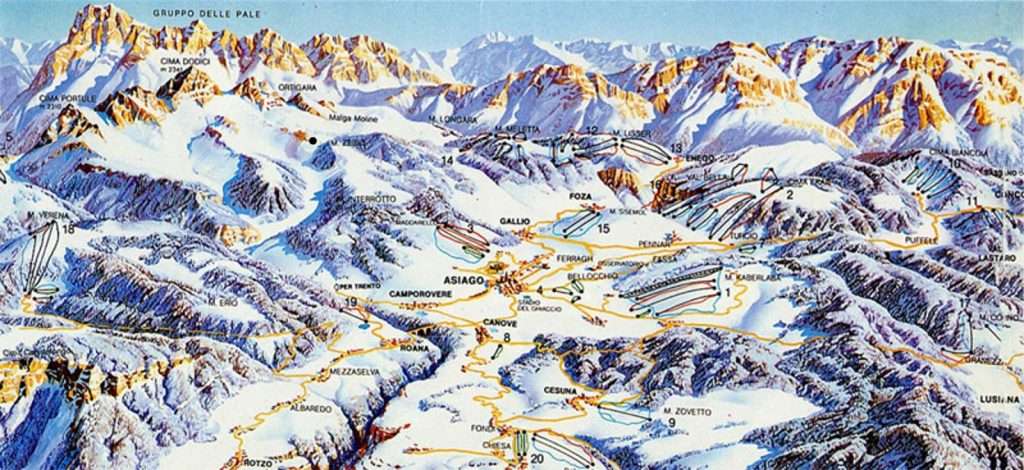
The plateau is first and foremost a cross-country destination. For downhill skiing there are about 80 km of runs spread over several small and mid-sized areas, mostly easy and intermediate: ideal for families and beginners. The season usually runs from December to March, snow permitting. Snow report and open lifts on the Asiago Plateau tourism portal.
Kaberlaba
Asiago’s own ski area, less than 3 km from the centre. Easy and intermediate runs served by a four-seat chairlift, with snowmaking. Ideal for children. Check the snow report to see which lifts are running.
Le Melette
Above Gallio, between 1,400 and 1,750 m. According to the official portal it has about 25 km of runs, from easy to black, and 4 lifts, including the Busa Fonda–Meletta six-seat chairlift, running since the 2019/20 season.
Verena 2000
On Monte Verena above Mezzaselva di Roana: 15 km of runs and 6 lifts, the highest on the plateau, reaching over 2,000 m, with the “Forte Verena” six-seat chairlift. Free parking for over 1,000 cars. Details on the Ski Verena website.
Val Formica – Cima Larici and Biancoia
Val Formica – Cima Larici, between Asiago and the Trentino border, has sunny blue runs for families and a four-seat chairlift. Biancoia, in Lusiana Conco, is a small area on the southern side of the plateau.
Ski passes
Each area has its own lift pass. At the time of writing we found no official prices for the 2026/27 season: check the individual areas’ websites and ticket desks.
Cross-country skiing

This is where the plateau has no rival in Italy: over 500 km of groomed trails for classic and skating, spread across several centres, all with a trail fee.
- Campomulo (Gallio): the largest, with over 150 km between 1,500 and 2,000 m. Base at the refuge at 1,530 m with rental, bar, restaurant and sauna. Nine trails and three variants, from an easy 5 km loop to long tours out to the dairies.
- Enego – Marcesina: over 50 km on the high Marcesina plain, starting from Valmaron. The Marciabianca citizen race is held here in February.
- Campolongo (Rotzo): at 1,551 m, linked by a 21 km trail to the Millegrobbe centre at Lavarone, in Trentino.
- Monte Corno (Lusiana Conco): 22 km.
- Asiago Golf Arena: the centre in town, handy for an hour’s training.
Snowshoeing and ski schools
Classic snowshoe routes climb to Forte Campolongo, Spitz di Rotzo, Malga Pusterle, from Cima Larici to Cima Manderiolo and to Forte Verena. At Campomulo there are marked routes kept separate from the ski trails. About a dozen ski schools, downhill and cross-country, operate on the plateau.
Summer in Asiago
From June to September the plateau is a web of forest roads, footpaths and cycle routes between meadows, woods and dairies. Altitudes are moderate (1,000–2,300 m) and most routes have no technical difficulty.
Forte Campolongo
From the Campolongo car park above Rotzo (about 1,540 m), a forest road leads in about an hour to the fort on the summit, which with Verena formed part of Italy’s 1915 frontier line. About 5 km, two hours there and back, easy.
Monte Fior Rock City
In the Melette area above Gallio, an easy walk leads among the limestone towers and corridors of Monte Fior. One of the best outings with children.
Dairies on foot and by bike
The gravel roads linking the dairies are perfect for mountain bikes and e-bikes, which you can hire on the plateau.
Adventure park and golf
In Roana, the Acropark Laghetto Roana has zip lines over little Lake Lonaba and six courses for all ages. Asiago has an 18-hole golf course in the meadows of the basin; in summer you can also play tennis and go horse riding.
Asiago cheese and mountain dairies

If you came here looking for the cheese, you are in the right place: Asiago is named after this plateau, where cheese has been made for about a thousand years. Today it is a PDO cheese (DOP in Italian), recognised in 1996. The production area covers the provinces of Vicenza and Trento and parts of Padua and Treviso; it is made from cow’s milk.
Fresco and Stagionato
There are two types. Asiago Fresco (once called “Pressato”) is soft and mild, aged about 20 days, or over 40 days for the Riserva. Asiago Stagionato (once “d’Allevo”) is firmer and stronger: Mezzano 4 to 10 months, Vecchio 10 to 15 months, Stravecchio over 15 months. On wheels marked “Prodotto della Montagna” (mountain product), milk, cheesemaking and ageing all happen above 600 m. Full rules on the Asiago Cheese Consortium website.
Where to see and buy it
The plateau has over 80 mountain dairies (malghe): in summer many make cheese on site and sell cheese, butter and ricotta directly. It is the best way to taste mountain Asiago, quite different from the supermarket kind. In town, the Caseificio Pennar dairy cooperative, founded in 1927, has a shop open all year. In September Asiago usually hosts Made in Malga, a festival of mountain cheeses with tastings and workshops.
The Cimbrians and local food
The plateau once spoke Cimbrian, an old Germanic language: Asiago is Sleghe, Roana is Robaan. Only a few hundred people still speak it; in Roana the Institute of Cimbrian Culture has a small museum. At the table Asiago cheese is everywhere: cubed with an aperitivo, in pasta, melted or grilled.
Day trips from Asiago
- Gallio (about 3 km): gateway to the Melette, Campomulo and the road to Ortigara.
- Roana and Canove (about 5–8 km): First World War museum, Institute of Cimbrian Culture, Acropark.
- Rotzo (about 15 km): the plateau’s oldest municipality, with the church of Santa Margherita and the prehistoric settlement of Bostel.
- Enego and the Piana di Marcesina (about 25 km): the great high plain for cross-country skiing and pasture walks.
- Valstagna and the Brenta valley: at the foot of the Calà del Sasso, on the River Brenta.
- Bassano del Grappa (about 40 km): the wooden Ponte Vecchio over the Brenta and grappa.
- Vicenza (about 60 km): Palladio’s villas and the Teatro Olimpico.
- Alpe Cimbra (Lavarone and Folgaria, about 30–45 km): over the Vezzena pass in Trentino, with ski runs and Austrian forts.
- Alleghe and Cortina d’Ampezzo: for the real Dolomites, allow 2–3 hours’ drive north.
Where to stay in Asiago
The plateau is compact: the villages are a few minutes’ drive apart. Pick your base by what you plan to do.
- Asiago centre: best without a car or if you arrive by bus; shops, restaurants and the war memorial on foot, Kaberlaba 3 km away. Hotels, B&Bs and apartments.
- Gallio: for cross-country skiers at Campomulo and downhill skiers at the Melette, and for Ortigara in summer. Quieter, good for families.
- Roana, Mezzaselva and Canove: handy for Verena and the museums; apartments and small hotels, often cheaper.
- Enego: for cross-country on the Marcesina and peace and quiet.
- Dairies and farm stays: in summer, for a cheese-and-mountains experience.
For a family week an apartment works best; for a weekend, a hotel in the centre. In August, at Christmas and over Italian bank holidays Asiago fills up: book early.
How to get to Asiago
By car
On the A4 motorway, exit at Vicenza Est and take the A31 Valdastico to Piovene Rocchette. From there the winding SP349 “del Costo” climbs to Asiago: about an hour in total from Vicenza. From Trentino you come from Trento along the Valsugana, then via Lavarone and the Vezzena pass. In winter you need winter tyres or snow chains.
By train
Asiago has no station. Take the train to Vicenza, then on to Thiene on the Vicenza–Schio line, and finish by bus. Alternatively, go to Bassano del Grappa. Timetables on Trenitalia.
By bus
SVT buses link Asiago year-round with Vicenza, Thiene, Padua and Bassano del Grappa. From Thiene the ride takes just over an hour. In high season there are also services from Milan. Timetables and tickets on SVT Vicenza.
By plane
The nearest airports are Verona Villafranca (about 105 km) and Venice Marco Polo (about 120 km); Treviso is about 130 km away. Without a car, get from the airport to Vicenza station and continue by bus, or book a private transfer. Asiago’s own small airfield handles tourist flights only.
Parking
In the centre there are car parks around the Corso and the squares, very busy in August and on winter weekends. For skiing use the lift car parks (free at Verena), and for cross-country the Campomulo centre car park. For Ortigara you park at Piazzale Lozze.
Frequently asked questions about Asiago
Where is Asiago?
In Veneto, in the province of Vicenza. It is the main town of the Asiago Plateau (Seven Communities), on the Trentino border, about 60 km north of Vicenza.
What is the altitude of Asiago?
The town is at 1,001 m. The plateau’s peaks reach about 2,300 m.
Is Asiago a town or a cheese?
Both. Asiago is the plateau’s main town; Asiago PDO cheese takes its name from it and is made in the provinces of Vicenza and Trento and parts of Padua and Treviso.
What is the difference between Asiago Fresco and Stagionato?
Fresco is aged about 20 days and is mild; Stagionato is aged from 4 to over 15 months and is stronger.
What is there to see in Asiago town centre?
Piazza Carli with San Matteo Cathedral and the Faun Fountain, the town hall, Corso IV Novembre and, just above, the Leiten War Memorial.
How many soldiers are buried at the Asiago War Memorial?
About 54,000 Italian and Austro-Hungarian soldiers of the First World War, most of them unidentified.
How many kilometres of cross-country trails does Asiago have?
Over 500 km across the plateau. The largest centre is Campomulo in Gallio, with over 150 km.
Where can you ski downhill near Asiago?
At Kaberlaba (3 km from the centre), the Melette above Gallio, Verena above Roana, Val Formica – Cima Larici and Biancoia: about 80 km of runs in all.
How do you get to Asiago without a car?
By train to Vicenza or Thiene, then by SVT bus. From Thiene it is just over an hour.
Where can you buy Asiago cheese on the plateau?
In summer straight from the mountain dairies; all year in dairy shops, such as the Caseificio Pennar in Asiago.
Weather in Asiago
Photos of Asiago


