


 Français
 Deutsch
 Italiano
ALLOGGI A Chamonix-Mont-Blanc
Scopri i migliori Hotel, B&B e Appartamenti in Montagna in base a migliaia di recensioni verificate.
Altitude1,035 m (centre)
WhereHaute-Savoie, France, below Mont Blanc
From Genevaairport 88 km
Key liftsAiguille du Midi 3,842 m · Montenvers 1,913 m
Ski passChamonix Le Pass or Mont Blanc Unlimited
Seasonsskiing in winter · hiking late June to mid-September
Updated October 2026 · Sources: Compagnie du Mont-Blanc, Chamonix tourist office, Tramway du Mont-Blanc, ATMB, Wikipedia
Find a place to stay in Chamonix-Mont-Blanc
Chamonix-Mont-Blanc is in the French Alps, in the Haute-Savoie department of France, at the head of the Arve valley and right below the French side of Mont Blanc. The town centre sits at 1,035 metres, and the municipality reaches all the way to the 4,806-metre summit. Geneva Airport is 88 km away, Lyon-Saint-Exupéry 220 km and Turin-Caselle 171 km. Through the 11.6 km Mont Blanc Tunnel, Courmayeur in Italy is about 20 km away.
About 8,700 people live in Chamonix, spread between the town and the hamlets of Les Bossons, Les Praz, Argentière and Le Tour. This is where mountaineering began: Mont Blanc was first climbed in 1786, and in 1924 Chamonix hosted the first Winter Olympics. That history explains why so many lifts take you into high mountains even if you don’t climb.
In summer, come for the Aiguille du Midi, the Mer de Glace and the high trails to mountain lakes. In winter, for several separate ski areas and the Vallée Blanche. Either way, check what is open before you book: in 2026/27 there is construction work in several places, from the Grands Montets to the tunnel.
What to see in Chamonix
The main sights are the lifts that leave from the town or the hamlets. Allow a full day for the Aiguille du Midi and half a day for the Montenvers. In bad weather you see nothing up high: check the webcams before you buy a ticket.
Chamonix town centre
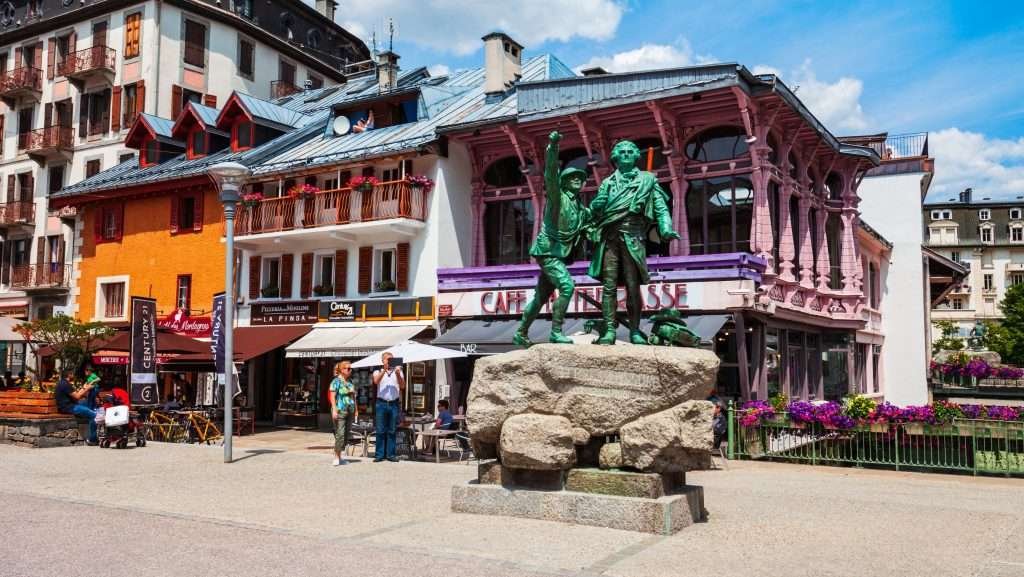
Chamonix has no medieval old town. The centre grew in the late 19th and early 20th century with mountaineering tourism: old grand hotels, chalets, outdoor shops and Place Balmat, with the statue of the Mont Blanc pioneers facing the summit. The Arve river runs straight through town.
You can walk it all in an hour: the Saint-Michel church, the pedestrian streets with bars and restaurants, the path along the Arve. Evening is the best time, when Mont Blanc turns pink at sunset.
Musée du Mont-Blanc
The former Alpine Museum, in an old grand hotel in the centre, reopened in July 2026 as the Musée du Mont-Blanc. It tells the story of the valley, the first ascents and the mountain guides. Its first temporary exhibition runs from December 2026 to 30 April 2027. A good choice for a rainy day. Opening hours on the tourist office website.
Aiguille du Midi
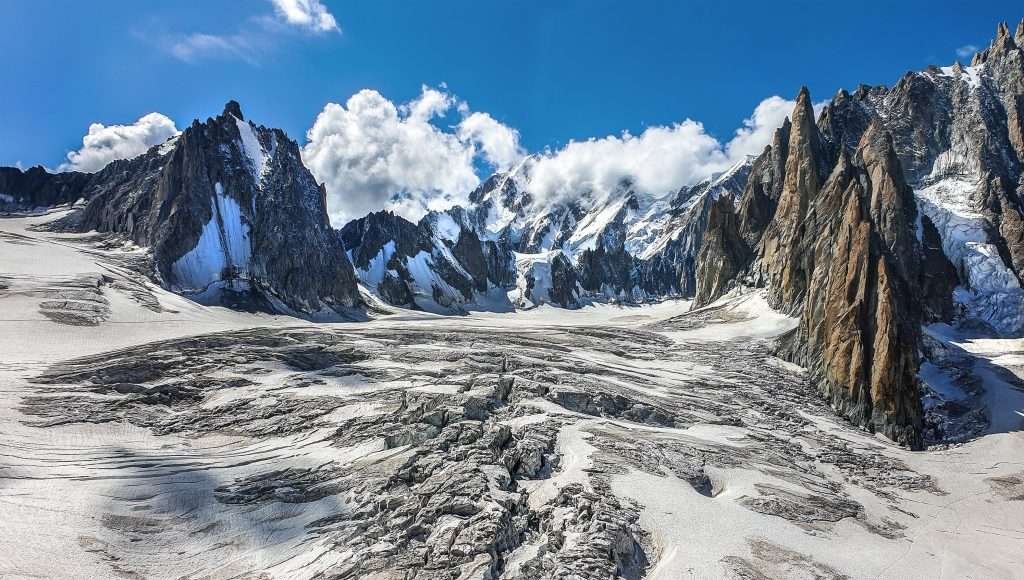
Chamonix’s most famous cable car leaves town at 1,035 metres and climbs to 3,842 metres, with a change at the Plan de l’Aiguille. At the top are viewing terraces, a tunnel cut through the rock and the Pas dans le Vide, a glass box hanging over the drop. Mont Blanc, the Dent du Géant and the Grandes Jorasses are right in front of you.
Booking is mandatory: you get a boarding number with a set time. If it’s sold out online, check again the day before, when extra places are released, or queue at the ticket office at opening. It’s cold up there even in August and the air is thin: bring a jacket and sunglasses and take it slowly. Prices and opening times on the Aiguille du Midi website.
Panoramic Mont-Blanc
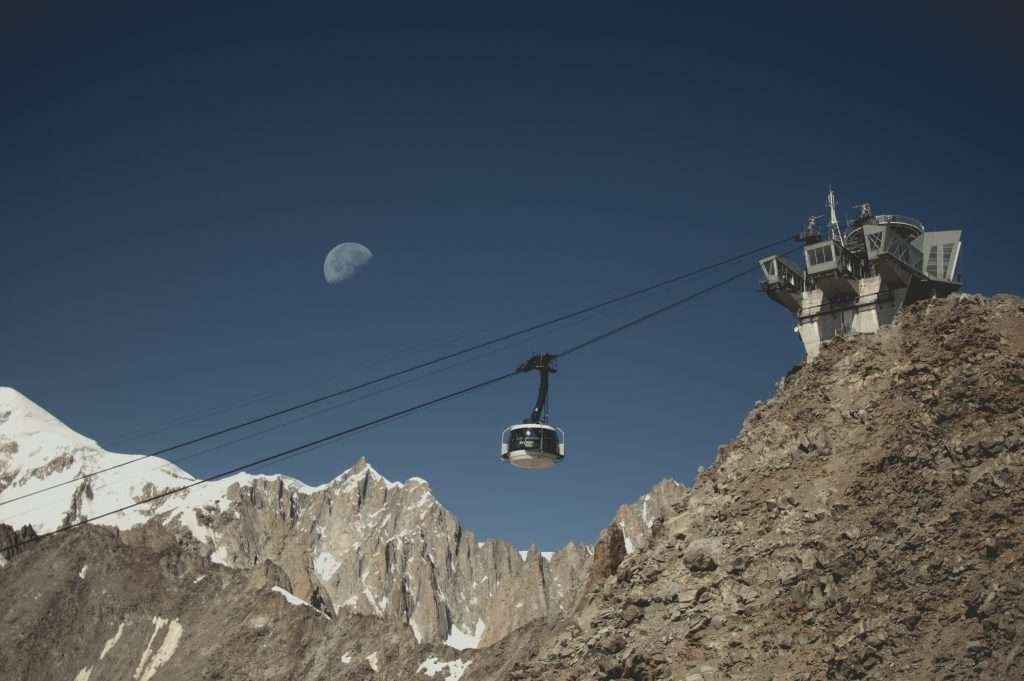
In summer only, a small gondola runs from the top of the Aiguille du Midi across the Géant glacier to Punta Helbronner on the Italian border. From there the Skyway goes down to Courmayeur. They are two separate lifts with separate tickets, and the Panoramic is not included in the MultiPass. For a France–Italy crossing in one day, book early and check the summer timetable.
Montenvers and the Mer de Glace
From the Montenvers station, next to the SNCF station, a rack railway climbs in about 20 minutes to 1,913 metres, facing the Mer de Glace, the big glacier flowing down from the Grandes Jorasses. At the top are the Glaciorium, about glaciers and climate change, a restaurant and the Montenvers refuge.
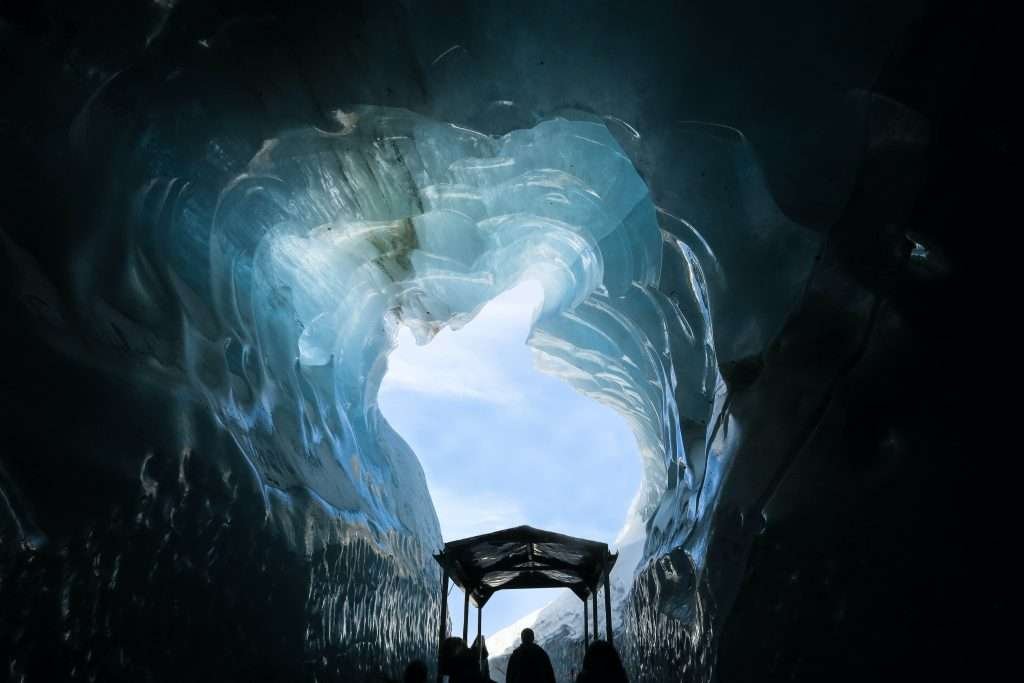
Since 2024 a 10-seat gondola takes you down towards the glacier, replacing the long flights of steps. From its lower station, about 170 steps lead to the ice cave at 1,760 metres, dug into the glacier every year. It is not accessible for people with reduced mobility. The train stops in autumn: in 2026 it is closed from 2 November to 4 December.
Brévent and Flégère
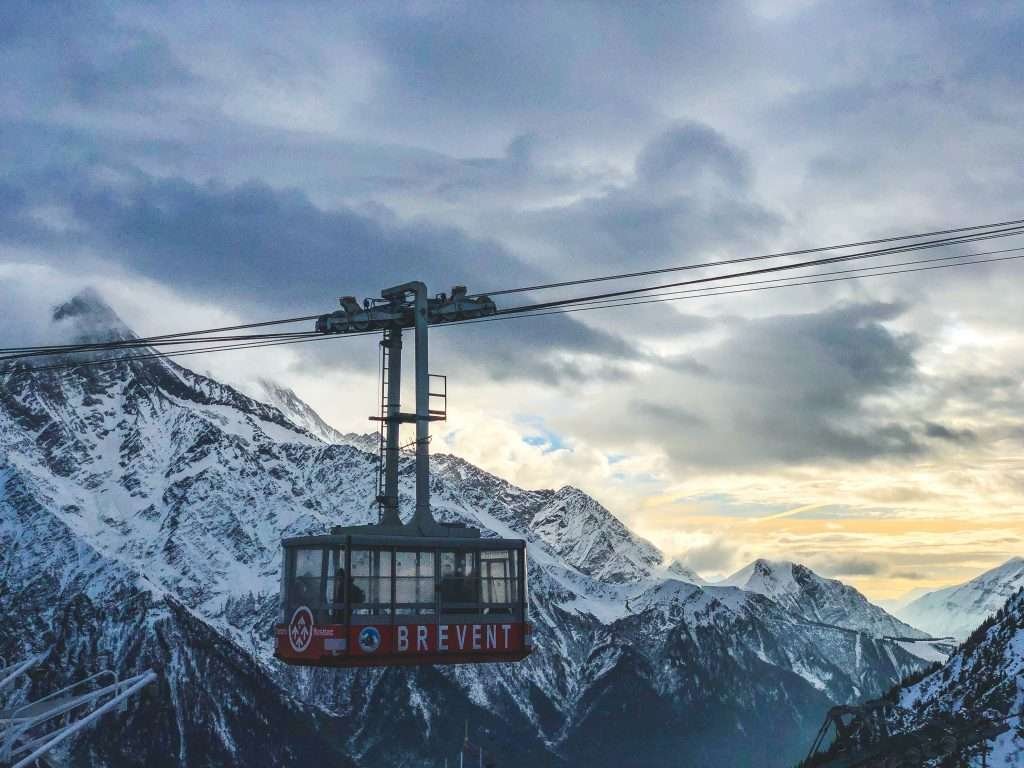
Opposite Mont Blanc, on the Aiguilles Rouges side, you get the best view of the massif. From the centre a gondola goes up to Planpraz at about 2,000 metres, then a cable car to the Brévent at over 2,500 metres. At Les Praz the Flégère gondola and the Index chairlift take you to almost 2,400 metres.
This is where the best summer hikes start, such as Lac Blanc, and in winter it’s the Brévent-Flégère ski area. A good alternative to the Aiguille du Midi when it’s crowded.
Bossons Glacier
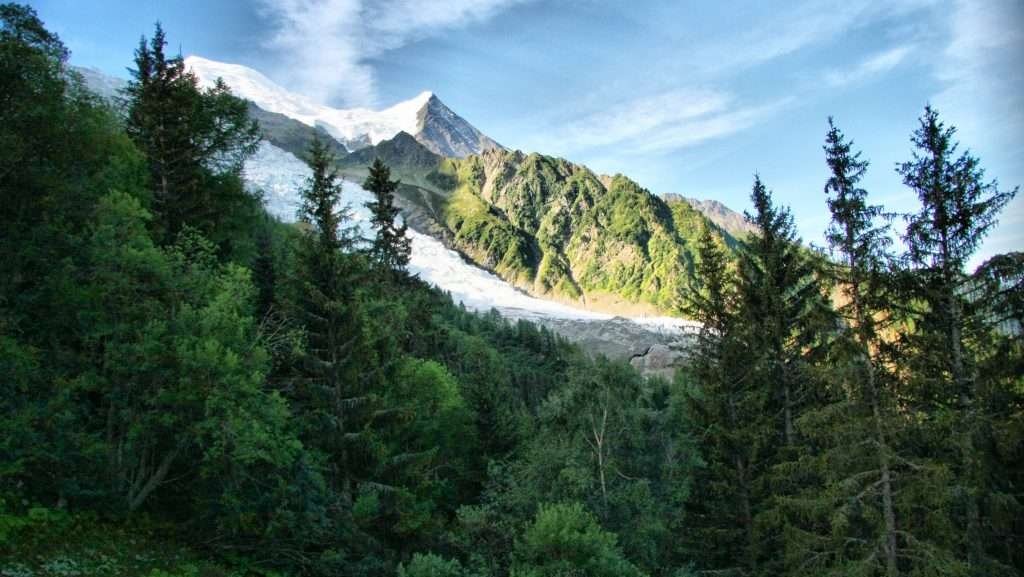
The Bossons glacier comes down from Mont Blanc almost to the valley floor, above the hamlet of Les Bossons, a few minutes from the centre towards Les Houches. You see it from the road, a tongue of ice in the middle of the forest. A trail climbs through the woods to a viewpoint in front of the glacier.
Argentière and Le Tour
Argentière, at 1,252 metres, is the village in the upper valley, below the Argentière glacier and the Aiguille Verte. It’s quieter than Chamonix and still feels like a village. Further up, at 1,462 metres, Le Tour is the last hamlet before Switzerland: the Balme ski area starts here, and in summer the trails to the Col de Balme.
Tramway du Mont-Blanc
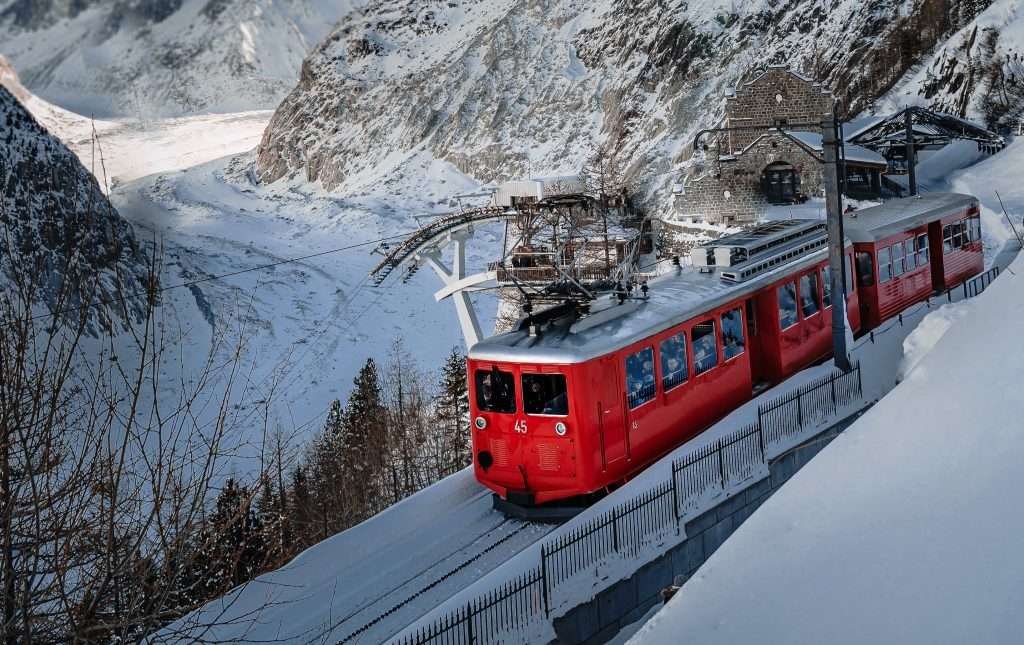
The Tramway du Mont-Blanc leaves from Le Fayet in Saint-Gervais, about 20 km from Chamonix. The rack railway climbs in about an hour to the Col de Voza and Bellevue, and in summer to the Nid d’Aigle at around 2,400 metres, below the Bionnassay glacier. It’s the start of the French normal route up Mont Blanc, and also a good family outing.
Extension work is under way, so the terminus may be temporary. The tram closes in autumn (in 2026 from 28 September to 11 December) and in winter runs only as far as Bellevue. Timetable on the Tramway du Mont-Blanc website.
Skiing in Chamonix
Chamonix is not one linked ski area. The valley has several separate areas, reached by ski bus or train. It suits good skiers and off-piste fans; beginners have small dedicated areas on the valley floor.
The ski areas
- Brévent-Flégère: above the town, sunny and facing Mont Blanc. The most convenient if you stay in Chamonix: the Brévent gondola leaves from town.
- Grands Montets: above Argentière, the highest and most technical area, famous for off-piste. The top cable car has been out of service since a fire in 2018. For winter 2026/27, a new gondola from Argentière to the Lognan plateau (1,972 m), with stations designed by Renzo Piano, is due to open; the link to the summit is planned for the following winter. Check what is running before you go.
- Balme-Vallorcine: from Le Tour and Vallorcine, wide and easier runs. Good for families and powder days.
- Les Houches: at the entrance to the valley, tree-lined runs that work well in wind or fog.
- Beginner areas: Savoy and Planards in Chamonix, Chosalets and Vormaine in Argentière, Tourchet in Les Houches, Poya in Vallorcine.
Vallée Blanche
From the top of the Aiguille du Midi starts the Vallée Blanche, the most famous off-piste run in the Alps, down the Géant glacier and the Mer de Glace to the Montenvers. It is not a piste: there are crevasses and the start is an exposed ridge on foot. Only go with a mountain guide, harness and avalanche kit.
Ski passes
The valley pass is called Chamonix Le Pass and covers the main areas. If you also want to ski in Italy, the Mont Blanc Unlimited adds Courmayeur and the Skyway. The official 2026/27 price list has not been published yet: prices and opening dates on the Compagnie du Mont-Blanc website.
Cross-country, snowshoeing and ski schools
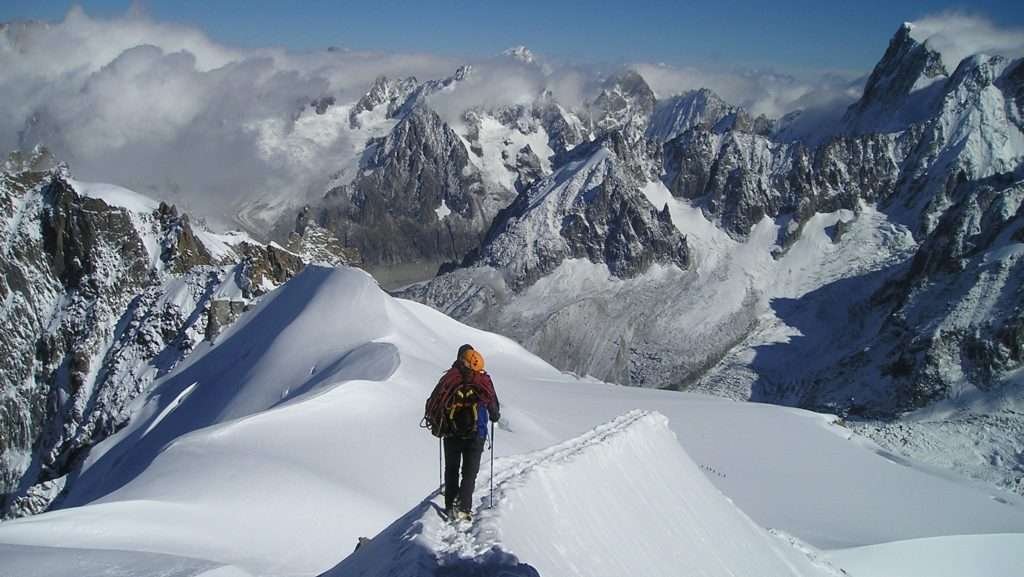
Cross-country trails run along the valley floor between Chamonix, Les Praz and Argentière. With snowshoes you can walk in the valley forests or take a lift up and follow marked routes. The valley has plenty of ski schools and mountain guides for freeride, ski touring and the Vallée Blanche.
Summer in Chamonix
In summer Chamonix is one of the great hiking bases in the Alps. The lifts take you up, and the balcony trails keep Mont Blanc in front of you. The real season runs from late June to mid-September; before that, the high trails still have snow.
Lac Blanc
The valley’s most famous hike. From the Flégère to Lac Blanc (2,352 m) it’s about 7 km return with 500 metres of ascent, roughly three hours of walking. The Index chairlift shortens the climb, but there is a section with chains. The lake is in the Aiguilles Rouges nature reserve: no dogs and no swimming. Snow can last until late June.
Balcony trails and the Tour du Mont Blanc
From the Brévent and Planpraz, balcony trails lead to the Flégère with constant views of Mont Blanc. From the Montenvers you can walk back down to Chamonix through the forest. Chamonix is also a stage on the Tour du Mont Blanc, the multi-day walk around the massif through France, Italy and Switzerland. For glacier days and mountaineering courses, book a local guide.
Cycling, climbing and paragliding
The valley floor is good for cycling, and a more continuous bike route between Chamonix and Argentière is being built. There are climbing crags for every level. In summer you can also fly tandem paragliding with local instructors.
With children
For families, the Montenvers train, the Brévent gondola to Planpraz and the Tramway du Mont-Blanc to Bellevue all work well. The Parc de Merlet animal park above Les Houches, at about 1,500 metres, usually opens from May to September, but it will be closed for works throughout summer 2027 and reopens on 1 May 2028.
Day trips from Chamonix
- Courmayeur (about 20 km through the tunnel): the Italian side of Mont Blanc, Via Roma and the Skyway up to Punta Helbronner.
- Skyway Monte Bianco: in summer you can reach it from above, via the Aiguille du Midi and the Panoramic Mont-Blanc, and ride down to Courmayeur.
- Pré-Saint-Didier: just past Courmayeur, outdoor thermal pools facing Mont Blanc.
- Saint-Gervais and Les Houches (about 20 km): the Tramway du Mont-Blanc and the Les Houches–Saint-Gervais ski area.
- Martigny and the Valais: the Mont-Blanc Express takes you into Switzerland via Vallorcine. From Martigny, trains continue towards Zermatt and the Matterhorn.
- Courchevel: if you want a big linked ski area, the Tarentaise valley is the place.
Where to stay in Chamonix
The valley is long and the ski areas are separate: pick your base by what you’ll do during the day and how you’ll get around.
- Chamonix centre: for arriving without a car, restaurants and nightlife. The station, Aiguille du Midi, Montenvers and Brévent are all walkable. Hotels in every category and plenty of apartments.
- Les Praz: for families and Brévent-Flégère skiers. Quiet, a few minutes from the centre, near the Flégère gondola.
- Argentière: for strong skiers and freeriders close to the Grands Montets, and for summer hikers in the upper valley. Village feel, often cheaper than the centre.
- Le Tour and Vallorcine: for families skiing at Balme who want peace and quiet.
- Les Bossons and Les Houches: if you have a car and a tighter budget. Chalets and residences, Les Houches slopes nearby.
Staying anywhere in the valley gets you the Carte d’hôte guest card, which makes the train free between Servoz and Vallorcine, so the hamlets work without a car too. For Christmas, February and August, book well ahead.
How to get to Chamonix
By car
From Geneva, take the A40 “Autoroute Blanche” to the head of the valley. From Switzerland you can also come over the Col de la Forclaz from Martigny. From Italy, drive up the A5 to Courmayeur and through the Mont Blanc Tunnel (11.6 km, toll). Winter tyres or snow chains are needed in winter.
About the tunnel: in autumn 2026 it only closes on some nights, but long closures of several months for works have been announced again for 2027 and 2028. Check dates and tolls on the Mont Blanc Tunnel website before you travel.
By train
The main station is Saint-Gervais-Le Fayet, about 20 km away, served by TGV from Paris (direct at certain times of year) and regional trains, including the Léman Express from Geneva. From there the Mont-Blanc Express climbs to Chamonix and continues to Argentière, Vallorcine and Martigny in Switzerland. With the Carte d’hôte the Servoz–Vallorcine section is free. In autumn, engineering timetables may apply: check on SNCF Connect.
By bus
Direct buses and shared or private transfers run from Geneva Airport, and there are buses to Courmayeur through the tunnel. Timetables change by season, so check before booking. In the valley, Chamonix Mobilité buses link the hamlets and lifts, with ski buses in winter and night buses. The mobility centre is at the Chamonix-Sud stop.
By plane
The nearest airport is Geneva, 88 km away. Lyon-Saint-Exupéry is 220 km away with its own TGV station, and Turin-Caselle is 171 km through the tunnel.
Parking
The centre is partly pedestrian, and car parks near the lift stations fill up early in summer and winter. Leave the car at your accommodation and use buses and trains, free or discounted with the Carte d’hôte. Car park locations and rates from the tourist office.
Frequently asked questions about Chamonix
Where is Chamonix?
In France, in Haute-Savoie, in the Arve valley below Mont Blanc. It’s 88 km from Geneva Airport and about 20 km from Courmayeur through the Mont Blanc Tunnel.
What is the altitude of Chamonix?
The centre is at 1,035 metres. Argentière is at 1,252 metres and Le Tour at 1,462. The Aiguille du Midi reaches 3,842 metres.
What is there to see in Chamonix town?
Place Balmat with the statue of the Mont Blanc pioneers, the Saint-Michel church, the Musée du Mont-Blanc reopened in 2026 and the riverside walk along the Arve.
Do I need to book the Aiguille du Midi?
Yes, booking is mandatory and you get a boarding number. If it’s full, try again the day before or go to the ticket office at opening.
How do you get to the Mer de Glace?
On the Montenvers rack railway, about 20 minutes to 1,913 metres. Then a gondola and about 170 steps take you to the ice cave.
How long is the Lac Blanc hike?
From the Flégère, about 7 km return with 500 metres of ascent, roughly three hours. June to September, no dogs.
Is the Mont Blanc Tunnel open?
In autumn 2026 it closes only on some nights. Long closures are announced for 2027 and 2028: check the tunnel website.
How do I get to Chamonix without a car?
By bus or transfer from Geneva Airport, or by train to Saint-Gervais-Le Fayet and then the Mont-Blanc Express.
Are the Grands Montets open?
The top cable car has been closed since 2018. For 2026/27 a new gondola from Argentière to Lognan is due to open; the summit should follow the next winter.
Can you visit Italy from Chamonix?
Yes: through the Mont Blanc Tunnel by car or bus to Courmayeur, or in summer via the Aiguille du Midi, the Panoramic Mont-Blanc and the Skyway.
Weather in Chamonix-Mont-Blanc
Photos of Chamonix-Mont-Blanc


