


 Français
 Deutsch
 Italiano
ACCOMMODATIONS IN MOENA
Discover the best Hotels, B&Bs and Apartments in Mountain based on thousands of verified reviews.
Altitude1,184 m (about 1,200)
WhereVal di Fassa, Trentino, Italy
From Bolzanoabout 45 km
SlopesAlpe Lusia 26 km · San Pellegrino–Falcade 59 km
Dolomiti Superski pass€80–89 per day (2026/27)
Ski season4 Dec 2026 – 4 Apr 2027
Updated October 2026 · Sources: Val di Fassa tourist board, Visit Trentino, Dolomiti Superski, Trentino Trasporti
Moena is the first village you reach when you enter the Val di Fassa from the south. It is in Trentino, the autonomous province of Trento, in the Italian Dolomites. The centre sits at 1,184 metres above sea level; the local tourist board rounds it to 1,200. With about 2,500 residents it is the largest village in the valley. The municipality includes the hamlets of Forno, Medil, Peniola, Sorte and Someda, and borders the Val di Fiemme, South Tyrol and the Veneto.
Key distances: Canazei is about 18 km away, Predazzo about 9 km, Bolzano about 45 km over the Costalunga Pass, Trento about 80 km. The nearest airport is Bolzano; most international flights land in Verona, Venice, Treviso or Innsbruck, all within three hours by car.
Locals call it the “Fairy of the Dolomites” for the pink light on the peaks at sunrise and sunset. In winter you ski on the Alpe Lusia, whose lift starts almost in the village, and at the San Pellegrino Pass, about 11 km away. At the end of January the Marcialonga cross-country race starts here. In summer there are easy family walks, the Fuciade hut, the Lusia lakes and the cycle path down to the Val di Fiemme. In the village, try Puzzone di Moena, the valley’s PDO cheese.
What to see in Moena
You can walk around the centre in an hour. For the rest, take the road to the San Pellegrino Pass or the Alpe Lusia gondola.
The old centre: Piaz de Ramon and Piaz de Sotegrava

The heart of the village is two squares: Piaz de Ramon, with old houses and painted façades, and Piaz de Sotegrava, with shops and bars. The main street, Strada Riccardo Löwy, fills up in the evening for aperitivo. Look out for the tabià, the old wooden hay barns: many are more than three hundred years old.
Moena is divided into districts, each with its own name. Navalge, now home to the largest car park, takes its name from an old tradition: the Moena basin was once a lake, drained by the first settlers. The boatman on the village coat of arms recalls the story.
San Vigilio church and San Volfango chapel

The parish church of San Vigilio is easy to spot by its tall bell tower, visible from most of the village. It is first mentioned in 1164, was rebuilt in Gothic style in 1533 and took its present form in 1929. St Vigilius is the patron saint; his feast day is 26 June.
Next to it stands the small chapel of San Volfango, which tradition holds to be the oldest church in Moena. Inside are 15th-century frescoes and a wooden ceiling.
The Turchia district

Turchia (“Turkey”) is Moena’s best-known district: narrow lanes, decorated barns and wooden houses. There are two explanations for the name. Legend tells of a Turkish soldier, wounded after the siege of Vienna in 1683, who was nursed and taken in by the villagers. Historians lean towards the presses (torchi) once used to process hemp.
In August the district holds its festival, with food stalls, music and folk dancing in the little square; the village band usually plays here too. Check the dates on the tourist board’s events calendar.
Someda and the Austro-Hungarian fort
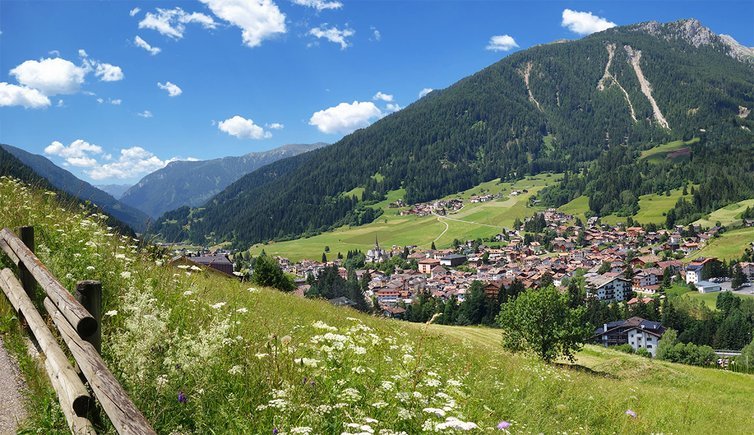
Someda is the hamlet on the hillside above Moena, towards Soraga. You can walk there on an almost flat panoramic road with views over the valley. In an old barn, the “Sul fronte dei ricordi” association displays, in summer, weapons, uniforms and objects found on the First World War front lines between Costabella, Monzoni and Cima Bocche.
A little further on is Fort Someda, built by Austria-Hungary in 1898 and used as a depot during the war. You can only see it from the outside.
La Gran Vera, the First World War museum
In the Navalge theatre, in the centre, the permanent exhibition “1914–1918 La Gran Vera” opened in 2014. It covers about 500 m² on three floors: Galicia in 1914, the trenches, the Dolomites front from 1915 and a final section against war. Recommended for ages 8 and up, it is the best option on a rainy day.
Lake Soraga, the “lake of Moena”
Many people look for the lake of Moena, but there is no lake in the village. The nearest is Lake Soraga, also called Lago di Pezzè, a reservoir on the Avisio between Moena and Soraga. A path follows it from above to Soraga, with the Latemar, the Catinaccio (Rosengarten) and the Monzoni in the background. Higher up are two natural lakes, the Lusia lakes, and the small lake at the San Pellegrino Pass.
San Pellegrino Pass
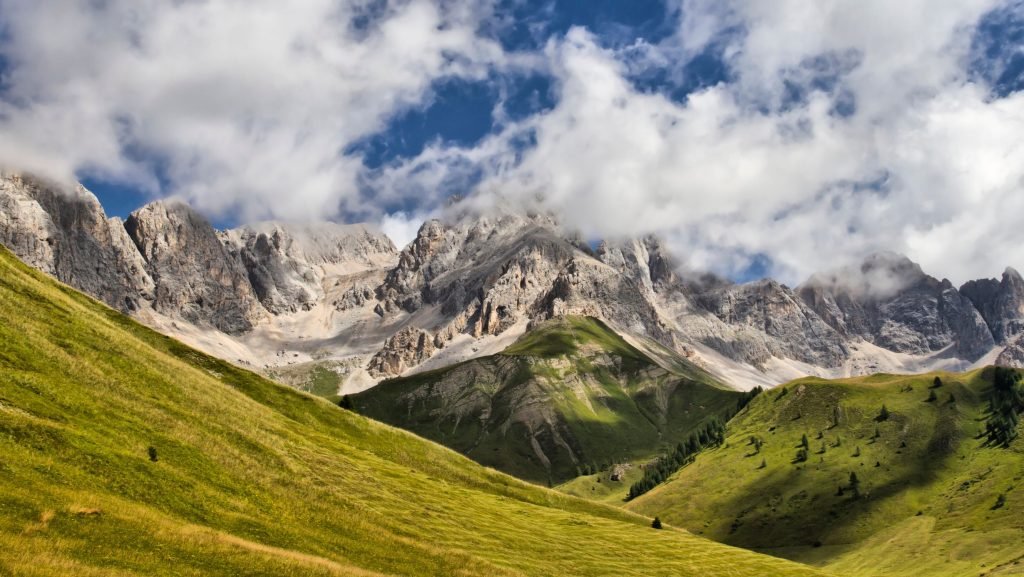
The San Pellegrino Pass (1,918 m) is about 11 km from Moena, on the border between Trentino and the Veneto: on the other side the road drops to Falcade and the Biois valley. It is a wide plateau of meadows under the Costabella ridge. From the pass a cable car climbs to Col Margherita, at 2,514 metres, with open views over the surrounding Dolomites. In winter it is one of Moena’s two ski areas.
Alpe Lusia and Le Cune
The Alpe Lusia is the mountain above Moena, towards the Val di Fiemme. From Ronchi, a few minutes from the centre on the San Pellegrino road, a gondola climbs to Valbona (1,810 m) and on to Le Cune, at about 2,200 metres. From the top you see the Catinaccio, the Pale di San Martino and the Lagorai range.
Skiing in Moena

Moena has two ski areas, linked by a shuttle bus that runs all day: the Alpe Lusia, from Ronchi, and the San Pellegrino Pass. Together they offer about 85 km of slopes. Both are part of Dolomiti Superski, 1,200 km of slopes on a single pass. In 2026/27 they open on 4 December 2026 and close on 4 April 2027, snow permitting.
Alpe Lusia
26 km of slopes and 8 lifts, linked to Bellamonte on the Val di Fiemme side. From Ronchi two gondola sections take you to Valbona and Le Cune; higher up, chairlifts reach the Lastè, the top of the area at about 2,330 metres. Runs are mostly red and blue, with a few blacks such as the Piavac and the Canalone Tomba. At the end of the day a ski road brings you back towards Moena.
It is a good area for families: a beginners’ area at Valbona, a kinderland, a toboggan run, a snowpark and a baby boardercross. You will find ski schools in Moena and at the pass.
San Pellegrino Pass – Falcade
This is the larger area: 59 km of slopes and 15 lifts between the pass and Falcade, in the Veneto. The Col Margherita cable car takes you to 2,514 metres, where the longest runs start. The black LaVolatA hosts the women’s World Cup: for 2026/27 the finish area has been enlarged, and the run is closed during races. From Falcade you get back to the pass on the Molino gondola.
Ski passes 2026/27
If you only ski in Moena, the Alpe Lusia/San Pellegrino pass covers both areas. Its 2026/27 prices are not yet clearly published: check them on the tourist board website. The Valle Silver and Dolomiti Superski passes are also valid. A one-day adult Dolomiti Superski pass costs €80 in low season and €89 in high season (Christmas to Epiphany and late January to March); juniors (born 2009–2018) €56/62, seniors (born 1961 or earlier) €72/80. Buy online at least two days ahead to save 5%. Full price list on the Dolomiti Superski website.
Cross-country, Marcialonga and snowshoeing
For cross-country skiing, head to the Alochet centre near the San Pellegrino Pass: about 18 km of trails between 1,700 and 1,900 metres, classic and skating, with a practice area.
Moena is the start of the Marcialonga, the 70 km classic-technique cross-country marathon. The 2027 edition is on Sunday 31 January, starting at 8 am from the Moena plain: the race climbs to Canazei, returns to Moena and continues via Predazzo to the finish in Cavalese. That morning the main road between Predazzo and San Giovanni di Fassa is closed for an hour, so travel later if you can.
On snowshoes or on foot, a groomed trail runs from the Morea area to Malga Bocche on the Alpe Lusia.
Summer in Moena
In summer the Alpe Lusia gondolas usually run from mid-June to September. Almost everything starts from the village or the San Pellegrino Pass.
From the San Pellegrino Pass to Fuciade
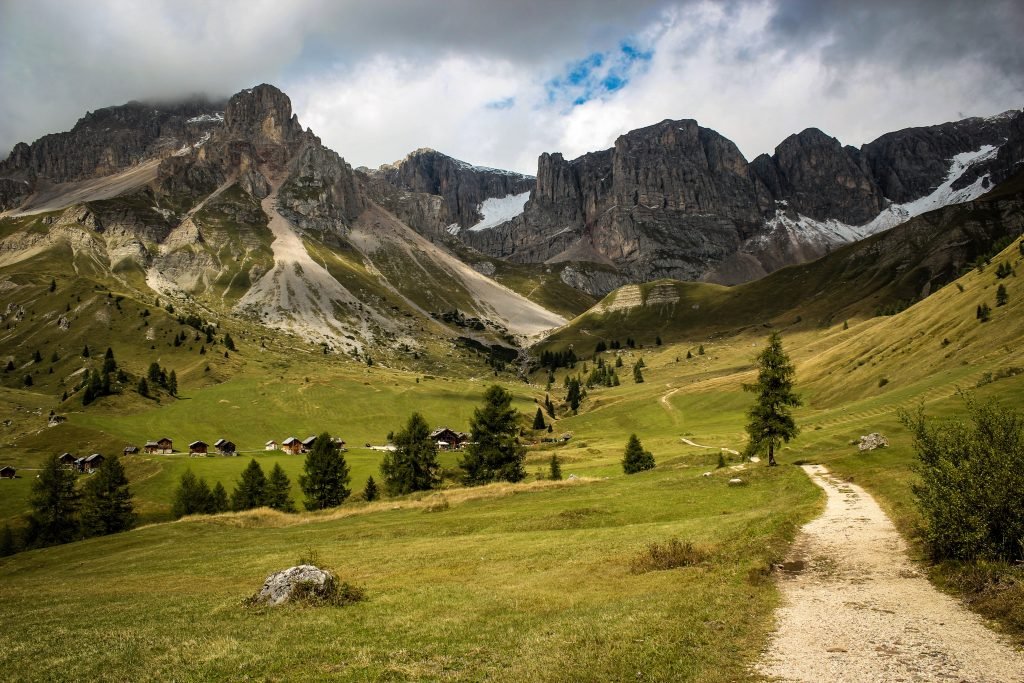
The best-known walk in the area. From the pass, follow the easy path, with little up and down, to the Fuciade basin: meadows, wooden barns and a mountain hut at almost 2,000 metres below the Costabella. Allow about 45 minutes; it works with a pushchair. In winter you walk up on packed snow or use the hut’s transfer service.
For a longer day, a loop continues from Fuciade into the Val Fredda towards Falcade, passes Malga Boer and returns to the pass.
Easy walks: Someda and Lake Soraga

The Someda walk starts on Strada de Pecé above Lake Soraga, climbs for a few minutes, then runs level along the hillside to the hamlet and the Alpe Lusia gondola station. Allow about an hour and a half there and back. Suitable for children and pushchairs.
The other easy walk goes from Moena to Soraga, following the lake from above. Return the same way, or drop down from Soraga Alta and walk back along the Palua lane. There are no cafés on the way, so bring water.
Malga Peniola
Malga Peniola is an alpine farm with food and drink on a terrace above Moena, towards the Sas da Ciamp. The easiest way: drive to Malga Panna, where there is a car park, then walk about an hour on a gently rising lane. On foot from Moena, go through Sorte and take trail 521 through the woods.
The Lusia lakes
Take the gondola to Le Cune (2,200 m), descend on trail 614 to the Lusia Pass and continue on trail 633 towards the Lastè. The route passes La Trincea, at 2,428 metres, where First World War positions remain, and reaches the first lake next to the Redolf bivouac. It is a full day for fit hikers: start early and check the time of the last gondola down.
Cycling the Fassa–Fiemme cycle path
The Dolomites cycle path of Fassa and Fiemme runs through Moena: 48 km in total along the Avisio, from Canazei to Molina di Fiemme. From Moena, ride up towards Canazei or down towards Predazzo. In summer the Bike Express bus carries bikes for the return trip.
What to eat in Moena
The local star is Puzzone di Moena, a PDO cheese since 2014, called Spretz Tzaorì in Ladin. It is made from cow’s milk in the Fassa, Fiemme and Primiero valleys, and its name (“the smelly one”) comes from its strong aroma. It is also a Slow Food Presidium. The “di malga” version is made only in summer, from the milk of high pastures between 1,700 and 2,000 metres. Try it at the mountain farms around the village and in the shops in the centre.
Restaurants serve Ladin and Trentino dishes: canederli (bread dumplings), polenta with cheese and mushrooms, carne salada (cured beef), strudel. In winter “A tavola con la fata delle Dolomiti” celebrates Ladin cooking; in September “Sapori d’autunno” focuses on local produce.
Day trips from Moena
- Lake Carezza (about 20 km): the lake below the Latemar, beyond Vigo di Fassa and the Costalunga Pass.
- Vajolet Towers: in the Catinaccio group, by cable car from Vigo di Fassa, next to Pozza di Fassa, then a trail from hut to hut.
- Canazei and the Pordoi and Sella passes (about 18 km to Canazei): the Sass Pordoi, the Marmolada and the Sellaronda.
- Predazzo (about 9 km): the Olympic ski jump, the geology museum and the Latemar.
- Falcade (about 20 km): over the San Pellegrino Pass, in the Veneto.
- San Martino di Castrozza (about 40 km): the Pale di San Martino, via Predazzo and the Rolle Pass.
Where to stay in Moena
Hotels, apartments, residences and farm stays: choose the area based on what you plan to do each day.
- Village centre: for travellers without a car (bus stops are in the village), for shops and restaurants on foot and for evenings out. Watch out for the limited traffic zone: ask your accommodation how to get there and where to park.
- Towards Ronchi and the San Pellegrino road: for skiers, close to the Alpe Lusia gondola and the shuttle to the pass.
- San Pellegrino Pass: for ski-in/ski-out and cross-country at Alochet. Quiet in the evening; you need a car to get down to the village.
- Hamlets (Someda, Sorte, Medil, Forno): for families and anyone after peace and quiet and a cheaper apartment. Car needed.
- Soraga and Predazzo: alternatives a few kilometres away if Moena is full.
Book early for Christmas, February and Marcialonga weekend.
How to get to Moena
By car
From the Brenner motorway (A22) there are two exits. From the south, leave at Egna-Ora and follow state road 48 over the San Lugano Pass and through the Val di Fiemme: about 45 km to Moena. From the north, leave at Bolzano Nord, climb through the Val d’Ega and over the Costalunga Pass to Vigo di Fassa, then turn south through Soraga to Moena. From the Veneto, come via Belluno, Agordo and the San Pellegrino Pass. From 15 November to 15 April winter tyres or snow chains on board are compulsory.
By train
Moena has no railway. The nearest stations are Ora/Auer, Bolzano and Trento, on the Brenner line from Verona and Innsbruck. From there, continue by bus. Train times on Trenitalia.
By bus
From Trento, Trentino Trasporti line B104 runs to Cavalese; from there line B101 continues up the valley via Predazzo and Moena to Canazei (check the timetable for a change at Cavalese). From Bolzano, buses run to the Val di Fassa over the Costalunga Pass; check whether you need to change for Moena. In winter a ski shuttle connects Ronchi and the San Pellegrino Pass. Timetables on Trentino Trasporti; tickets are cheaper in the app than on board.
By plane
The nearest airport is Bolzano, about 40 km from the valley. The airports with the most flights are Treviso (about 160 km), Venice (about 175 km) and Verona (about 180 km), plus Innsbruck, Bergamo (about 280 km) and Milan (about 350 km). In winter, shared transfers usually run on Saturdays from the main airports to the Val di Fassa; private transfers are also available.
Parking
Moena’s centre is partly a limited traffic zone, with electronic gates that read number plates. In high season it becomes pedestrian-only at certain times. Before driving in, ask the tourist office or your accommodation to avoid a fine. The largest car park is Navalge, a short walk from the centre. To ski on the Alpe Lusia, park at Ronchi; at the San Pellegrino Pass there is a free car park at the Costabella chairlift. More information on the Val di Fassa tourist board website.
Frequently asked questions about Moena
Where is Moena?
In Trentino, northern Italy, in the province of Trento. It is the first village of the Val di Fassa coming from the south, on the edge of the Val di Fiemme. It is not in South Tyrol, although Bolzano is only about 45 km away.
What is the altitude of Moena?
The centre is at 1,184 metres, roughly 1,200. The Alpe Lusia slopes reach about 2,330 metres and Col Margherita 2,514.
How far is Moena from Canazei?
About 18 km along the valley road: 15 to 20 minutes by car, longer in high season. Bus line B101 links the two villages.
How far is Moena from Bolzano and Trento?
About 45 km from Bolzano, under an hour over the Costalunga Pass. About 80 km from Trento, a good hour and a half through the Val di Fiemme.
Is there a lake in Moena?
Not in the village: tradition says the basin was a lake, drained centuries ago. The nearest is Lake Soraga, just to the north. Higher up are the Lusia lakes; Lake Carezza is about 20 km away.
Where can you ski in Moena?
On the Alpe Lusia (26 km, from Ronchi) and at San Pellegrino Pass – Falcade (59 km). A shuttle bus links the two; the Alpe Lusia/San Pellegrino pass covers both.
When is the Marcialonga 2027?
Sunday 31 January 2027, starting at 8 am from Moena. 70 km in classic technique, finishing in Cavalese.
Where can I park in Moena?
At the Navalge car park, near the centre. The old centre is a limited traffic zone: do not drive in without a permit.
What to do in Moena when it rains?
The La Gran Vera First World War exhibition in the Navalge theatre, the Someda exhibition in summer, the San Vigilio and San Volfango churches, and a tasting of Puzzone cheese.
Weather in Moena
Photos of Moena


